
Overland to the Nass
To my regret, I never met the late Guy Ilstad. We corresponded for several years, beginning back when I was working for The Daily Colonist in Victoria at the start of my journalistic career.
Our friendship began by my playing a long shot after his name came up while I was researching the intriguing story of Quatsino’s John Sharp. The watchman for a dormant coal company, Sharp’s mysterious death had long intrigued historians because of rumours he’d really been William Clarke Quantrill.
History accepts that the notorious Confederate guerilla leader was killed in the last days of the American Civil War. But, decades after Appomattox, people were convinced that the reclusive John Sharp was an escaped Quantrill.
It’s a great story, one I’ve told previously in the Chronicles.
>>> See Did Notorious Civil War Guerrilla Leader Escape to Vancouver Island?
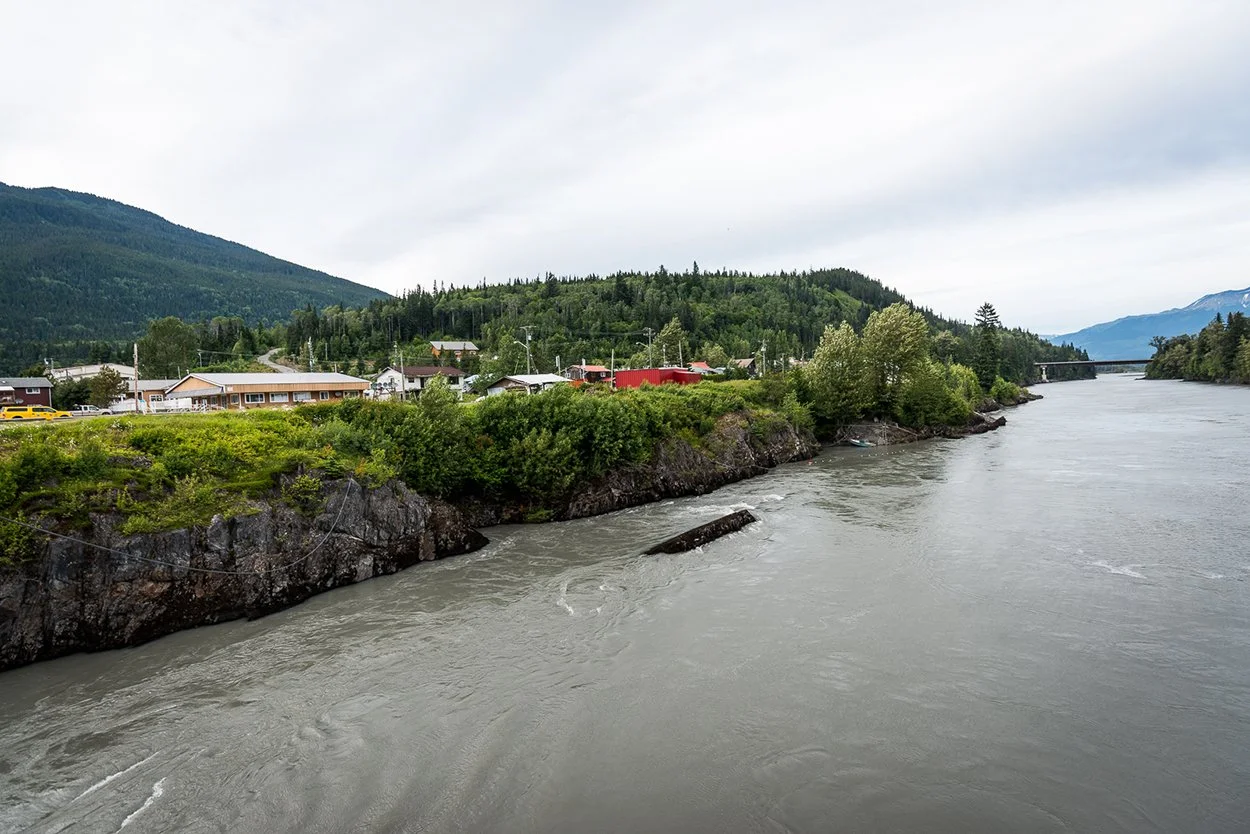
The Nass River and Nass Valley were little known to the outside world at the time of Mr. Ilstad’s survey work in 1910. —Wikipedia
Back to Mr. Ilstad who was identified in a newspaper account as ‘George’ Ilstad, when, as a boy, he’d found Sharp dying in his cabin and sought medical help.
So I wrote to ‘George’ Ilstad of Quatsino and trusted the post office to find him. They did, and thus began several years of correspondence and a growing friendship. It was obvious to me that he was a very interesting guy and well read with a lifelong experience of working in the woods. He also had a passion for history that matched my own.
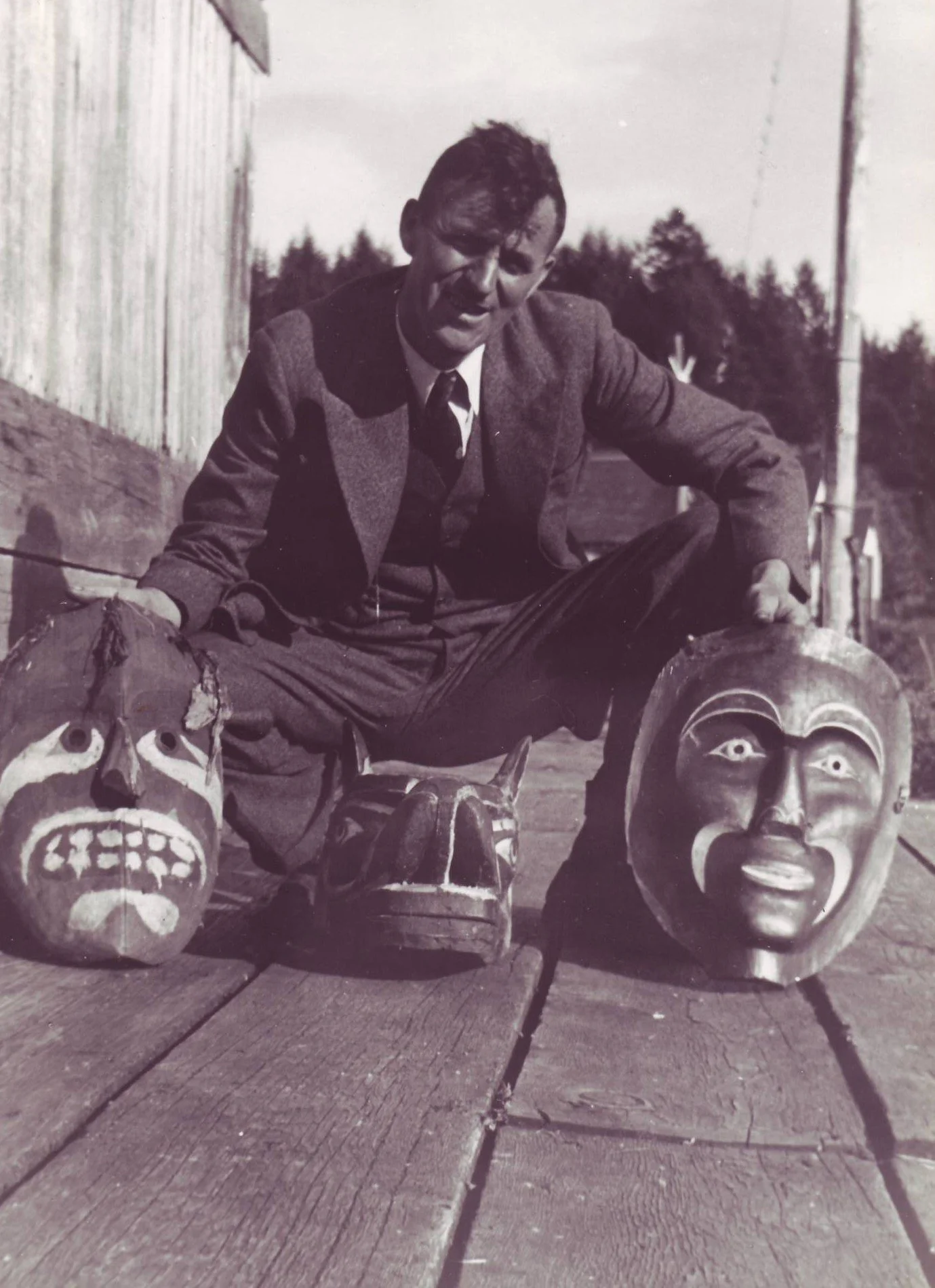
Guy Ilstad of Quatsino posing with several priceless ceremonial masks. —Author’s Collection
In 1969, he wrote a story about his adventures in 1910, when the construction of the Grand Trunk Pacific Railway precipitated a land boom. He and two others were hired to stake out 10,000 acres in northern B.C. for an American company.
Here’s his firsthand account of that long ago trek which he entitled, “Overland to the Nass.” Please bear in mind that his reference to “hostile Indians” was his and his companions’ perception of one of the dangers facing them in the wilds. I’ve left his account as he told it, even though, today, it borders on the politically incorrect.
* * * * *
The Gold Rush of 98 still lives on, for Robert Service created a legend that will long survive. But the richest boom in British Columbia passed with no bard to immortalize its Grand Hour or to scatter stardust, yet the timber boom of the early 1900s, though ushered in by prosaic sawdust, produced more wealth than all of the Klondike's harvest of gold.
When the vast virgin forest land of British Columbia was opened to the public, all who wished to acquire Crown Land, as it was designated, could do so by simply blazing a mile of compass line and setting stakes at the proper intervals, then writing a description of the land on the squared post. One mile of line entitled the agent to 640 acres on both sides of the line, or a total of 1,200 acres.
Consequently, timber lands were snapped up by eager buyers and brokers paying out 25c an acre, for the exploiters soon availed themselves of this bonanza. Along with this great timber excitement came a frantic wave of land buying and railroad speculation.
The Grand Trunk [Pacific] Railroad was nearing completion to Prince Rupert while the PGE [Pacific Great Eastern] Railway was building east from Squamish at the head of Howe Sound and land value soared to fantastic figures.
At this time there seemed to be a railway mania for numerous promoters were on the prowl seeking investors. Only a few of the proposed railways ever reached the construction stage, most in fact existed only on blueprints and perhaps in the not-too-honest, but agile, brains of their sponsors.
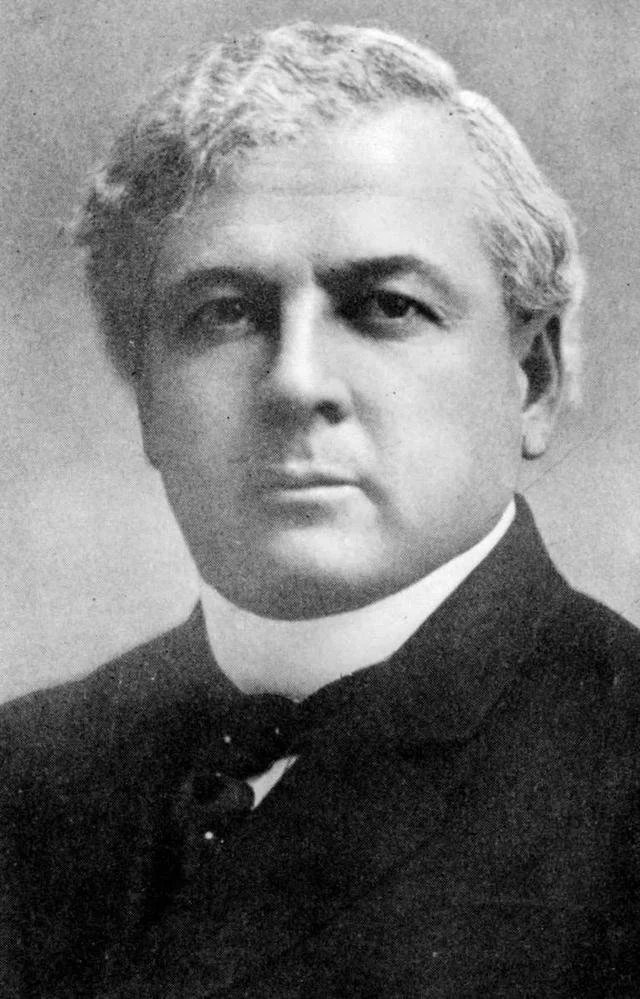
BC Premier Richard McBride was among the most enthusiastic believers in railways. —BC Archives
Even the premier of British Columbia had a finger in the railroad pie, and with 40 years in the building, a costly pie it turned out to be...
When the boom was at its height in 1910 the Upper Nass became the focus of attention for land seeking speculators for now a railroad was being built from Stewart...to tap the Nass country. This portion of British Columbia was not only a wilderness difficult to access but dangerous also. The Indians [sic] living there resented any influx of settlers and it was known that travellers had been driven out by hostile natives. Even this did not seem to daunt the land seekers eagerly bent on the 25c per acre price.
This was the lure that drew myself and two companions to the Nass Valley in 1910.
We were to share equally on a land-staking mission although only one of us was empowered as the legal agent for an American firm that had advanced $300 with the promise of accepting 10,000 acres of national land at a commission of 25c per acre. A representative of the firm came to Victoria to accompany us and to report to his American sponsors on the character of the soil and climate.
In October 1910, we boarded the S.S. Prince Rupert, a fine new Grand Trunk steamer, 300 feet long and with a speed of 18 knots. This vessel then plied between Victoria and Prince Rupert.
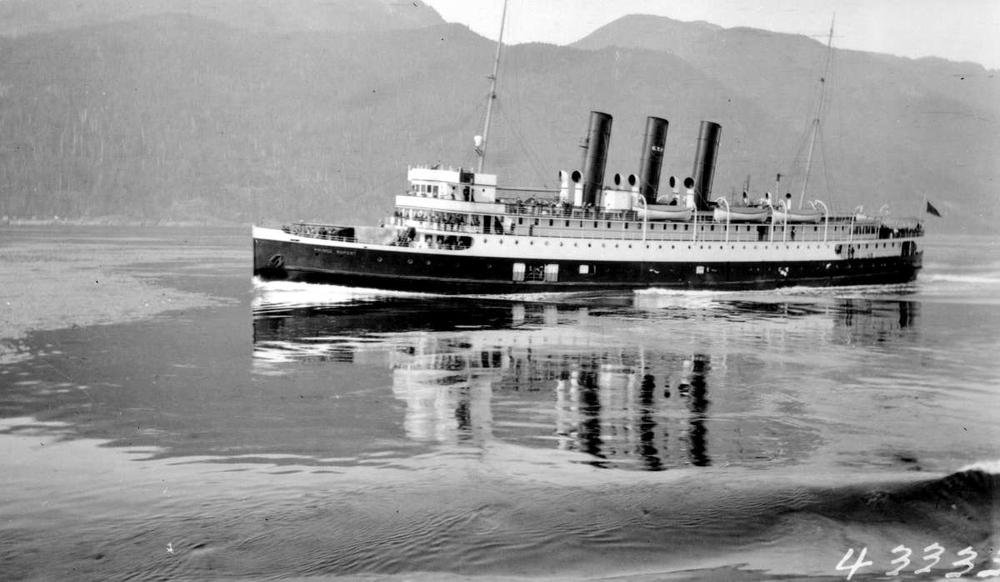
The Grand Trunk Pacific’s S.S. Prince Rupert was new in 1910 when Guy Ilstad and friends sailed north on their great adventure. —BC Archives
Two days later we arrived at the then new, sprawling town which was to be the terminus of the Grand Trunk Railway and where steel was fast approaching. We transferred to a vessel that carried us to Stewart on the Alaskan boundary and next day disembarked at this new boom town where railway was also being built to the interior British Columbia and the Nass country.
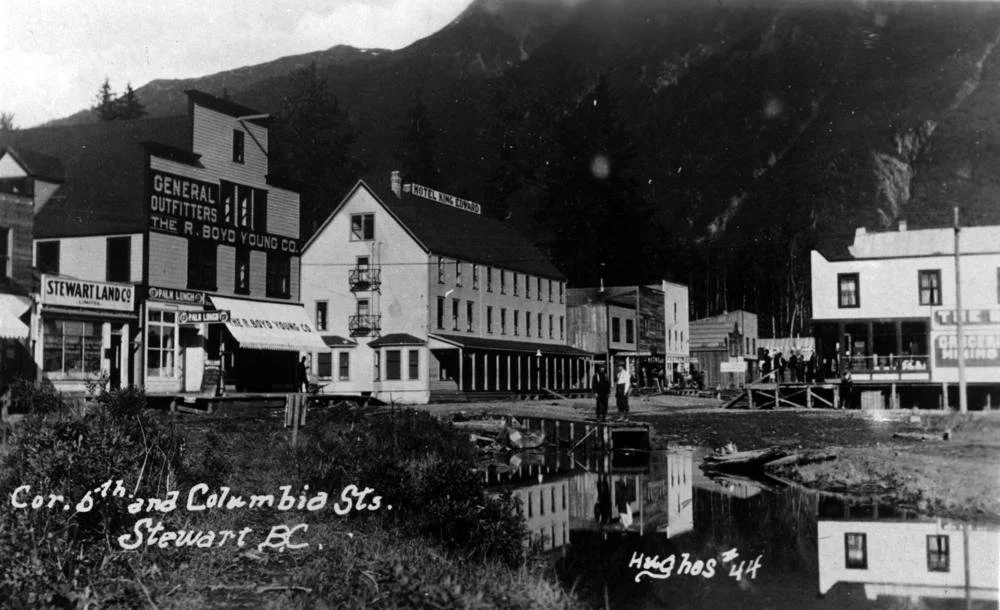
Boom town Stewart as it appeared in 1914, four years after the Ilstad party passed through. —BC Archives
There being no wharf we went to shore in a launch from which we stepped dry shod into a wagon backed hub-deep in the waters of Portland Canal. We soon realized we were in a boom town when the driver of the wagon collected $7 for our transportation to a newly-built hotel. We [also] soon discovered also that there was not enough change for any coin less than 25c.
In this raw village of exorbitant prices we stayed only long enough to buy our outfit which included some extra rounds of ammunition for our arsenal (a 30-30 rifle and a .45 pistol) when we learned of recent Indian aggression in the Nass Valley for we were determined to press on in spite of the Indian menace. [Such was Mr. Ilstad’s and his companions’ concern at the time.—Ed.]
But here we were to meet our first checkmate. Our American agent turned back after one look at the trail before us.
Over the 60 miles of this rough trail we must carry on our packs, tent, food and blankets which would load us with more than 60 pounds each, and our land agent was not young. Though he lacked the stamina for this long gruelling march, he showed wisdom in abandoning a journey on which he must surely have collapsed.
However, he urged us on, reassuring us that we would reap our promised commissions when the Nass land was staked and legally recorded.
Early next day we were on that long inland path toiling toward our goal. Our route followed the new railway grade where nine miles inland it's definition faltered like a falling hope and came to its end at Bitter Creek. And Bitter Creek it must have been to the shareholders whose hopes had died with ending of steel at this forsaken spot. We stopped for a rest and mail at the Log Cabin roadhouse.
Standing amid the boarded-up and deserted building, it, too, seemed to typify the forlorn spirit that pervaded the place.
At the end of the third day we reached the formidable barrier...the Bear River glacier. Here we were faced with a mountain of ice 1,500 feet high. Its icy slopes chilled us from within and without. However, a route through the numerous and fearsomely dark chasms was flagged with iron rods and tiny red pennants.
We made our journey over this precarious terrain without incident and camped at the mountain’s icy foot as dusk was shadowing the narrow valley. We were up at dawn and after a hasty breakfast shouldered our packs and pressed on. At nightfall we camped beside a lake set amid low hills that were sparsely clothed with aspen trees.
Here began (although we did not know it at the time) and ended our timber staking. Here, too, we were visited by the leader of a survey party who was on his way to Stewart. When he learned we were on our way to the Nass....now only a mile away, he expressed both surprise and concern.
“You boys are heading the wrong way, " he said. "Snow can be expected any time now and without snowshoes you'll starve before you get out. Better turn around.”
With this grim admonition he left us. Bold with the rashness and ardour of youth, we gave little heed to his warning. The three of us were in our late teens and at next day’s dawn we were up and heading for the Nass River. By noon we were floundering knee-deep in icy water. The valley was flooded, but worse than the flood waters was the dense growth of tree-size willows, twisted and leaning in all directions.
Four hours we fought our way through their all but impassable tangle. Now numbed by the chili waters and exhausted from our struggle through the willow thicket, our progress was slowed to a nail snail’s pace. To climax it all, snow began to fall.
And soon we were wandering in a ghostly snow-white, flooded forest.
We paused and listened in anxious perplexity for the murmur of the river but could hear nothing. The snow continued to fall. Finally, we held a brief consultation and decided there was no alternative but to turn back. Downcast and silent, we retraced our steps. The snow ceased as we emerged from the flooded area and the sky brightened but even this hopeful sign failed to raise our depressed spirits.
When we reached the lake we were startled to find an Indian canoe drawn up on the shore. More than a little alarmed, we looked to our firearms and loaded them with care. A silent and apprehensive trio crawled into soggy blanket that night and slept but little. We seemed unable to warm ourselves after our long sojourn through the icy waters of the flooded forest.
We felt we had little time to spare for warm-ups by morning or evening fires and on the third day arrived again at the foot of the glacier. We look to its summit with anxious apprehension for on the morrow we must cross it.
From this great ice field that challenged us a freezing wind swept down upon our evening camp as we tried in vain to warm ourselves. We still shivered by our blazing fire and the bucket of water fetched from a nearby stream filmed over with ice within minutes. We heated huge boulders in the fire and set them under our evergreen mattresses...and what a comfort to get our feet warm at last.
We broke camp at dawn and set our faces resolutely towards the icy mountain that chilled our shivering bodies. But loaded as we were with camp gear, the exertion of ascending the steep glacier soon warmed us to the excess.
Hostile Indians were behind us now, but before us loomed the glacier with its unknown and hidden crevasses. We hoped if the weather remained fair and no snow fell to conceal these dreaded pitfalls, we could in a matter of hours win free from our frigid prison. With this hope uppermost in our minds we ascended without pause.
But we were not to escape these menacing ice fields without an unforgettable trial.
We had scarcely set foot on the summit when the valley was darkened with the swiftly approaching snow storm. In moments we were engulfed in flying snowflakes that shut out our vision. Blindly and fearfully we struggled on for we had yet to negotiate the extremely dangerous ice stairs where one slip would mean death.
Our terrifying and only guide now was the snow slides as they roared down from the summit, having been launched by the new falling snow.
(To be continued)
