
From Riches to Rags to Riches to Rags...
Certainly the career of Gustav Alvo von Alvensleben was one of extremes—from German aristocrat to BC developer extraordinaire to enemy alien, imprisonment and financial ruin.
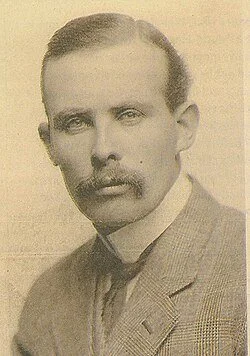
Gustav Konstantin (Gustin) von Alvensleben, better known as Alvo von Alvensleben. —Wikipedia
Anyone researching provincial history in the years immediately preceding the First World War is sure to see this name celebrated in press stories; some even credit him with founding the Vancouver stock exchange.
But, with war, all that ended. The celebrated business tycoon was accused of being a German spy (he wasn’t) and his world came tumbling down.
* * * * *
More than a century later, his name still turns up from time to time, There’s simply no denying that Alvo von Alvensleben was a remarkable man.
Initially, his father would have been the last to agree. Although perhaps not the black sheep of an ancient noble family, Alvo, the third of four sons, got off to a slow start so far as the senior von Alvensleben was concerned. True, Alvo had reluctantly bowed to his father's wishes and joined the German army but, rather than distinguish himself as an officer, the handsome, mustachioed Alvo seems to have devoted his energies to wine, women and song.
The last thing on the mind of the carefree second lieutenant of artillery was his army career; a fact which his father at last begrudgingly had to concede. When his father cut off his allowance, Alvo accepted the inevitable, bade farewell to the army, to his father and to the Fatherland. Early in 1904, the playboy boarded a trans-Atlantic steamer at Hamburg and sailed to join an older brother Joachim on his El Salvador coffee plantation.
Unfortunately, Alvo’s arrival coincided with a world-wide depression in the coffee market; Joachim faced ruin and Alvo was on his own.
But if his brother was unable to assist him financially, he was able to give him some good advice: Go to British Columbia. There, he said, Alva would find a land of opportunity awaiting a sharp young man of his background and as yet untapped abilities.
It was 1904. Having no wish to return home in shame, Alvo headed north and landed in bustling Vancouver with little more than the expensive clothes on his back, a fine hunting rifle and a four dollars. Setting up shop in a run-down hotel (he’d already learned some of the finer points of survival), he looked about for opportunity. But opportunity proved to be elusive, he was forced to hock his fine rifle.
Worse, he had to face the grimmest fact of all: he needed a job. Reconciling himself to this fate almost worse than death, the German nobleman, former army officer and playboy invested his last few dollars in a packsack and some blankets, and hit the road.
Thumbing his way through the Fraser Valley, he found a job as a field hand on an isolated farm for two $2 per day. Before long, he encountered a fellow expatriate who worked as a railway section hand. One thing led to another, with the result that, when they parted, they’d exchanged more than pleasantries. Alvo took over the job as section hand, and his acquaintance assumed his former role as farmhand.
Before long, he advanced to oarsman in the Fraser River salmon fleet for $4 daily. With autumn and the end of the fishing season, he stayed on at the Brunswick cannery as watchman, supplementing his meagre income by hunting the 1000s of wild ducks which inhabited the Delta lands, and selling them for 35 cents each to Gastown restaurants and the Vancouver Club.
By the following salmon season he was again hard at work, this time as master of his own two-man boat, which entitled him to two-thirds of the daily catch. Coincidentally, this season provided a record catch; but, as luck would have it, Alvo and fellow fisherman didn't profit greatly from from the silvery harvest because the over-taxed canneries restricted them to so many fish per day..
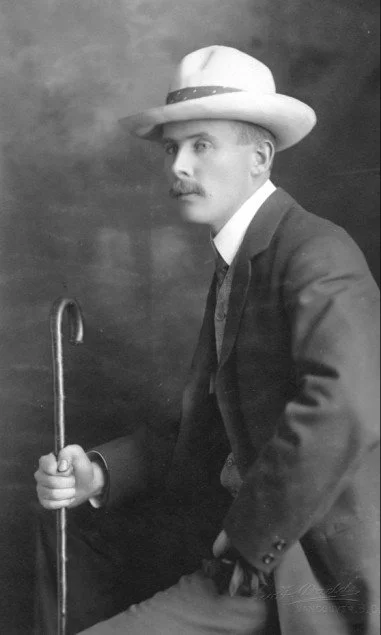
Even after the loss of his business empire, Alvo maintained his dapper appearance. One historian has even described him as a peacock.—Vancouver Archives
This didn't strike Alvo, by then more than a little aware of the value of a dollar, as fair or practical.
Three years after his arrival in B.C., with $1500 in the bank, he looked about for fresher fields. After due consideration he chose the wide-open field of real estate and finance where, he was sure, there’d be no limits to a man's “catch.” Confident of success, he rented a tiny office on Granville Street in Vancouver and hung out his shingle as Alvensleben Finance and General Investment Co.
Unfettered by such trivialities as a license, let alone studies and examinations, Alvo was soon in business. By this time the onetime playboy had come to realize that to succeed in booming frontier BC, one needed ambition, determination and imagination—qualities which he proceeded to demonstrate that he possessed in abundance.
Perhaps the greatest testimony to the handsome young aristocrat’s powers of persuasion is the fact that he talked the Vancouver Sun into giving him a 90-day advertising account on credit. (Some historians think he didn’t really ask for a credit line but, in true Teutonic fashion, demanded it.) Whatever the case, credit was granted him and he began an extensive and expensive promotional campaign—large ads complete with grammatical errors because Alvo insisted upon preparing his own copy despite an infirm grasp of English.
Nevertheless, he was an immediate success in real estate and soon traded his shabby little office on Granville for bigger and plusher quarters, a move made necessary by the fact that he’d added three salesman to his firm, including his brother Werner. Further proof of his growing acceptance in financial circles was his involvement in the founding of the Vancouver Stock Exchange. Some days, his company’s transactions accounted for more than half of the Exchange’s activities.
Who could doubt his success when, with German backing, he financed construction of downtown Vancouver’s first steel-frame high-rise, the 13-storey (53m/175 feet tall) Dominion Building—upon its completion in 1910 the tallest building in the British Empire? Or his handsome mansion in expensive Kerrisdale district (now a girl’s school) that required a staff of 13 servants?
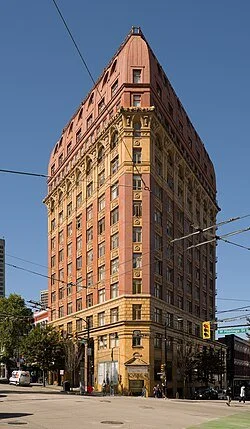
The restored Dominion Building is now a national historic site. —Wikipedia
No doubt, the public awareness that his father was a close friend of Kaiser Wilhelm didn’t harm business, particularly among German immigrants, his personal and family contacts in the Fatherland, and other impressionable European investors. By 1912, fuelled by a frenzied real estate market, Alvo employed a staff of 50.
Taking time out to visit the Fatherland and his family, he made side trips to England and Holland to persuade well-healed family connections to invest in his growing B.C. empire. The former black sheep of just a few years before found his aristocratic heritage to be a golden pass to the hierarchy of Europe. Some of his largest investors read like a Who’s Who of early 20th century Germany: Chancellor Bethmann-Hollweg, Prussian Field Marshal General von Mackensen, a member of the Krupp arms family—even Kaiser Wilhelm himself.
With the money rolling in, Alvo invested heavily in projects throughout the lower B.C. mainland, Vancouver Island and the Queen Charlotte Islands (Haida Gwaii).
One of his first ventures was drilling for oil in the Athabaska tar sands. In May 1912 the Vancouver Province reported that his and fellow German investors’ Vancouver Timber & Trading Co. had bought 1,000 feet of waterfront on Burrard Inlet, opposite Port Moody, for a proposed sawmill capable of cutting 200,000 board feet daily. Timed to take advantage of an extension to the North Shore of the CPR, this was one of Alvo’s brainchilds that would be caught in the recession that preceded the outbreak of World War 1.
By this time married to Edith Westcott, a Vancouver teacher he’d met while working in the salmon fishery, and with whom he’d have three children, Alvo had his fingers in a dozen pies, ranging from canneries (fishing and whaling) to mining, forestry, a fertilizer plant, a trust company and real estate holdings that included the famous Wigwam Inn.
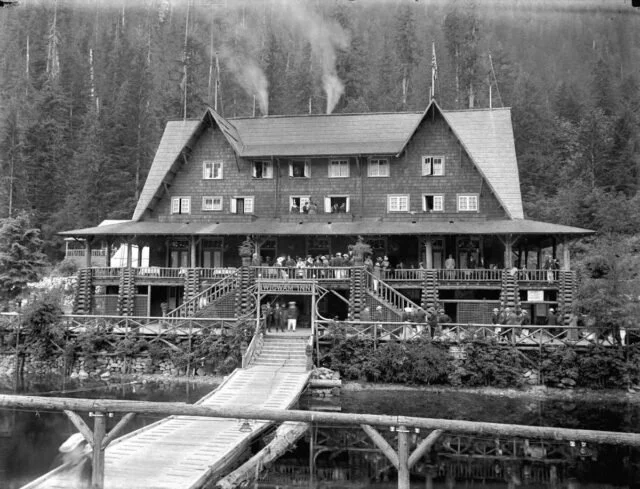
Vancouver’s Wigwam Inn, with its colourful history and reputed ghost is one of Alvo’s legacies. —Vancouver City Archives
He also ventured across the border, acquiring control of an Issaquah, Wash. mine which had been bankrupted by a years-long labour dispute. Thanks to his peacemaking efforts which were described as being “almost socialistic”—recognition of the union, fair wages and improved working conditions—he soon had the mine back in production with, at one point, as many as 500 workers who sparked a local building boom.
The Wikipedia entry for Alvo von Alvensleben is nothing less than glowing: “...By vigour, vision and entrepreneurial risk-taking, [he had] within a few years advanced from a simple day labourer to become a millionaire in high finance. Even within his lifetime he was regarded as a legend and is now considered one of the great figures from the pioneering days of British Columbia....”
Curiously, although Alvo got his first real start in in real estate, he preferred to put his money and that of his investors into the comparative security of businesses and buildings.
By 1912, eight years after his arrival in Vancouver with little more than the clothes on his back, Alvo had built an empire. But, just a year and more after, there were clouds on the horizon; the greatest real estate boom in provincial history was showing signs of cooling and, despite his caution in this field, Alvo couldn't escape the rippling currents.
By the summer of 1914, he was in serious difficulty, his many companies requiring a $2 million transfusion.
Alvo, by this time greatly concerned, returned home, sure that, because of British Columbia's potential, any slump would be temporary and he’d have no difficulty in raising the necessary funds in the Fatherland.
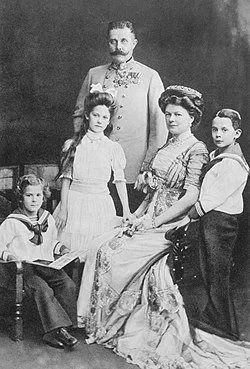
The assassination of Austrian Archduke Franz Ferdinand Carl Ludwig Joseph Maria and his wife Sophie in Sarajevo, June 28, 1914, precipitated the outbreak of the First World War four weeks later. —Wikipedia
He hadn't, however, taken into account the drastic state of international affairs. Even before the assassination of Archduke Ferdinand and the squaring-off and flexing of muscles by Germany and Great Britain, Germany was beset by a lengthy recession. Capitalists of both nations were interested only in pulling their invested chestnuts out of the fire, not in gambling further on holdings in distant British Columbia.
Almost panic-stricken, Alvo sailed for Vancouver. His ship wasn’t far into the North Atlantic when Germany jack-booted through Belgium and the First World War spelled finish for an era, for millions of lives—and for the financial dreams of Gustav Alvo von Alvensleben.
After landing in Seattle he slipped into Gastown to see what, if anything, he could salvage. It was hopeless. Anti-German sentiment raged and most of his properties and investments, estimated to be valued at 25 million dollars (you can multiply that by 30 today!), were confiscated. When a warrant was issued for his arrest as a suspected spy, he fled south, legend having it that he did so disguised in women’s clothing.
But, when the United States joined in the conflict three years after, Alvo lost his liberty there, too, having been betrayed by a business acquaintance. Interned at Salt Lake City, he spent three years in custody, not being released until more than a year beyond war’s end. An investigation of his pre-war activities had turned up no evidence of his involvement in espionage or any other form of hostile behaviour; ironically, one of those who spoke on his behalf was the man who’d had him arrested.
After his release he returned to Seattle, finding employment in real estate and as a stock broker.
Forty years later, once again involved (but on a considerably smaller scale) in finance, Alvo visited Vancouver. “I spent the happiest years of my life in Canada, a wonderful country,” he declared. Amazingly, he didn’t sound bitter and he hadn't lost his faith in the province's future: “There are just as many opportunities today as when I came here in 1903 [sic]. Don't wait till opportunity knocks, go out and find it.”
Alvo von Alvensleben passed away, aged 85, in Seattle in 1965, having spent the greater part of his life and working career in the U.S. He’d never attempted to resurrect his business empire in B.C. and his last years, according to a son, were said to have been spent in near poverty.
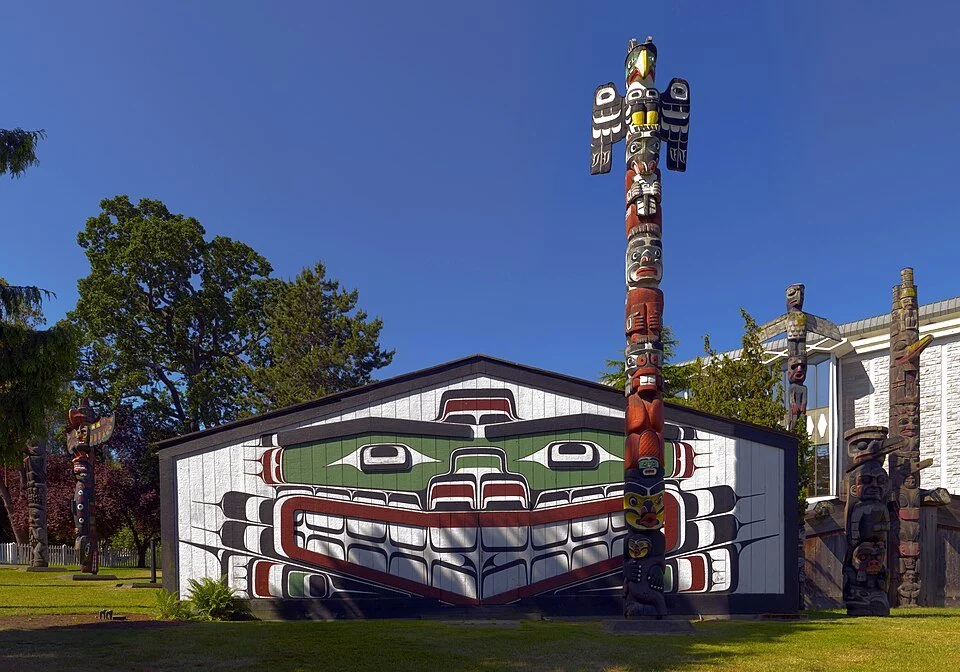
It’s urban legend that Alvo von Alvensleben gave Victoria its destination Thunderbird Park. —Wikipedia
As for his B.C. legacy, there were many who insisted upon believing he’d been a spy, that one of his isolated up-coast projects was really a secret submarine base, that, had Germany won the war, he was going to be appointed Governor of B.C. Today, Vancouver has its landmark Dominion Building, Kerrisdale has Crofton House, his former mansion that’s now a girl’s school. Then there’s the Vancouver Stock Exchange and the Wigwam Inn, the luxurious ca 1910 “health resort” on Indian Arm with its colourful history as a resort for the wealthy. Among its illustrious guests in its brief heyday were American billionaires John D. Rockefeller and John Jacob Astor
Then came hard times as a brothel, illegal casino, and even, at least according to legend, hideout for gangster Al Capone. Seized by the government, it eventually was purchased by the Royal Vancouver Yacht Club and, since 1985, it has served as a private, members-only club.
