
Overland to the Yukon – the Hard Way
(Part 1)
It’s hard to think of bankers as being colourful; I’ve never met one who was.
But, fortunately for storytellers such as I, there’s always that exception to the rule.
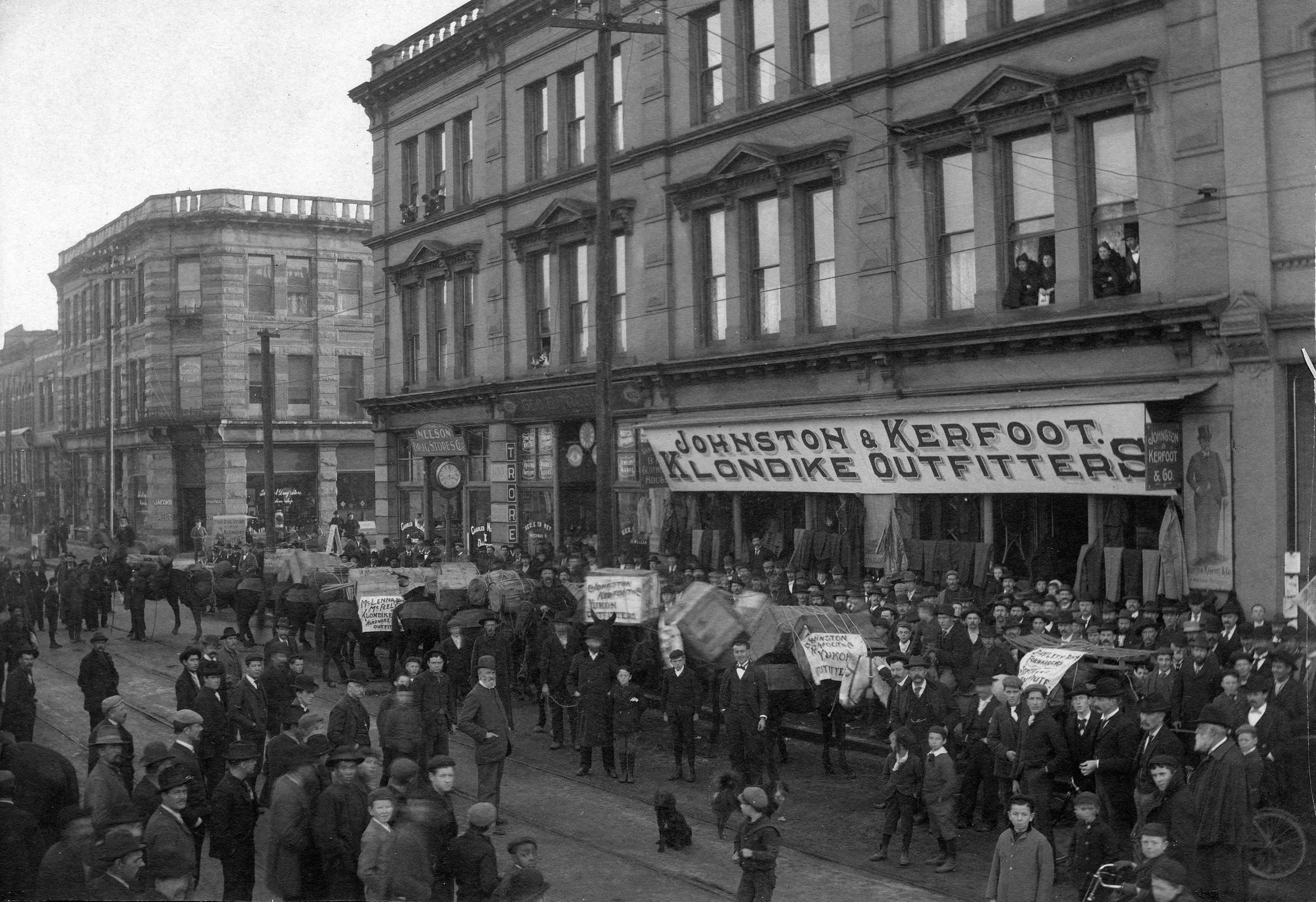
A Klondike expedition heads out from downtown Vancouver in 1898. This is where our banker began his epic journey to the Yukon diggings. —Vancouver Archives
Banker David Doig certainly was out of the ordinary, having been described in a government document as a “bon vivante with a taste for caviar, oysters on the half-shell, good whisky, champagne [with his breakfast!]...and entertaining women”.
Mind you, that’s not the David Doig as he was known to his employers, the Bank of British North America (BNA), when they chose him, at the respectably mature age of 39, to open the first bank in booming, brawling Dawson City.
But Scottish-born Doig was no pin-stripe suit. His staider peers had to have known that he was “colourful and flamboyant”—perhaps these were the very qualities they considered necessary for a city boy to successfully brave the Yukon wilderness to open the region’s first commercial bank.
The BNA would later be absorbed by the Bank of Montreal and Doig, after serving in Montreal, Brantford, Ontario, and Dawson, would round off his career as manager of the Victoria BM branch.
He has left a fascinating account of his journey to Dawson—1,500 miles and 47days—with $1 million dollars in cash and an armed Mountie escort.
* * * * *
On April 1st, 1898, our party of six embarked at Vancouver on the S.S. Pakshan—a typical ocean tramp, bound for Skagway with the object of opening a branch at Dawson, 550 miles or more in the interior. It was the desire of the [BNA} to be the first in the field and our instructions were to spare no expense in reaching our destination.
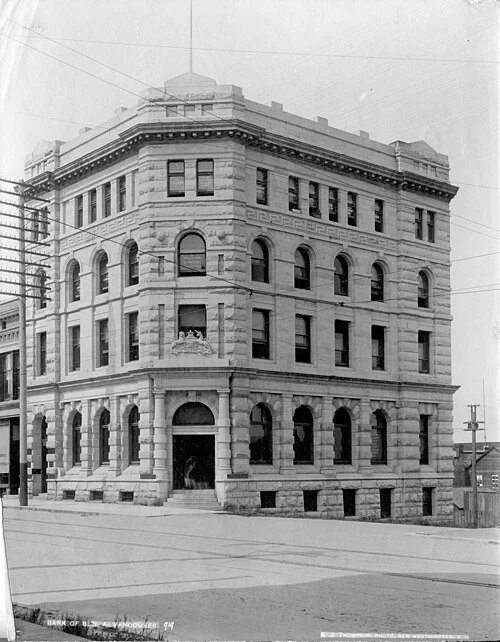
The Bank of British North America building in Vancouver; until its merger with the Bank of Montreal, it was one of Canada’s leading banks, and David Doig’s employer. —Stephen Joseph Thompson photo, Wikipedia
After three days sail through beautiful scenery we reached Wrangell, founded many years ago as a Hudson's Bay fort but now a boom town of some 3,000 people. With a few hours to wait, we had time to make an acquaintance with the place. The large majority of the population live under canvas, and the streets and sidewalks are in such a condition that it requires considerable agility to navigate through the mud and slush.
Gambling is clearly the staple industry, and fleecing of in-going Klondikers is carried on merrily with great success in the most open and bare-faced manner possible.
Nearing the head of Lynn Canal, Dyea and Skagway appear almost simultaneously, the one marking the approach to the historic Chilkoot Pass on the left hand, and the other the hardly less impressive and forbidding White Pass on the right.. Rugged and precipitous mountain-walls of granite, partially covered with a forest growth of evergreen and poplar rising into the snowline define a boundary of an ancient fjord on whose upper cliffs American enterprise have inscribed in giant characters the value of “General Arthur’s Cigars,” “Kelly Nostrums,” and other equally worthy articles.

You don’t have to fear for your wallet or your life when you visit Skagway today. —https:// www.skagway.com/things-to-do
Perhaps the most striking feature of Skagway Harbour is the enormous wharfage which encroaches on the sea. Four distinct lines of pile anchorage project about half a mile into the ocean providing access to the town, such rendered necessary by the height of the tide, or more correctly, by the amount of mud flat exposed at low water.
We had arranged to go over the Dyea trail but on reaching Skagway learned that on the day previous to our arrival, a landslide had occurred in which about 100 people were buried alive. As a consequence we decided to take the White Pass route.
At the time of our visit the town was practically under the control of the notorious “Soapy Smith,” the leader of a large gang of thieves and murderers. Robberies committed in open daylight went unpunished, and although many murders took place, there were no convictions. Quite close to the hotel at which we put up, and while we were there, a man was shot dead, but although the identity of the murderer seemed to be well-known, no arrest was made.
Gambling went on to a great extent—faro, roulette, craps and stud poker being played under the same roof and usually in a large room adjacent to the bar. The “look-out” under ordinary circumstances is not much in evidence. But his loaded shotgun is always ready to draw a bead on any desperate victim who may attempt to shoot the deft manipulator of the cards.
A story was told me which will illustrate the methods adopted by “Soapy” to rob the public.
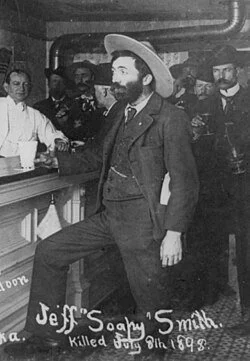
The infamous conman and Skagway gang leader Soapy Smith died, appropriately, in a gunfight. His scams have become legendary, but banker Doig and NWMP Inspector Wood were more fearful of the threat his gang posed to the fortune they were transporting to Dawson.—Wikipedia
Notices were posted containing the patriotic information that he would raise a regiment to fight the Spaniards [during the Spanish American War—Ed.] and informing intending recruits to call at a certain office. On the appearance of the victims they were requested to undress preparatory to undergoing a medical examination in an adjoining room.
While there, all money and valuables were removed from their clothes. Needless to say, the regiment never appeared at the front.
During our stay in Skagway, the Bank’s cash, amounting to over $1 million, was placed in the log cabin occupied by Inspector Wood of the North West Mounted Police, and which was guarded in the daytime by two troopers, while at night the inspector and I slept there on cots placed in diagonal corners.
To account for the presence of Canadian police in Skagway, it should be mentioned here that the Boundary Commission had not yet announced its award, and although it was generally known that the dividing line between Alaska and Canada was to be some 20 miles north of Skagway, the NWMP were still awaiting the official announcement.
One night, Inspector Wood and I were awakened by the thud of a bullet embedding itself in one of the logs of our cabin, followed by the sharp report of a gun. Naturally, we thought it was a “hold-up,” and Wood suggested that we had better crawl under the beds as the robbers would likely know the elevation at which to fire.
Then, as no further firing was heard, we ventured cautiously to the door and, after about 10 minutes of suspense which seemed much longer, to our great relief there was nothing further. Next day, we learned that a bartender had been killed in a feud between two saloons and apparently a stray bullet had struck our cabin.
Inspector Wood, not being desirous of repeating the nervous strain of the previous night, insisted upon...starting the following evening and a cavalcade of five well-mounted troopers and three of the Bank staff slipped quietly up the White Pass trail with the treasure, while I remained behind to spend the night with Soapy Smith in his gambling hell [sic] to throw him off the scent.
I remained there until the return of one of the troopers about 6:00 in the morning with the news that the party had reached the summit—Canadian territory—without any mishap.
The Skagway trail, as the route from Skagway to the lower end of Lake Lindemann via the White Pass is termed, is a piece of roadway and trail some 42 miles long, all of which during a limited “good” season and summer, is easily passable to pack trains.
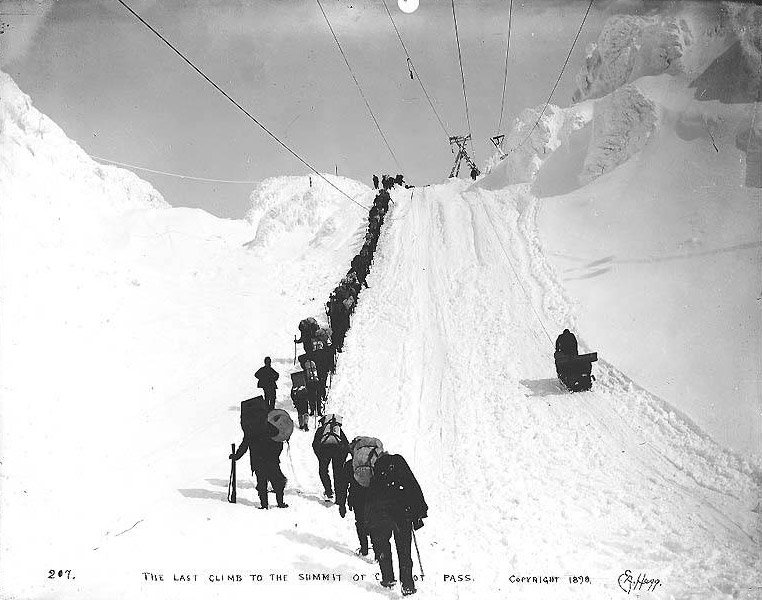
Photos of miners hiking up the slopes of the Chilkoot Pass with 60-75 pounds of gear and grub on their backs—often having to make more than 30 trips up and down to deliver the mandated 1,000 pounds of provisions to the summit—are among the most famous photographs of history. Luckily for banker David Doig and his Mountie escort, they made the epochal climb in summertime. —Wikipedia
At other times, it is nothing less than execrable, a condition detested by the 1000s of forfeits to life which appear with equal offence to both eye and nose. The stench of decayed and decaying horseflesh is such that no one is likely soon to forget.
In winter, of course, snow blocks out the scars and tempers the odours which summer mishaps have imposed upon the landscape.
The climb to the summit is not particularly hard in good weather, when travelling light, but it is a sad sight to see men—many past 60----packing 50 to 75 pounds and making from 30 to 40 trips backwards and forwards until their whole outfit, which by Government regulations must weigh at least 1000 pounds or over, are moved. One can understand why many lose heart, sell out and return in disgust, often broken down in health through over-exertion.
At the summit we met a party returning to Skagway with the remains of a young man who had died from disease brought on by eating snow—a thing one is tempted to do while toiling on the trail.
We found that snow-glasses are a very necessary part of one's outfit when going in during the winter or early spring. We met a few people who had omitted to bring these eye-protectors, suffering from snow blindness.
The head of Lake Bennett, which is considered to be, and properly is, the fountain-head of the Yukon, lies many miles north of Lake Lindemann, with which it is connected by an easy sand portage. Probably no other spot on the globe has shown such a rapid development of the shipbuilding industry as this one and it is certain that from no other place have as many small craft been launched in a given period of time
This glory has now departed and a few steamboats today replace the endless number of scow, rafts and lighter boats which initiated the stampede into the El Dorado.
Lofty, rugged mountains enclose lake Bennett on three sides, only southward does the eye follow a more distant landscape over Lindemann to catch the crest of the Chilkoot divide. Iron Mountain or “Sunset Mountain” as it is more appropriately called, stands as a grim sentinel to the North West.
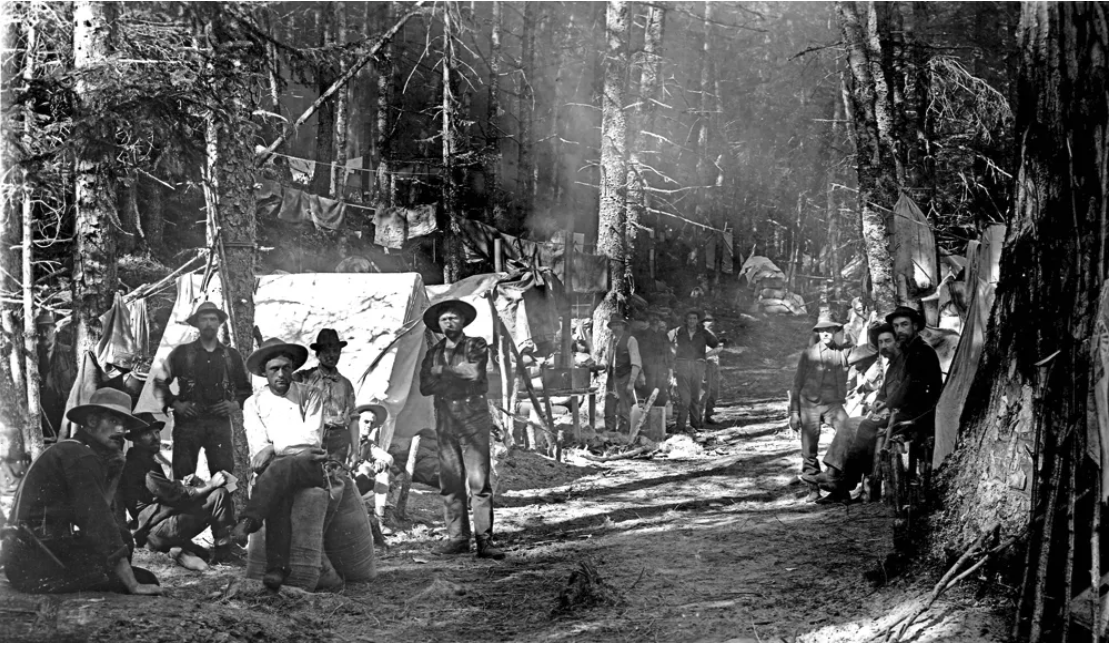
Lake Lindemann, BC, was a frenzied tent city of prospectors who had to build their own scows, rafts or boats while they awaited spring breakup. — https://www.nps.gov/klgo/learn/historyculture/historic-chilkoot-trail.htm
It was our misfortune to be delayed at this point for 16 days waiting for our baggage. We chafed under our enforced idleness, more especially on hearing that a party from another bank had arrived in Skagway and was daily expected in Bennett; however, everything turned up at last and we started with dog teams and horses at midnight on April 25th.
To see 100s of loaded sleds carrying huge square sails gliding over the ice at a speed of three or four miles an hour, was indeed a picturesque and novel sight.
We did a good day's tramp before camping at Caribou Crossing, a distance of 28 miles. Here I had my first experience of sleeping in the open air, and although the ground was covered with snow and the temperature below freezing, it was much more comfortable and refreshing than being packed in a bunk-house or tent.
That the bunk-houses along the trail were exceedingly uncomfortable and disagreeable will be easily understood when it is mentioned that they are simply benches built tier upon tier, and that it not infrequently happens that as many as a hundred men are packed in a space 25 feet square.
In such circumstances sleep is out of the question and for my part I used to dread the coming of night when I had to put up in such places. For sanitary purposes it [was] strongly advisable to use one's own blankets.
(To be continued)
