
More Outcasts and Oddballs
After all these years, and millions of words, I’ve never tired of reading and writing about BC eccentrics.
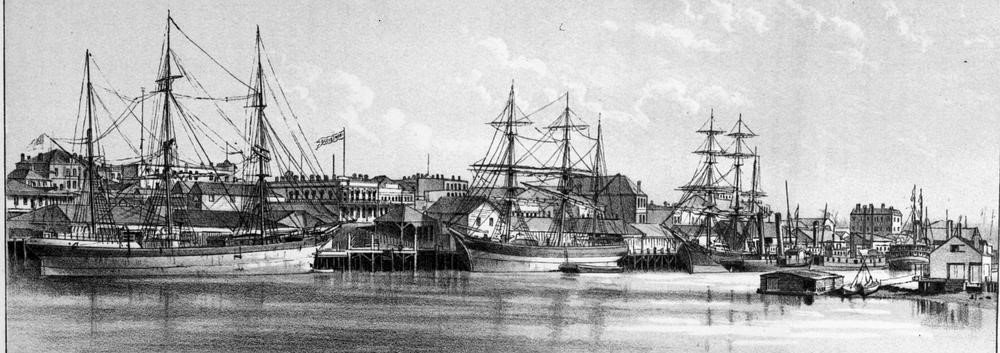
Every new arrival in pioneer BC had a story to tell—not always a happy one. —BC Archives
Many of them, sad to say, were tragic, sometimes the authors of their own misfortune, others the victims of circumstance. Some of them simply marched to different drummers.
All of them had stories to tell and some, if only briefly, caught the attention of newspaper reporters who were ever on the alert for the out-of-the-ordinary.
* * * * *.
Rare indeed was the day that the pioneering columnist had to plead for news. Rather, Victoria in the 1860s, despite its insularity, was a reporter's Mecca: tragedy, humour, romance and adventure intrigued Victorians almost daily.
Nevertheless, on Aug. 4 1860, the morning newspaper found itself bereft of courtroom drama.
“Judging from the past two days, Victoria is either becoming a very moral town, or the rogues are all in ‘quod.’ Thursday, there was only one case in Court, and yesterday, not even a drunkard was to be found in the dock. Barren times, these, for a news-gatherer. Hardly an item to be scared up, and the people calling, ‘Won’t somebody do something desperate, and give us a chance for a good item?’”
Usually, the Police Court provided no end of newsworthy volunteers. Only three weeks later, the notorious Amelia Copperman (See ‘Victoria’s Odd Couple’) of Johnson Street made waves and the news—literally—when she charged fellow storekeeper Carlo Bossi with having thrown a basin of dirty water in her face.
After the Crown and defence counsel made their presentations, it was evident that the affair amounted to a neighbourly squabble. When a female customer stole some pocket handkerchiefs from Amelia’s shop, she charged into Bossi’s store and searched several women customers, but failed to recover her property.
“An altercation then ensued between complainant and Bossi, and the latter, as Mrs. Copperman says, deluged her with dirty water.” Bossi was fined one pound sterling for his ungentlemanly conduct.
His place in the dock was quickly taken by Allan McIsaacs from “the land o’ cakes,” who’d been arrested by Officer Trura for bootlegging whisky. At his trial it was learned that McIsaacs had suffered from a case of high spirits (in more ways than one) and, during a spree, had treated every Indigenous person he met with liquor.
The court took a dim view of his generosity and fined him 10 pounds. Not having the “needful," he was sentenced to three months in the Bastion Square police barracks and chain gang.
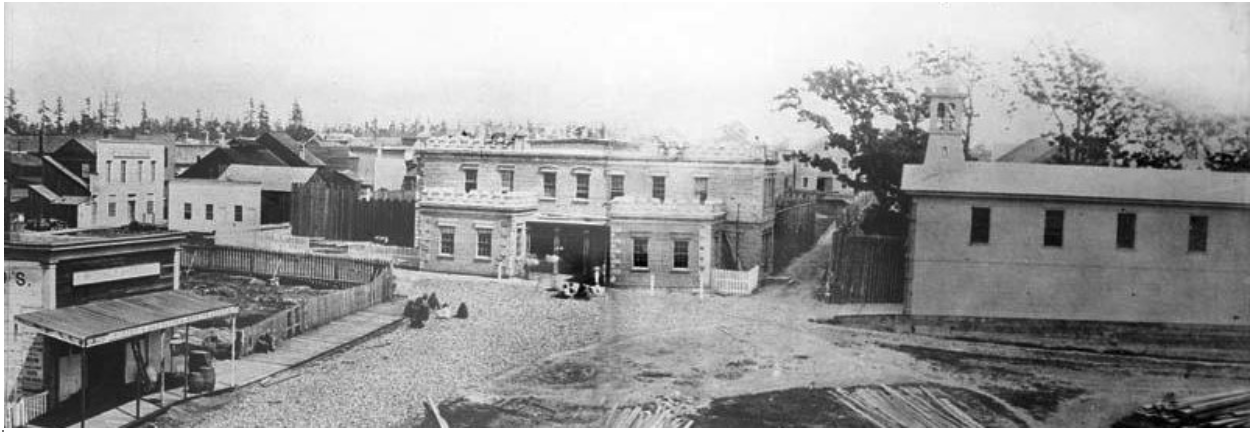
Victoria’s Bastion Square Police Barracks and Police Court, where many a drama, some humorous but most sad, played out. —BC Archives
Another whisky peddler who fell afoul of the law was Thomas Mitchell, late of the Sandwich Islands, who’d been caught in the act of trading a bottle of whisky for a shirt. The shirt, which he’d just donned, proved to be an expensive one, costing him $50 or three months in the chain gang. It wasn’t stated which Mitchell chose.
The August 30th issue of the Colonist contained not one but three dramatic adventure stories, ranging from the tragic to the outrageous to the criminal.
An Equimalt resident known only as “Big Bill” had created something of a stir by dropping dead in the house of a friend. He’d complained of not feeling well an hour before but, as he didn't appear to be ill, and remained “quite lively and cheerful,” his friends hadn't taken him seriously. Upon his sudden demise, however, questions were asked and, at last report, Coroner Dickson was on his way to Esquimalt to hold an inquest.
Further mystery (at least for modern-day researches) is prompted by the following article, the Colonist having omitted the protagonists’ names: ‘Yesterday afternoon, about 4:00, a difficulty occurred in front of the Hotel de France, Government Street, between a barrister from Fort Yale, and a certain gallant captain resident in this city.
“The barrister struck the captain a severe blow with the cane, and the parties [then] clinched. They were separated by the bystanders before any damage had been inflicted on the other side. The origin of the difficulty has not transpired.”
That same day, the competing Gazette not only reported the news but made it as well. The Colonist, undoubtedly with some satisfaction, reported that Gazette publisher George E Nias had charged his office collector, George Harding, with having embezzled the newspaper’s accounts and destroyed the books. At the time of the Colonist going to press, Harding had successfully eluded pursuit.
It was the turn of the city's marine fraternity to express amazement in mid-October, when the steamer Maria, upon completion of an extensive refit, was launched. and returned to her natural element. At that point the script went awry as the Maria proceeded to fill with water. She was headed for the bottom by the time shipyard workers were finally able to wrestle her alongside Holbrooks’ wharf.
February 1861, brought an unpleasant surprise to Chinese resident Hong Hoo who was sent to the debtors’ prison on a writ procured by a fellow countryman. Hong was said to be taking his confinement “very hard, says he doesn't owe a cent, and declares that he will contest the legality of his detention.
“In the meantime, [he] is liberally supplied with chow-chow and opium by his outside friends, and eats enough at one meal to keep a small family for a week."
(Victoria has improved in several respects since 1861: prison and opium have been outlawed, and the obviously condescending reportage is no longer with us.)
BC’s capital was indeed dull when its illustrious town crier John Butts failed to make news. John rectified this serious lapse in October by assaulting an Indigenous couple. Upon conviction, Magistrate A.F. Pemberton fined him 50 shillings or 30 days. Ironically, John was said to have been making a determined (and once in a lifetime) effort to go straight. It was stated by parties who hadn't appeared for his defence that he’d been provoked by the man and woman who’d followed him through the streets, and threw a brick at him.

Perhaps Victoria’s most outrageous character ever, town crier John Butts. —Author’s Collection
Perhaps the city's outcasts and oddballs had attracted international attention, the spring of 1863 marking the arrival of the agent for the British and Foreign Bible Society. He came “upon the excellent mission of organizing branches of the Parent Society in this [Vancouver Island] and the sister colony [British Columbia]. May he prosper."
Despite the common penchant for painting succeeding generations in darker hues, delinquency was a problem in Victoria back then, too, it being reported that “mischievious” boys had set fire to some grass on Beacon Hill.
By the time the flames were under control, several acres and oak groves had been burned.
Stupidity wasn't confined to adolescents, either, as indicated by the action of excursionists who lit a fire at Rosebank, opposite Esquimalt. A resident, thinking them to be in trouble as it was very late, immediately rowed to their aid. Upon his approach the shore party “hooted at him and ran into the woods to avoid being recognized”. The unnamed Samaritan declared that he’d be in no hurry to go to the rescue of others in the future.
Finally, Elizabeth Thurber forfeited her $20 bail when she failed to appear in court to answer a charge of having bombarded the Dew Drop Inn with stones and other missiles.
* * * * *
One of Victoria’s more intriguing deaths on record is that of carpenter James H Gilchrist who disappeared in the summer of 1898, leaving three orphaned children—and a mystery.
On the evening of August 13th, Government Street druggist C.H. Bowes later informed police, a man answering to Gilchrist’s description purchased 10 grains of strychnine. Others thought they’d seen him, early the next morning, walking rapidly in the direction of Macaulay Point.
Police had been notified when Gilchrist failed to return to his Craigflower home after telling his friends he no longer had anything to live for since the death of his wife, days before.
As Mrs. Gilchist was laid to rest in Ross Bay Cemetery on a rain-sodden Sunday afternoon, police stepped up the search for the missing carpenter, sure that he’d taken the poison and thrown himself into the sea off Esquimelt.
The Gilchrists had arrived from England some years before, and had drawn widespread notice for their obvious mutual devotion that, according to a newspaper reporter, had been “carried...to an extreme that had won for them a reputation for mild eccentricity. They were inseparables [sic], and each found complete happiness in the society of the other.
“When the children came—for there are three in the little family so suddenly bereft of both father and mother—they were the constant companions of both parents whenever they appeared in public, Mr. Gilchrist invariably carrying the youngest, even when the single ‘long-dresses’ period of childhood had...been passed.”
The closeness of the Gilchrist family became all the stranger when their house was visited by officials and concerned neighbours. Instead of finding a warm, comfortable home, they found that the family had followed a lifestyle that was Spartan and extreme.

As police continued their search for the missing carpenter, his wife was laid to rest in Ross Bay Cemetery. —Author’s Photo
Despite the fact the carpenter had always been employed and enjoyed top wages (up to 3.75 a day), it was common knowledge that Gilchrist had been “economical even to penuriousness in his daily life, yet when death opened the doors to the neighbours, it was found that the home was fitted with scantiness common only to the living places of the very poor, and happily seldom met with in Victoria.
“There were, for example, few ordinary dishes or cooking utensils; the children's mattresses were placed on the floor for want of bedsteads; and the blankets were woefully scant and few.
“What disposition Mr. Gilchrist could have made of his money is accordingly puzzling the western suburb almost as much as the mystery of his fate."
Until Mrs. Gilchrist’s relatives in the Old Country (thought to be wealthy) could be notified, the children were placed in temporary foster homes and the search for Gilchrist continued. Described as being 35 years old, six feet tall, having a husky build with sandy hair, a heavy moustache and “muttonchop” whiskers, and invariably dressed in light grey, he wouldn't have been difficult to recognize.
It was a man of this description who’d been seen walking purposely towards Macaulay Point, and druggist Bowes identified Gilchrist from a photograph as the man who’d bought poison, supposedly for a cat. He’d given his name as Pelly, and an address on Bay Street. Sergeant Hawton, Constable's Redgrave and Walker, and Special Officer Johnston, who were handling the case, stated that they were convinced that Gilchrist had taken his own life.
It was then learned that Gilchrist hadn’t acted out of grief but from fear of prosecution for having neglected his wife after she’d suffered a miscarriage at home.
Only after a neighbour had seen the Gilchrist children disposing of blood-stained clothing, and threatened to call the police, had he sent for a doctor. Mrs. Gilchrist had immediately been admitted to hospital. By that time, however, she’d been hemhorraging for almost 10 hours and couldn't be saved.
Had he been called even two hours earlier, declared Dr. Frank Hall, Mrs. Gilchrist would have recovered. It was thought that the supposedly doting husband hadn't sought medical aid because of the cost.
A Colonist reporter then recalled that the carpenter had been known to walk two or three miles to work daily in all kinds of weather rather than spend the carfare. “What he did with his money is a mystery. He did not spend it, that is certain; for his house was miserably furnished, and he and his family had no clothes, but those they wore from day to day... As far as can be learned, he had no bank account, so the inference is that he either hid his money or sent it to England for investment, expecting to return there.”
Chief of Police Henry Sheppard stated that Gilchrist, if found alive, would be charged, despite the carpenter’s declaration to Dr. Hall that it had been at his wife's insistence that he hadn’t called him.
It was then learned that the mysterious purchaser of strychnine at Bowes’ Pharmacy wasn't Gilchrist, after all; nevertheless, police held to the theory that he’d jumped into the sea off Macaulay Point and dismissed a report that “somebody was seen around" the Gilchrist residence the night after his disappearance.
Two weeks after he vanished, the body of James Gilchrist was pulled from the Strait of Juan de Fuca, and a coroner's jury ruled death by suicide will temporarily insane. At the inquest, neighbours further clouded the tragedy when they testified that the family’s existence had been the result of genuine poverty, rather than that of obsessive parsimony.
