
Overland to the Yukon – the Hard Way
(Part 2)
Last week, banker David Doig and his Mountie escort evaded the notorious Soapy Smith’s gang in Skagway and made it over the dreaded Chilkoot Pass to Lake Lindemann, BC.
They were delivering more than $1 million in cash to open the most northerly branch of the Bank of British North America in Dawson City during the Klondike gold rush.
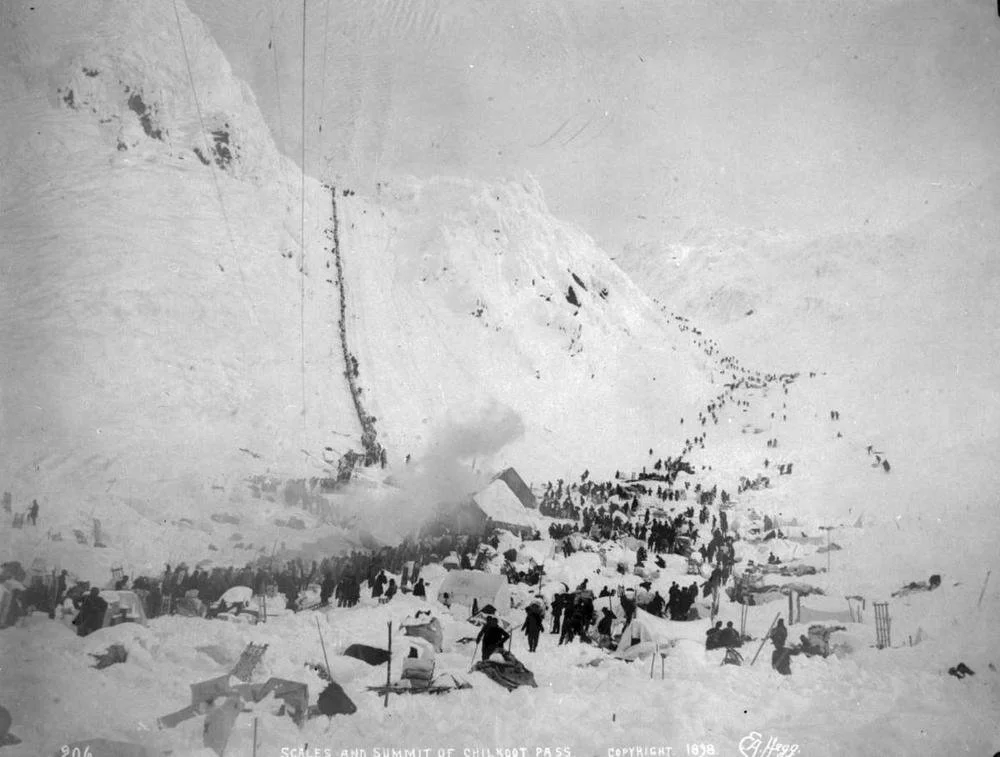
The summit of Chilkoot Pass in winter. Banker David Doig and his Mountie escort were able to do it in mid-summer. —BC Archives
Late in April 1898, 26 days after leaving Vancouver, they resumed their journey by canoe. The observant Doig couldn’t resist commenting upon the cruelty he witnessed, and the on-the-spot justice meted out to a gold-seeker caught stealing:
All sorts and conditions of animals are used for packing and hauling—horses, oxen, mules, donkeys, billygoats, dogs, etc., being called into requisition. A common language is talked to them all—not the kind in common usage in Sunday School—and a representative of the S.P.C.A. would have had an exceedingly busy time.
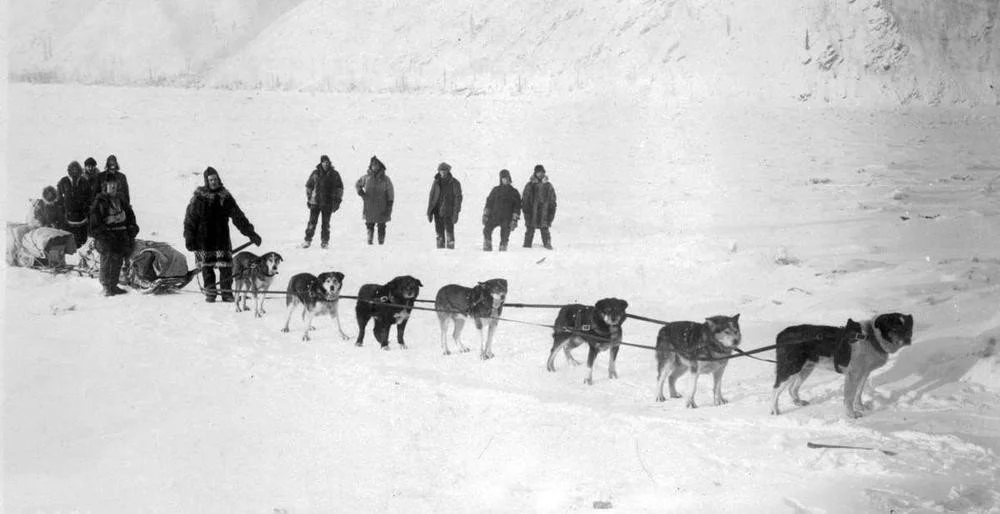
This photo of a dog team is entitled, ‘Pride of the Yukon.’ The sad reality, as noted by author Doig and many others, was that animals of all kinds were brutally abused during the Klondike gold rush. —BC Archives
An early start was made over Lake Tagish and after a hard day's travel of 20 miles, we came upon open water near the quarters of the North West Mounted Police where we underwent our last overhauling by the Customs authorities.
As an illustration of the administration of justice in Canadian territory, a man was convicted for stealing a sack of flour from a cache. The penalty—$50 and costs, outfit confiscated and banishment from the country.

Justice in the gold fields was swift and harsh. This man has been stripped to the waist and is about to be lashed before being sent back down the trail, bearing a sign, THIEF. —BC Archives
Doig then resumes his fascinating travelogue:
* * * * *
We launched our four Peterboro’ canoes which we had brought with us from Vancouver; and it was a great treat to paddle down the river connecting Tagish and Marsh or Mud lakes after our long and weary tramp.
On crossing Mud Lake we found the ice quite rotten, causing several of the party to come to grief; in one case considerable difficulty was experienced in pulling out the heaviest man of the party, but nothing more serious than a thorough soaking was the result. This turned out [to be] the longest day of all, as we had to contend against a strong headwind and a soft, slushy track.
On reaching Sixty Mile River late that evening, we were all so dead beat that there was not a dissenting voice when someone proposed a rest of 24 hours.
Again we took to our canoes and here we began to appreciate the services of our Transportation Manager. He proved to be adept in loading canoes and pack horses and was such an excellent shot that he kept the camp supplied with ducks and snipe all the way down the Yukon. The birds were very wild and not so plentiful as we were led to believe.
The four to five-mile current of the Yukon hurried us on to the head of Miles Canyon where the stream has cut a deep and narrow gorge with almost vertical basalt cliffs. The stream is thrown into a chaotic, seething mass of foam and many an enterprising craft has found a final home in its shallows.
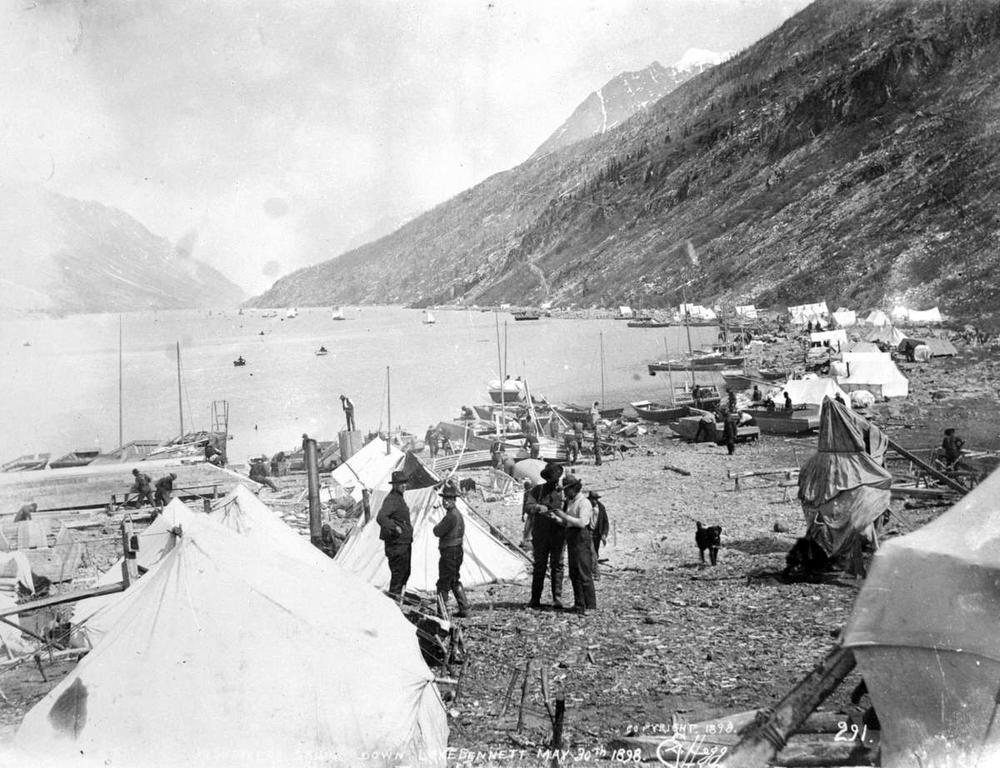
Bennett Lake, May 1898, was a frenzied scene as miners launched their homemade rafts, scows and boats. —BC Archives
Emerging from the upper gate of this canyon, the river enters upon if anything, a still more troubled course, the fury of the White Horse Rapids, as reflected in the boiling foam being more impressive to the eye than is the roar of the canyon waters to the ear. A “log-tramway” about four miles long, to carry freight and passengers around the dangerous waters, has lately been constructed and removes from the timid traveller an element of real danger.
However, there is a certain kind of excitement in shooting the canyon and White Horse Rapids not wholly to be eliminated nor even despised. A few men follow the dangerous occupation of pilots in these waters, at which they make about $100 a day in the busy season.
I was here that we first observed that marvel of the Northern skies, the unbroken Aurora Borealis. Those who have seen fragments of the Northern Lights have no conception of the wonderful display which is here exhibited in the wintry vault of heaven. The huge golden curtains describing rainbow arcs from horizon to horizon, move and flow as if tossed by a gentle wind, alternately streaming their flashes of magnetic light like so many beacons to the firmament.
Hour after hour we gazed upon this strange, luminous display, wondering the whence and wherefore. Several times we could distinctly hear a crackling sound which accompanied the electrical disturbance and with each new impulse the sky effects appeared to glow with increased intensity.
It was a sight that will forever remain in my memory.
At the head of Lake Lebarge we again met with ice and had a ticklish job unloading and hauling the canoes out of the water. The ice was so thin that every now and then some someone got a good soaking. The great majority who had succeeded in reaching Lake Lebarge were content to camp and wait for the breaking-up of the ice, as it was reported [to be] dangerous to attempt a crossing. We decided to push on. The ice was very rotten, and it was unnecessary to caution anyone to keep close to the canoes and be ready to jump.
It was with relief that we reached Thirty-Mile River and again took to the canoes.
The Thirty-Mile River, although not mentioned in the guidebooks as being difficult of navigation, gave us more trouble on account of its shallowness than any other part, and, although none of our canoes drew more than a foot of water, still we got “hung-up” several times.
From now on the journey was of the pleasantest nature with the exception of ice flows and jams, which at times were a source of delay. A goodly number of boats and rafts came to grief, but we escaped almost without a scratch. Occasionally, a fair wind would spring up which we were not slow to take advantage of and with the joint assistance of a 10-knot breeze and a five-six mile current, we could go along at a speed.
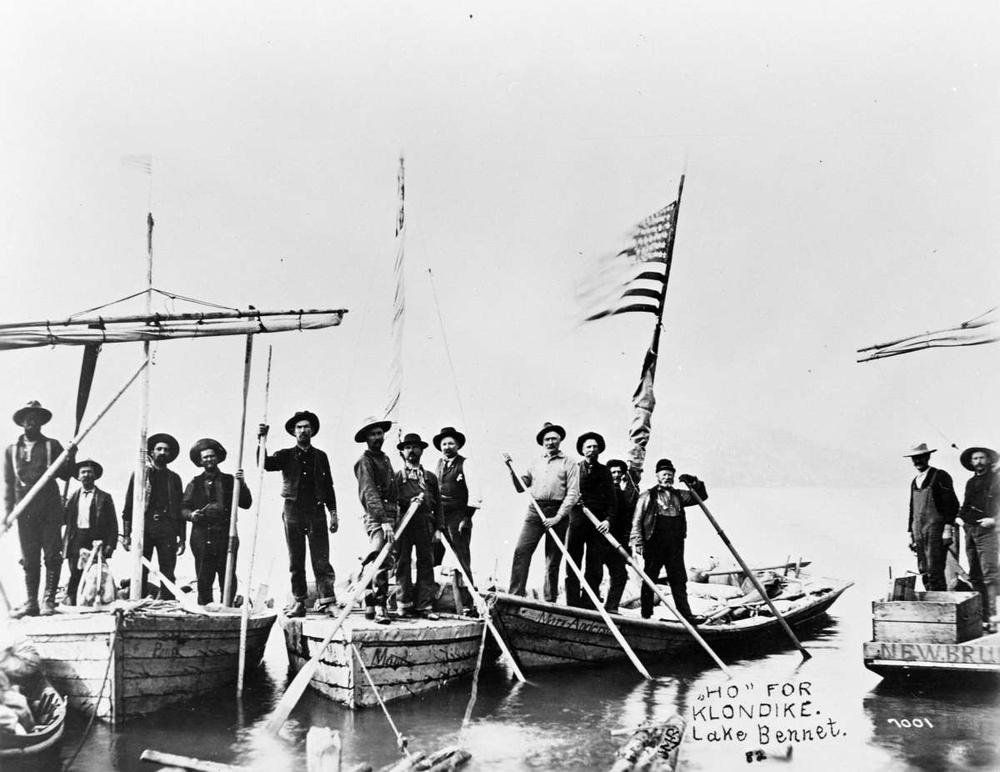
Some of the ragtag fleet en route to Dawson City. Doig’s party packed in their own Peterborough canoes as far as Bennett Lake and later sold them for a tidy profit. As Doig saw firsthand, some boat crews fell out bitterly.—Vancouver City Archives
An incident gave us some amusement while camping near Five-Fingers Rapids. As one boat, one cooking stove, etc., are sufficient for two or three men, it is manifestly an advantage to form a partnership in preference to coming in singly, and this custom is usually followed.
Disputes between partners occur frequently, the tribulations of the trail being trying to tempers and nerves clash and often a split takes place. Being called upon to arbitrate between two partners who had agreed to disagree I succeeded in dividing the cache to the satisfaction of both parties, a comparatively easy affair. But I was nonplussed on finding that a boat still remained, and what to do in the matter was a mystery to me.
However, they solved this difficulty themselves by cutting athwart the boat in two and, much to my surprise, I saw both parts six weeks later in Dawson, each with an improvised stern. The “lines” were not what might be termed beautiful, but the results were effective.
At first we had difficulty in dealing with the Indians, whose prices were absurdly high. As they had plenty of fresh moose and fish, this was a matter of considerable regret to us but, on finding out later that a cupful of tea or sugar represented $1.00 and a plug of tobacco, $5.00, our business relations were facilitated.
At Fort Selkirk, the eye is held by a relief of bold mountains on one side abutting like a gigantic cliff upon the stream, on the other spreading out in the form of a huge rampart or table-land. Passing the mouth of the Stewart we looked in the direction where many have chosen to make the search for gold. The incoming turbid waters hardly impressed us, for in the course of the last few miles, the character of her own river had materially changed.
From being fairly clear for most of its course, it was now murky to obscurity, the volcanic sediments of the White River having come as a legacy from the Alaskan side.
Soon we neared the spot which only recently told its tale of fabulous riches.
Within the greatly undulating mountains to the north east, overlooked by nobler summits which rise to some 4,000 feet, lie the sources of Bonanza, El Dorado, Sulphur, Dominion and Hunker creeks, all closely bunched together. A short journey further and the Yukon is joined by the most famous stream of all—the Klondyke.
The Klondyke is a stream in name and not in deed, for it carries little or but inconsiderable gold. Into it, however, flow Bonanza with its auriferous arm, the El Dorado and Hunker, two of the Argonauts’ fairest dreams.
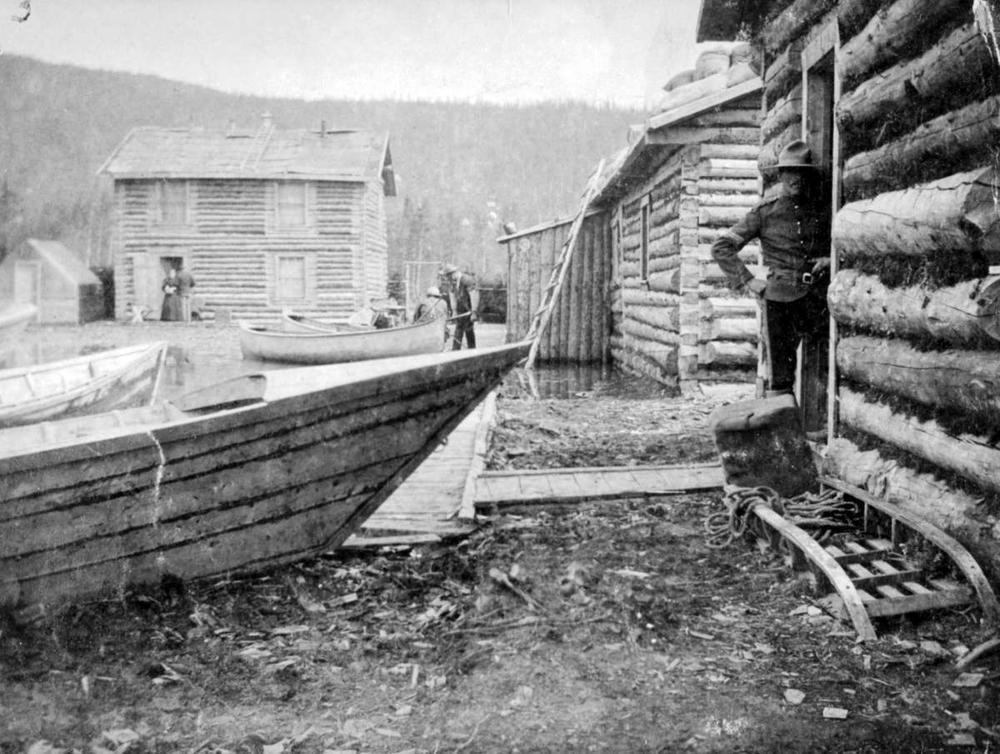
Upon arrival in Dawson City, Doig set up a temporary office near the North West Mounted Police barracks. A wise choice as he was sitting on the Yukon’s first real currency—more than $1 million! —BC Archives
Dawson lies just below the inflow of the Klondyke at a point where the Yukon still hurries forward with a stream six to seven mile miles current past two giant masses of volcanic origin. On one of these, close to the side of Dawson itself, is a lofty, bald scar. Tradition has it, that within its debris lie the remains of more than 50 miners.
We arrived in Dawson on the morning of the 17th day of May. My first experience in Klondiyke prices was gained in the selling of [our] two canoes, which netted us $900, as against an expenditure of $150 at Vancouver.
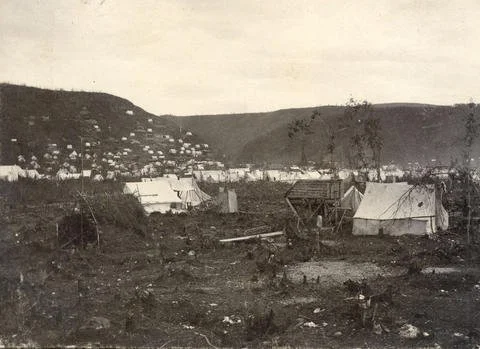
Early Dawson when tents prevailed. —Vancouver City Archives
On presenting the order for the purchase price of the canoes at one of the Hudson[‘s] Bay Company's stores in Dawson, I found to my surprise that the currency used in this district [was] gold-dust at $17 to the ounce. As a further illustration of the prevailing prices in Dawson on our arrival, we sold 15 gallons of Hudson's Bay Company rum, brought in for medicinal purposes and not required, for $65 a gallon.
There being no genuine liquor in the Camp—hooch distilled in Dawson was the only available tipple—the saloon that bought our “fire-water” did a roaring trade. It was used to flavour and disguise the disagreeable taste of the hooch.
At first there was a distinct taste in all their liquors of rum, but by and by it became more and more attenuated, finally disappearing gradually like snow in spring.
Having secured a temporary office, we opened for business on the morning of the 19th May, bringing banking facilities right into the wonderful gold-producing region. With the establishment of the first bank in Dawson, was terminated a chapter in bank- founding common as unique as it was important to the commercial interests of this new territory.
* * * * *
David Doig continued with the Bank of British North America after it was absorbed by the Bank of Montreal, eventually retiring in Victoria. When his memoir was posthumously published in the BM’s staff magazine, nothing was said about his subsequent years in Dawson.
Two years later, however, he was back, the editor writing: “Faithful readers of the Staff Magazine (if there are any) will recall that the issues of February and April 1951 contained a report of the difficulties encountered by David Doig in leading a party to Dawson City in 1898.
“His purpose in making the hazardous journey in great haste, it will be recalled, was to establish at Dawson City a branch of the B.B.N.A. before any other banks could arrive there. He was several weeks ahead of the closest competitor, the Canadian Bank of Commerce.
“We have now been fortunate enough to obtain a copy of a report he wrote later, giving his early impressions of Dawson City. This makes a fitting—if belated—sequel to the earlier reports which appeared.”
Next week, the conclusion to “Overland to the Yukon – the Hard Way,” and a few words about David Doig that would never have appeared in his employers’ staff magazine!
(To be continued)
