
Overland to the Yukon – the Hard Way
(Conclusion)
In last week’s BC Chronicles, banker David Doig and his Mountie escort successfully arrived in boomtown Dawson City with $1 million in cash. The young Scottish banker had been entrusted with opening Canada’s most northerly branch of the Bank of British North America.
This was at the height of the fabled Klondike gold rush.
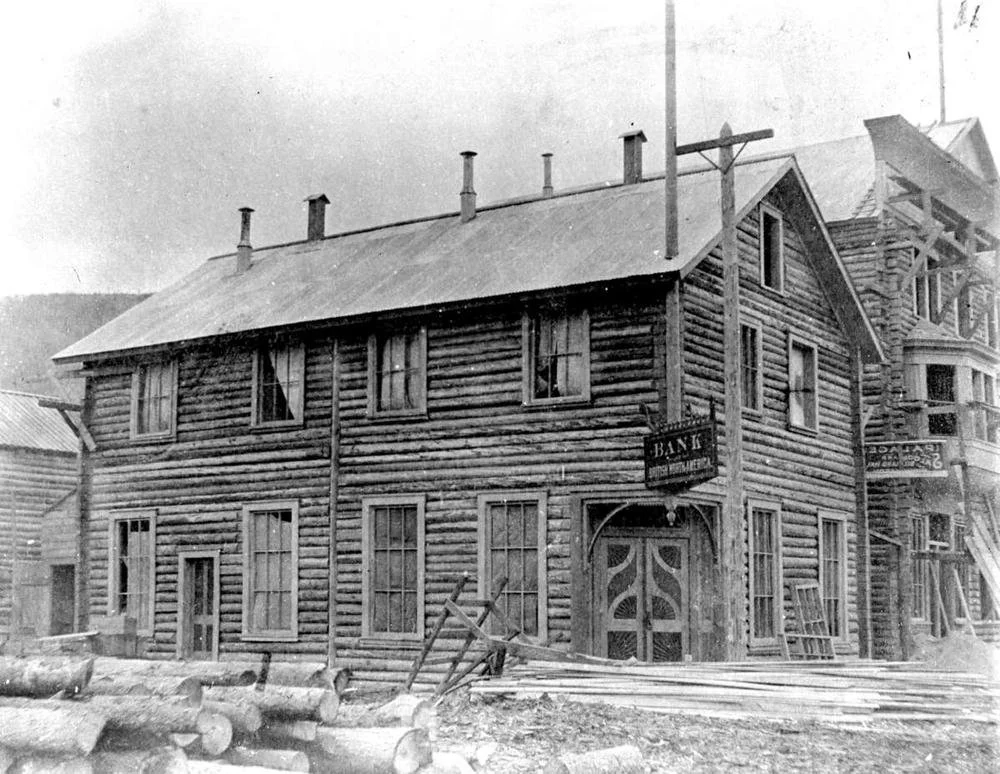
On May 19, 1898, two days after their arrival in Dawson, Doig opened the Bank of British North America in a tent with a staff of eight. The two-storey structure shown here was later built to his specifications, and has been restored by Parks Canada. —BC Archives
It had been a long haul over the Chilkoot Pass then by boat down the Yukon River before a temporary office could be opened for business.
In 1951, long after Doig’s retirement and death in Victoria, the Staff Magazine of the Bank of Montreal, which had absorbed the BBNA, published Doig’s memoir of his Klondike odyssey. Two years later, the magazine came into possession of a letter written by Doig to his superiors, the subject of this week’s BCChronicles.
David Doig wasn’t your usual austere banker, and his reputation as a “party hearty” kind of guy has long outlived him. But, first, this final instalment in his own words:
* * * * *
H. Stikeman, Esq.,General Manager. Sir—
I wrote your last from Lake Marsh.
On reaching the foot of Lake Laberge we found open water and with the exception of meeting some ice jams, arrived in Dawson city on the 17th ultimo without meeting any further obstructions. We were the third party to arrive this spring.
Dawson City is situated on the right bank of the river a mile below the junction of the Klondyke and Yukon. The principal street, if one may dignify it by that name, runs along the water front, is ungraded and without sidewalks, and at this time of the year is almost impassable on account of the mud.
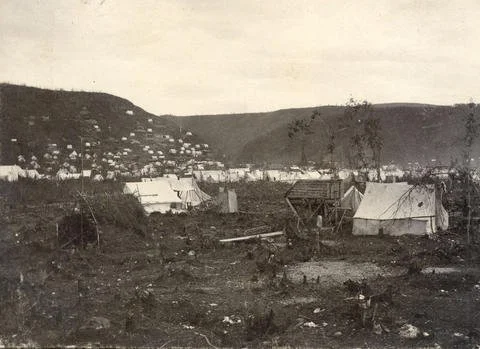
Dawson was little more than a tent town at the time of David Doig’s arrival in the spring of 1898. —Vancouver City Archives
During the winter the population was estimated at 1,500; it is probably now over 5,000 of whom 4/5 are living under canvas. It is estimated that 20,000 people are coming in over various trails and there will likely be as many more by St. Michael. The most of the buildings are made of logs and are occupied principally by saloons, gamblers, real estate and mining brokers.
There are no general stores outside of the Companies, the Alaska Commercial Co. and the Northwest Trading Co., and they are all almost at a standstill from want of goods. Real Estate is held at an exceedingly high figure—about $400 a front foot, and as the Government are contesting the ownership of the townsite with a man named
L— no title can be given in the meantime to the property.
The shortage of food has had the effect of making prices very high, the following is a sample prevailing now, viz: Moose meat [by the pound] $1.50, sugar $1.00, Ham $3 per lb., Tinned Meats $5, each, Eggs [frozen] $12.00 per dozen, Beer and Whisky $5 and $10, respectively. The regular wages for labourers is $1.50 per hour.
Gold dust has been passing as currency at $17.00. per ounce in trade, but from information gathered at the Coast, and from the appearance of the dust, I think that the average value is about $15 per ounce. To be on the safe side, I have been paying $14.00 per ounce for small quantities, and against large quantities have advanced the like amount, and arranged to adjust the difference after its being assayed, deducting create, insurance and Bank charges.
The mining Inspector who has just returned from a trip to the different Creeks collecting royalty, estimates the output this season at $7,000,000.
This is much less than was anticipated, but is partly accounted for by the fact that large numbers were ordered down the river to Circle City, where food was plentiful last fall, and when a famine was expected here. This had the effect of making labour very scarce and many claims were not worked as a consequence.
It appears to me that the wealth of the district has not not been much overestimated, and this is sure to be one of the greatest mining camps the world has ever seen, if the Government treat the prospector half decently. This they have signally failed to do up to date and large numbers are going down the river daily to prospect in American territory.
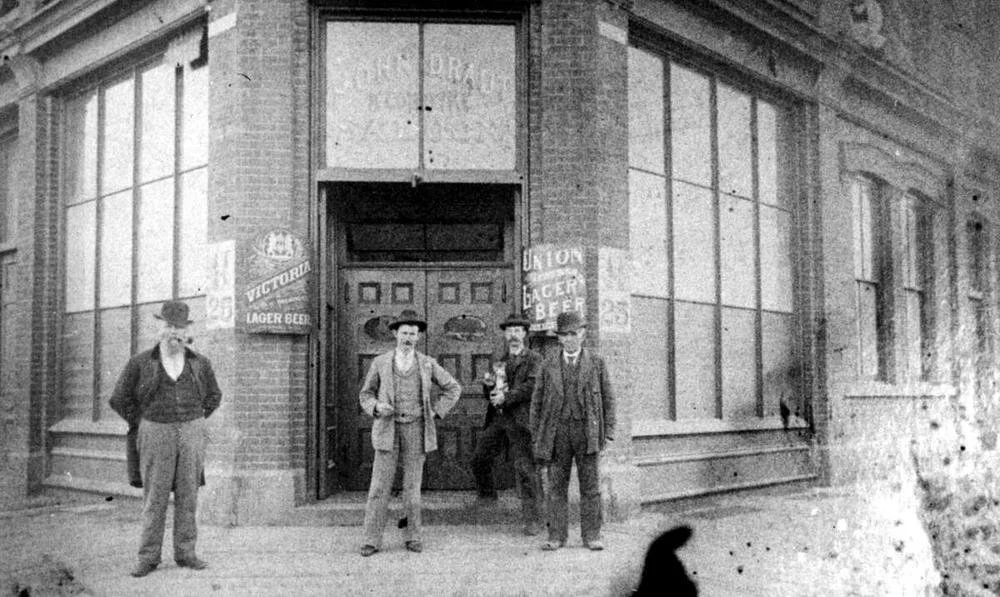
One of the first orders of business in any frontier mining town was the building of saloons. —BC Archives
The rents asked for any kind of log building on the Main Street are from $500 to $2000 per month. However, I succeeded in getting a temporary place, fairly suitable, at $50 per week, and we opened for business on the 19th May. Owing to the river rising and covering the whole swamp, business was virtually suspended for a week about the end of May.
To enable us to resume business as quickly as possible, I had a frame tent erected with a floor on a dry lot which is now our office.
Referring to the premises of the British American Corporation which we were to have the privilege of using, they are situated in Klondyke City, two miles distant from Dawson on the opposite side of the Klondyke River which was bridged across and for crossing which a toll of $1 was charged. Since the flood, the bridge was swept away and for nearly a month there has been practically no communication between the two places...
In any event, it was entirely out of the question even to open temporarily in the premises they intend to purchase as it would have cost everyone $1 each to come to the Bank to do business.
I have almost completed arrangements with James McDougall, the Klondyke Croesus to put up a two-storey log building for the Bank, the ground floor for Office and the upstairs for living accommodation for the staff and he has promised to start work on it as soon as he can get the nails and logs—two scarce commodities in the Dawson markets—logs in the meantime are worth $9 each and nails $20 per lb.
Although no definite agreement has yet been made between us I think I can get a year’s lease, or less if desired, at a rental of about $350 per month. He is exceedingly anxious to have us there as he proposes putting up several buildings on some lots adjacent, and I have pointed out to him that they rent at high figures on account of their proximity to the Bank. As a building and lot such as the one proposed would cost about $20—25,000, I think it preferable to lease if there is a chance of doing so at a reasonable rental.
The Treasure I am keeping in the meantime in the N.W.M.P. barracks in one of the cells, the key of which is kept by the Staff Sergeant, and the place is under the surveillance of a Corporal's Guard.
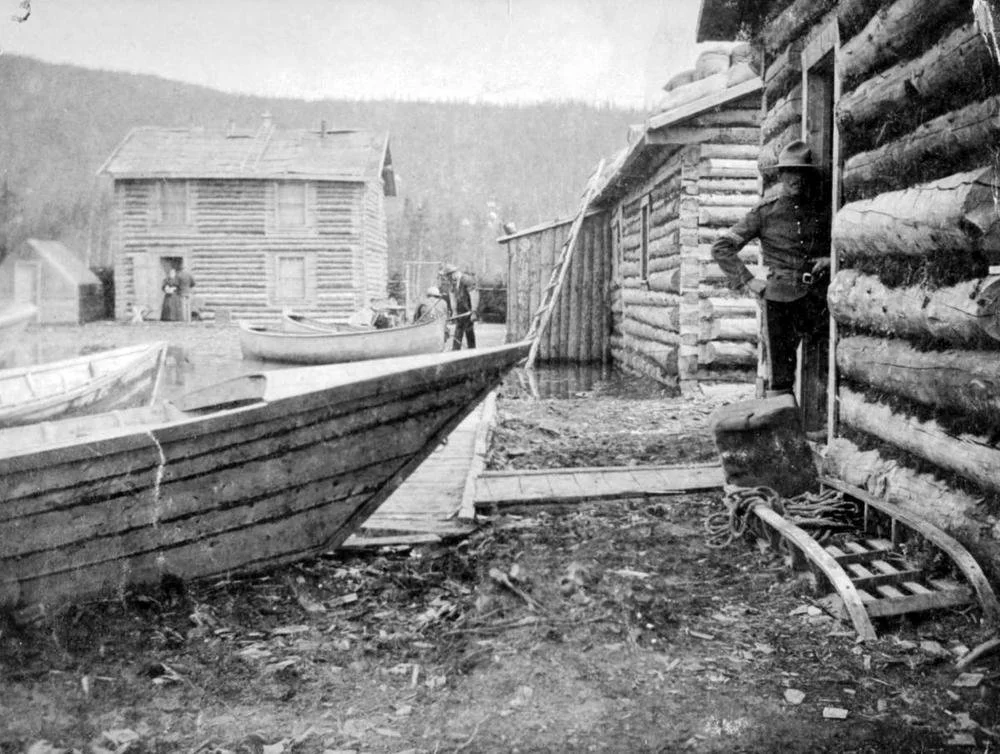
To keep safe the more than $1 million in cash that Doig had hauled in, the money was kept in a locked cell and watched over by a “Corporal’s Guard” in the North West Mounted Police barracks, which was nearby and handily accessible to the new bank. —BC Archives
We are still living under canvas and were it not for the mosquitoes (the Klondyke breed appear to be exceptionally voracious), this mode of living is pleasanter than any other as the weather is becoming very warm and sultry. As getting our meals at the restaurants is out of the question (the price is $2.50), I have engaged the cook who came in with us at $100 per month.
Our supplies are now pretty well down to straight salt pork, bacon, and beans, and although it cannot be said that we are not living on the fat of the land, still it gets somewhat monotonous; however, this will be remedied shortly as several steamers are expected daily with cargoes of eatables...
For your information I may mention that the Government has signally failed in rising to the occasion of successfully governing this new country. Few surveys have been made, no trails have been cut, there are no titles to property, the mining records are so badly mixed up that every now and then a creek is closed to enable matters to be straightened out.

The Customs House where prospector’s bought their mining certificates. As far as Doig was concerned, other than the NWM Police, the federal government’s presence in Dawson as an abject failure. —Vancouver City Archives
The November mail from the outside was delivered since my arrival here, and with the single exception of the excellent manner in which the Mounted Police look after the lives and property of the citizens, making Dawson as free from robbery and violence as any town in Canada, the authorities at Ottawa have made a mess of things generally.
As I have not had all the accounts from Vancouver in connection with the expedition in here I am unable to forward you a statement of the expenses in the meantime.
Acting without instructions from you I have charged the same salaries as each received outside. As Mr. Finlaison, who is doing Accountants work, received less than Mr. Stow, please instruct me in the matter. In arranging the salaries for this inhospitable and unhealthy country, I would suggest that the fact be kept in view that the present staff undertook a dangerous journey in the Bank’s interest, made more so by our pushing ahead when almost everyone else stopped, not being turned from navigating rivers although full of ice flows with occasional jams, crossing lakes over rotten ice where everyone of the party went through time after time and reaching Dawson amongst the first three boats of the season.
Messrs. Finlaison and Stow worked hard and uncomplainingly all the trip, as well as since their arrival here, and it is mainly due to their individual efforts that such good time was made. Altogether they did excellent service for the Bank.
From the inaccessibility it will always be a very expensive place to live in and from my own experience I find $5 does not go as far as $1 on the outside. I would recommend a considerable increase over the Victoria allowance as well as free board.
I have applications daily for loans, usually large amounts $5,000 to $20,000, but have not seen my way to entertain any of them. I think that after getting thoroughly familiar with the Creeks and the Claim owners, a few carefully selected loans might be made with very little risk, and at large rates of interest, 2 or 3 per cent per month.
Since opening we have made over $1,000 in commission. This does not show up as yet at the credit of commission account as the charge for the safe keeping of gold dust is made when we deliver it to the assayer which will be very shortly.
All of which is respectfully submitted, I am, Your obedient servant. Sgd. D. Doig, Sub-Manager.
P.S.-I beg to suggest that when Branches advise us to cash the cheques or sign drafts of any one they should not as a rule be payable at par. People coming in here get used to paying high for everything and we can collect a larger commission here. We may have to cash their cheques or drafts at the beginning of the winter and hold them for six months or so before we can get a chance of sending them out, consequently an outside Branch is not in as good position to know how much to charge to reimburse the bank.
* * * * *
In 1953, the editor of the BM’s Staff Magazine summed up the adventurous David Doig as “one of those able, energetic and shrewd Scotsmen who have contributed so much to the successful growth of the Canadian Banking system,” and noted Doig’s retirement in 1922, his death seven years later.
Perhaps not surprisingly, the Bank of Montreal’s company magazine account of Doig’s Klondike adventures, as given here, are fairly low-key, definitely without any real dramatics. (Thanks, in part, to Doig’s obvious modesty and sense of duty.) Other published accounts were somewhat more colourful upon Doig’s passing in Victoria in June 1929.
His lengthy obituary in the Colonist more successfully captured his character and the highlights of his career: “A life crammed full with romance and adventure and a will to win regardless of the hardships that beset him...”
His death, which came two days after a heart attack, took his friends by surprise as the 70-year-old had always appeared to be hale and hearty. He left his widow Mary and two brothers but no children. Scottish-born and trained in banking in England, he’d arrived in Vancouver in 1884, joining the Bank of British North America in Victoria that same year and, after serving as a ‘paying teller’ and accountant, he was promoted to manager of the Trail branch in 1897.
His career took a decided turn with the excitement of the Klondike gold rush and the BBNA’s decision to open the first bank in Dawson. Even though he spent the first months operating out of a tent, the bank enjoyed “a steady stream of gold” from the start.
Thanks in great part to the fact that, “among the rough element of the Northland, beset with danger on all sides and facing the ever-present threat of robbery, Mr. Doig conducted the branch in a capable manner.”
After several years in Dawson he was re-posted to Victoria and was manager of the city branch when the BBNA merged with the Bank of Montreal. He was popular in local business affairs and an avid cricket fan.
But there was more to David Doig than the dedicated banker and businessman.
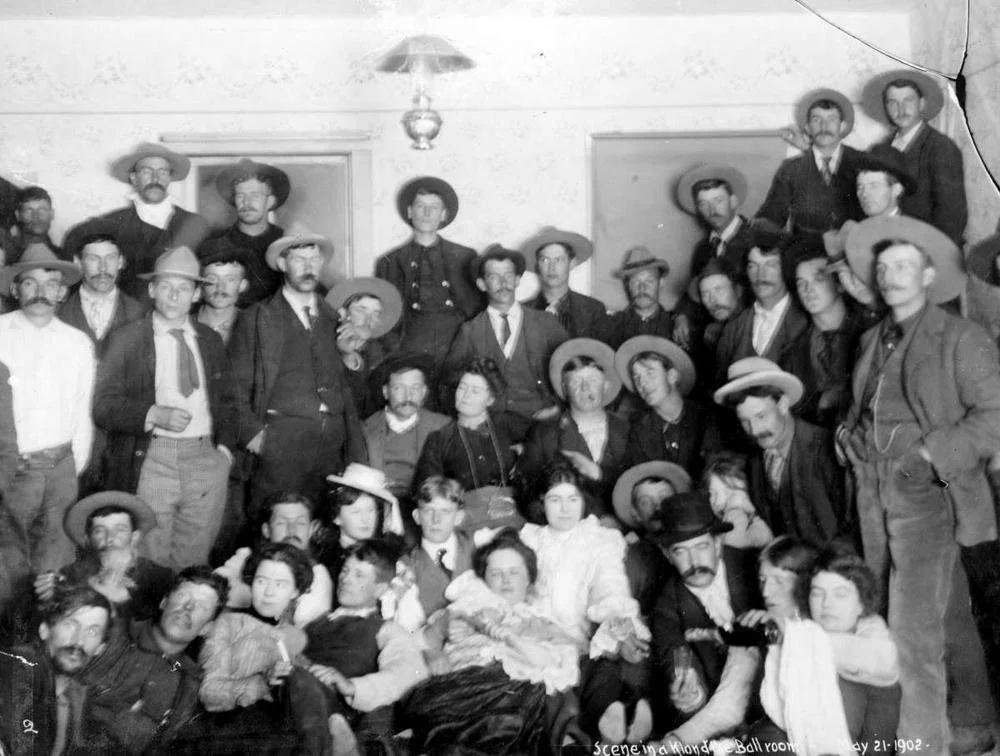
With Doig’s well established reputation for enjoying good company, good whisky and champagne, readers can draw their own conclusions as to whether he also dallied in Dawson’s red light district. —BC Archives
Author Edward F. Bush, in a manuscript written for the National Historic Parks and Sites Branch in 1973, describes Doig as one of the most colourful characters in the Klondike business community—high praise, considering the stories that abound of outrageous and bigger than life Yukon pioneers.
According to Bush, Doig was a “bit of a bon vivant” who liked women and music, enjoyed a pint of champagne with his breakfast, and once had had to be rescued from freezing to death in a snowdrift where he’d passed out after too many whiskies. Whether he, as did many of Dawson’s better-off citizens, availed himself of the services proffered in the city’s brothels isn’t mentioned by Bush or other historians.
Bush quickly adds that this playboy image didn’t affect Doig’s business acumen.
Doig also dabbled in mining by buying shares in a gold claim that turned out to be a rich producer, and, it has been alleged, some of the best loans he made were in his own behalf, not that of his bank.
Questioned about this, Doig told his employers that if they thought they could run the Dawson branch better, to do so, and the subject was dropped. Perhaps this explains his ability to live luxuriously despite the high cost of living in Dawson as he’d itemized in his memoirs.
