
Saluting the Men o’ the Deep
Last week marked another workers’ memorial day when we honoured the 1000s of men and women who have been killed or injured on the job. During the past year, in BC alone, there were 138 workplace deaths.
In Nanaimo, the National Day of Mourning also commemorates the May 3, 1887 No. 1 Esplanade Mine disaster that killed 150 men in a single disaster.
News reports of both events coincided with my writing my newest book about the coal mines of the South Wellington area. In the course of research, I’d found myself checking the Department of Mines’ Annual Reports for 1959 and 1960.
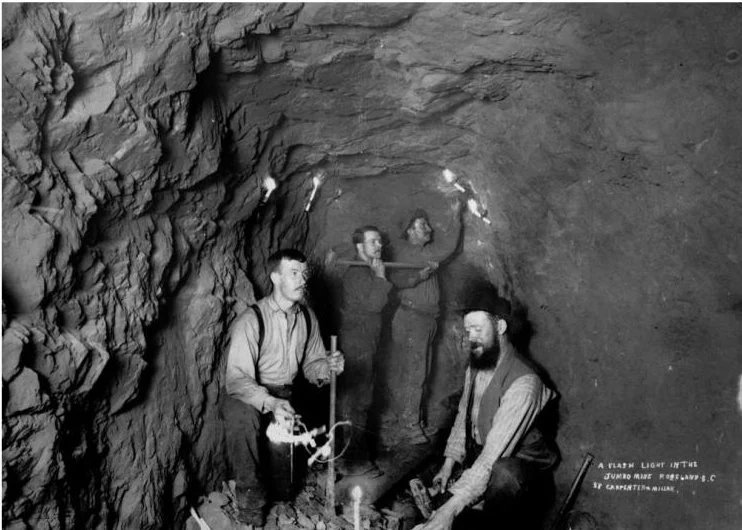
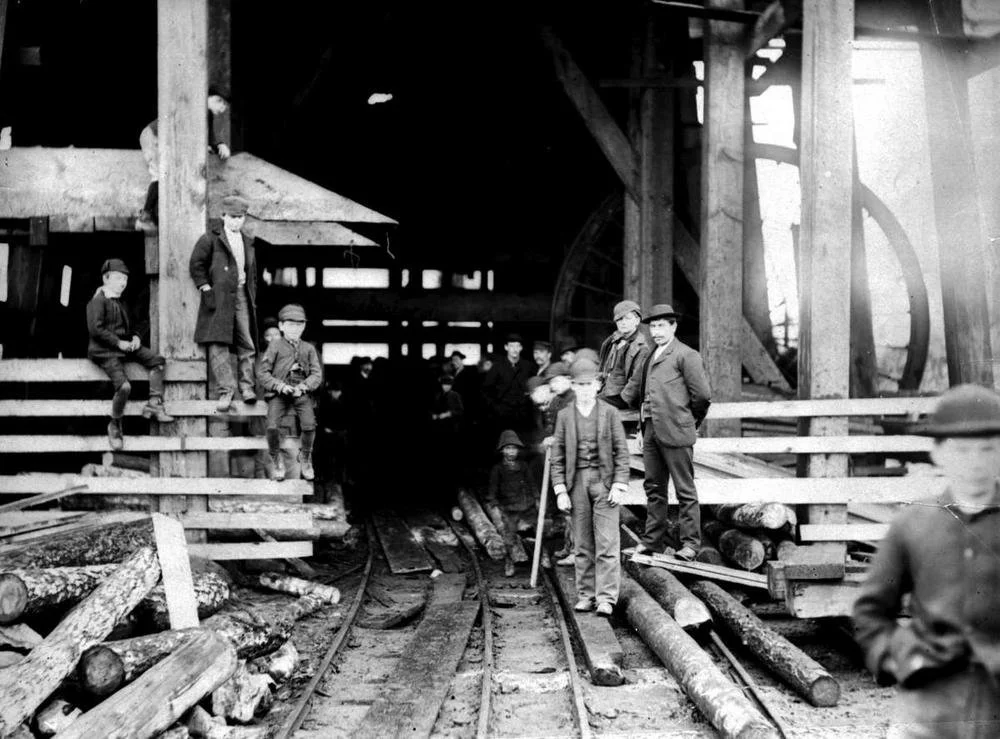
Does no one remember the men who daily risked their lives underground? Did they have to get themselves killed or maimed to get their names in the provincial mining reports? —BC Archives
I was looking for something else altogether, but my attention was drawn by the workplace accident reports for those two years. There are pages of them—more than 16,000 words in total—the equivalent of six weekly BC Chronicles!
What struck me most, besides the seemingly never-ending list of accidents and their multitude of causes, many of them fatal, was that 1959 and 1960 are within the memories of some BC Chronicles readers. We’re not talking ancient history but within our own or our parents’ lifetimes. Somehow, that makes it more immediate and personal, at least for me.
Mining was, always has been, and still is, a dangerous job, perhaps even more so than those of a peacetime soldier or a police officer. What follows isn’t meant to be morbid or a simple litany of tragedy.
Rather, I’m hoping readers will interpret it as it is intended—as a tribute to those who’ve chosen mining as an occupation; this includes quarrying and oil drilling. BC has been built on the bones of our pioneers.
Because of obvious space limitations, I’ve selected and slightly condensed just a few of the accidents recorded in 1959. Readers will note the variety of causes and, alas, some cases of human error. They’re reminders that those of us who have been blessed to lead more sedentary—and safer—lives should count our blessings.
* * * * *
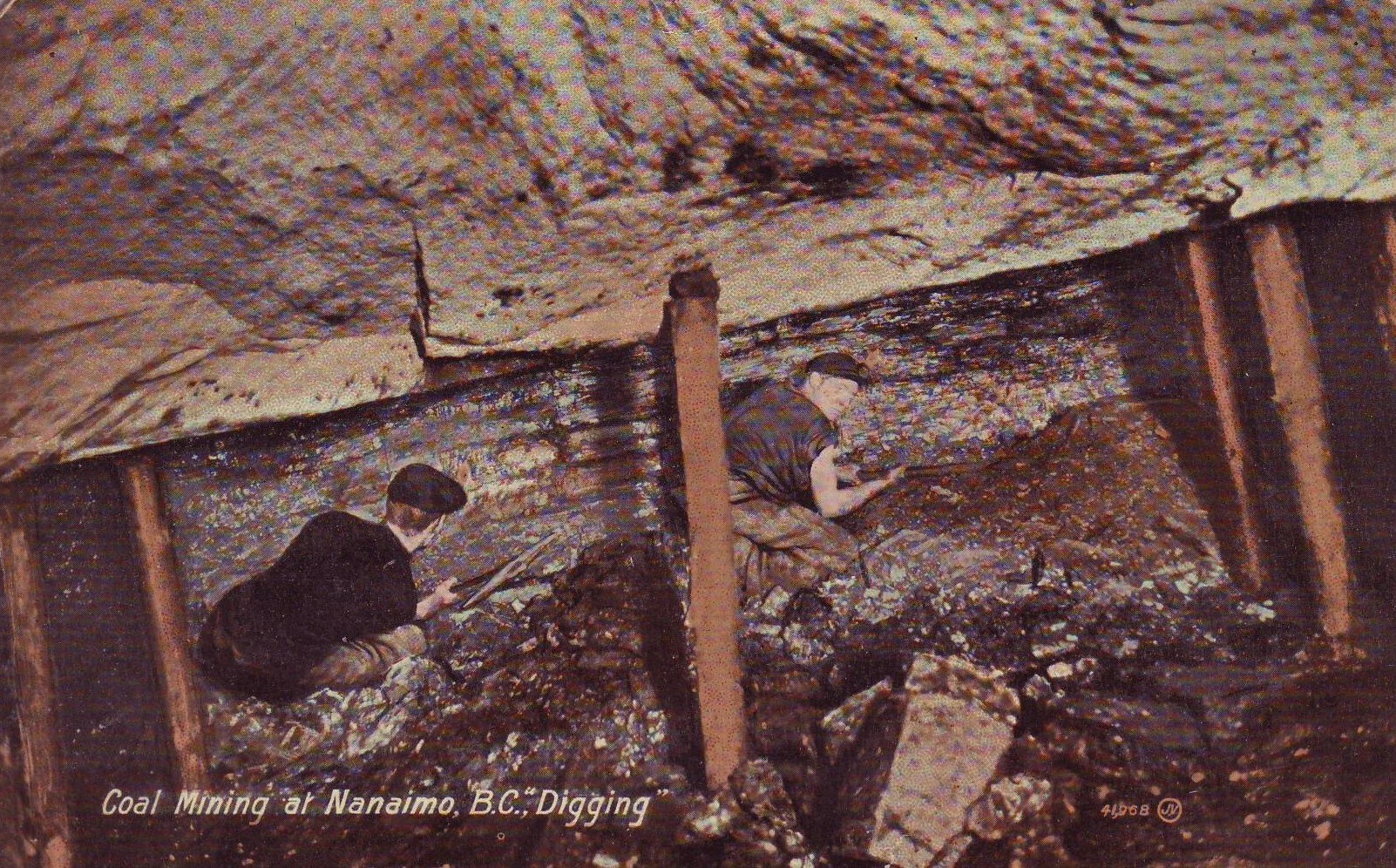
Do you wonder that it was dangerous to work underground? —Author’s Collection
Adelard Bouillion, aged 39, married, and employed as a miner by Torbrit Silver Mines Ltd. at the Toric mine was killed in a snow and rock slide on the surface railway on April 7th, 1959, at about 1 p.m. The surface railway...extends along the side of a mountain slope for a distance of about one-half mile from mine to mill. It is of 2-foot gauge and is covered with a snowshed for its entire length.
On the day of the accident. the train crew was making its second trip from the mill to the mine. Adelard Bouillion was riding as switchman in the first car of a five-car train of empties when a slide of snow and rock crashed down on the snowshed, collapsing the shed around the first two cars. The motorman saw Bouillion stand up and endeavour to shield himself with his arms before he was buried by debris.
The motorman tried without success to reverse the train. Help was then obtained, and in about 20 minutes Bouillion's body was uncovered, but there was no evidence of life.
About 40 feet of snowshed was carried away by the slide. A slide had occurred in this area about eight years previously and one in March, 1959, but the main problem has been the removal of heavy snow from the snowshed rather than slides. In March a reported 12 feet of snow had fallen, accompanied by some rain. On the day of the slide it was warm and the snow was melting. A coroner's jury made no recommendations.
Lazo Delic, employed as a mechanic's helper by Cassiar Asbestos Corporation Ltd., was fatally injured while working on a tram-line tower on May 13th, 1959, at about 4 p.m. [He] had been detailed to grease the sheave hub on No. 5 angle station of the tram-line. This sheave is 15 feet in diameter and is installed horizontally in a steel tower 82 feet above the ground. To grease the hub, the procedure is to climb the ladder to the top of the tower, unscrew the grease cup from the hub, and then fill and replace it. Access to the fitting is from above the sheave and directly over the spokes via a steel channel 8 inches wide.
There were no witnesses to the accident, but apparently Delic was in the process of replacing the grease cup when in some undetermined manner he fell or slipped into the spokes of the sheave wheel, which was in rotation. He was carried around and fatally crushed between the spokes and the tower components.
The body was found about 20 minutes later, but death could be presumed to have been sudden. All tram-line workers had been instructed not to work on the towers when the tram-line was in operation. The deceased had had experience the previous year on tram-line towers and was regarded as a capable worker and a good climber. The coroner's jury returned a verdict that Lazo Delic met his death by accident and no blame was attached to anyone.
Edward Rejman, aged 48, single, and employed as a trammer, was fatally injured at the Mineral King Mine, Toby Creek, at approximately 11:20 p.m. on May 25th after being buried under a comparatively small quantity of rock. Rejman, acting as trammer and motorman on No. 6 level, was loading two 2-ton-capacity side-tipping V-type rocker cars...at the time of the accident, assisted by a scraperman.
After loading one car he had to clean a small amount of spillage of muck from between the wheels of the loaded car prior to moving. He leaned over between the car and the chute, and while so doing the hopper of the car tipped over, completely burying him with muck from the car, with the exception of a portion of his legs. His partner, who was standing at the other side of the car, tried to right the car and remove some of the muck from Rejman.
He failed to do so and had to summon help. Rejman was released 15 minutes later, but showed no sign of life on his release. He did not respond to artificial respiration, which was applied for approximately two hours until the arrival of the doctor from lnvermere, who pronounced him dead.
It is suspected that the locking device on the hopper was not properly set prior to loading the car, and the deceased, in leaning over to clean the spillage from the rail, grasped the top of the hopper, and in so doing caused the hopper to tip.
The locking device was checked after the accident and was found to be in working order. The checking of the locking device would be done by the deceased, as he was in charge of the loading, and his partner had only been sent to assist him. The coroner's jury returned the verdict that Rejman had met his death as a result of suffocation and no blame was attached to anyone.
William Stanley Austin, aged 33, married, and employed as a miner by Giant Nickel Mines Ltd. near Hope, died in Vancouver on July 18th, 1959, as a result of severe pelvic injuries received from a fall of rock in the mine on July 9th, 1959... Austin, in company with two other miners, entered the stope on the day shift...and they commenced examining the place, scaling down loose rock, and washing down.
At about 9.05 a.m. a large rock fell on Austin and one other miner, seriously injuring them and rendering them semi-conscious.
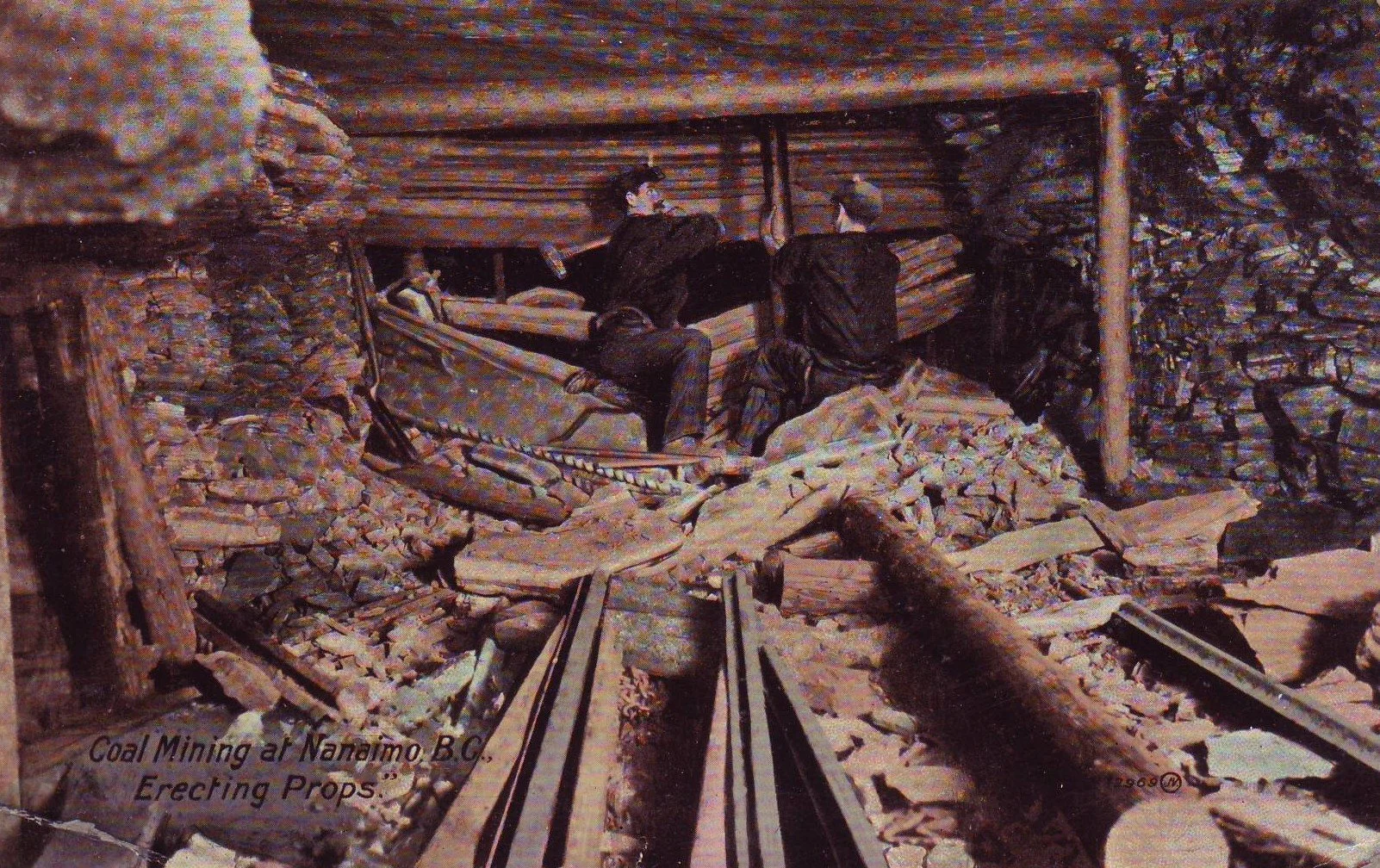
These miners are setting props, just one of the many dangerous tasks they performed daily. —Author’s Collection
The shiftboss was immediately notified, help was obtained, and the men were taken to Hope and later to Vancouver. According to information obtained from the uninjured miner, who was washing down at the mine, both injured men bad begun to scale the back of the stope, but experienced great difficulty in barring down one piece of rock...
They tried for some time to get it down with their 8- to 9-foot scaling-bars, but without success. It would seem that they then gave up for the time being and continued to scale other loose rock nearby. While doing this, they evidently stood under the above-mentioned rock, which fell without warning a distance of about nine feet. It broke into three or four pieces, but later measurements indicated it was approximately 5 by 21 feet by l-foot and weighed about 500 pounds.
The coroner's jury found that death was accidental, but made the following recommendations:
The mining regulations contain a provision stating that if loose rock cannot be brought down by a scaling-bar, blasting-powder must be used.
A man be designated in charge of safety practices in a work area consisting of three or more men.
Where piecework is being carried out, safety regulations be strictly enforced.
In the future, all witnesses to accidents be required to make a statement as soon as possible.
Victor E. Warren, aged 36, married, and employed as a miner at the Bralorne mine, was fatally injured during shaft-sinking procedures in the Queen shaft on August 18th at about 7:30 p.m...
The shaft is mucked out with a Cryderman mucker... The muck is hoisted by sinking-bucket to No. 32 level, where it is dumped into a pocket, from whence it is hoisted up the main section of the shaft and distributed as fill in the stopes.
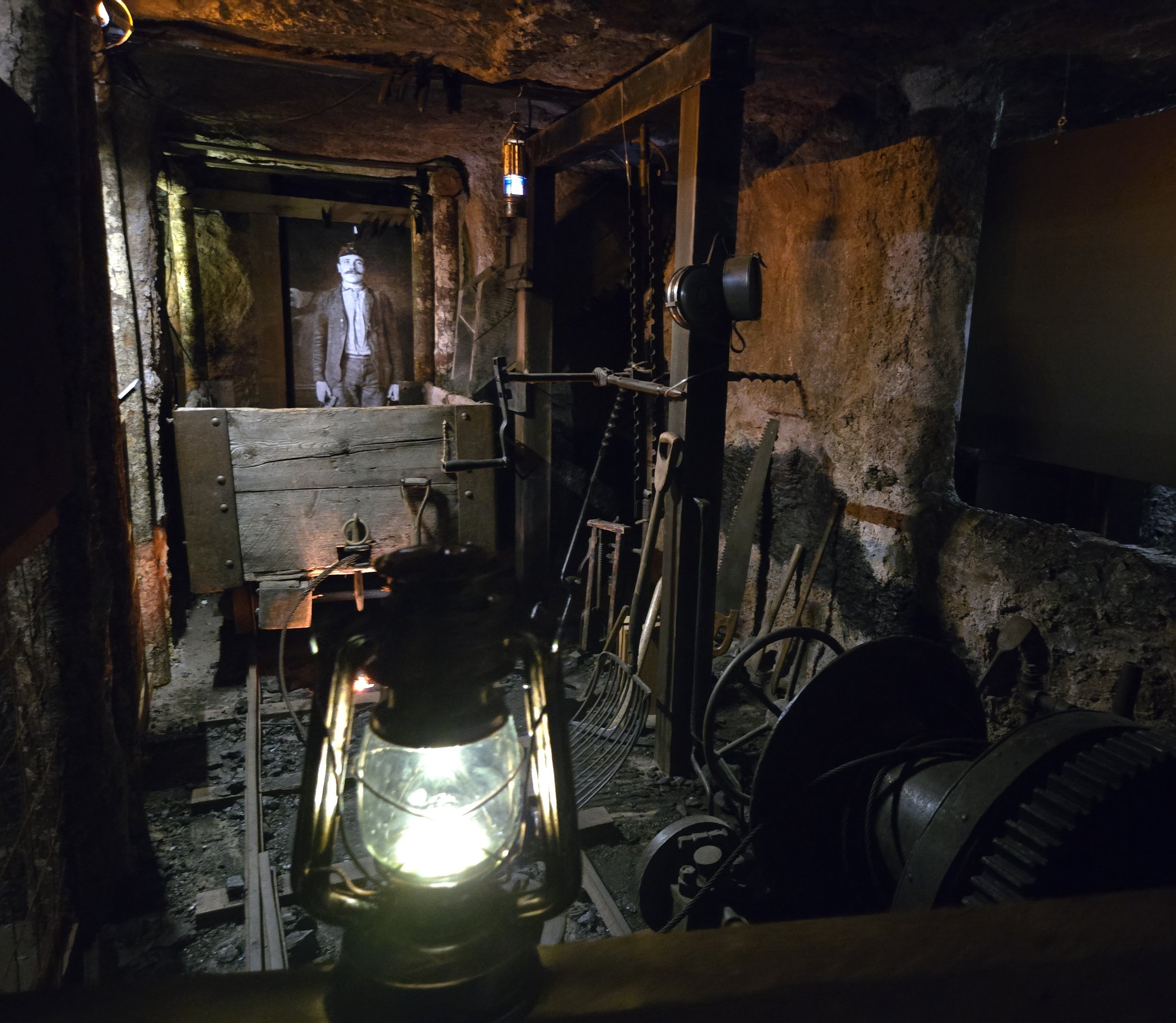
This realistic display in the Nanaimo Museum gives visitors a sense of the claustrophobic conditions of working underground in a coal mine. —Author’s Collection
The sinking is carried on on two shifts. On the night of the accident the crew consisted of the hoistman, the shaft leader, the deceased, and two other miners. At the beginning of the shift, the hoistman lowered the other four men in the bucket. Two men remained on the blasting set, while the shaft leader and Warren descended farther in the bucket to scale the shaft from the blasting set downward. Warren was standing on the lip of the bucket, steadying it, while the shaft leader was using the scaling-bar and standing on the floor of the bucket.
The safety crosshead, which normally provides effective cover over the bucket, was in the chairs three sets above the blasting set. The bucket was about 12 feet below the blasting set when a quantity of rock sloughed from the side of the shaft 80 feet above. It was deflected by the crosshead and then struck the men in the bucket. Warren was knocked 25 feet to the shaft bottom, while the shaft leader suffered considerable head injuries.
Good rescue work was immediately carried out, but Warren died at 9:15 p.m. in the Bralorne hospital... Death was due to multiple skull fractures and brain hemorrhage, with the injuries resulting from a fall rather than from a blow on the head.
The shaft was well timbered throughout, and catch-alls had been built at intervals to catch any small pieces of loose rock. The sides of the shaft were not lagged, as the rock was diorite, which is usually sound. However, the rock fall occurred from a position where a dyke crossed the shaft. This area, as well as the rest of the shaft, had been inspected by both the shaft captain on the previous shift and the shaft leader on the shift when the fatality took place. Both were experienced men.
The coroner's jury returned a verdict that death was accidental, with the recommendations that the lining of the shaft be kept closer to the working area, and that a safety belt be used by the man on the rim of the bucket while scaling down.
Carl Ernest Weber, aged 39, married, and employed as a motorman in tbe Aurum mine of Cariboo Gold Quartz Mining Company Ltd., was fatally injured in a haulage accident on September 3rd, 1959, between 2 and 3 a.m. The accident occurred on the 4000 level, which is the main haulage level of the Aurum mine and is an adit level...
Weber had been employed regularly on the night shift, which was from 7 p.m. to 3 a.m., and his job was to take empty cars in, load them at the chute, and bring out the full cars to the surface. Weber was seen by the shiftboss at the beginning of the shift, and at that time he appeared to be in a normal state of health. The last person to see him alive was the cage-tender, who stated that at about 2 a.m. he saw Weber loading a car.
You didn’t have to go underground to get killed in a mine, you could be drowned, buried alive in snow, be pinned in the cab of your overturned truck, be crushed by a falling tree... —BC Archives
Shortly after 3 a.m. the shiftboss noticed that Weber had not come out with the others at the end of the shift. At 3:20 a.m. he was found at the chute, still on the seat of the locomotive, but dead from severe head injuries. A doctor was on the scene by 3:50 a.m., when death was officially pronounced. Later evidence indicated death was due to extensive skull fractures and hemorrhage... It was evident that at the time of the accident Weber was bringing a train of empty cars into the mine, there being six cars in front of the locomotive and six behind.
It is necessary for the motorman to lean forward as the locomotive passes under the chute, as the chute projects and the operator's seat on the locomotive is on the same side as the chute. In this case it was clear that for some reason Weber had failed to do this, and, as a result, when he reached the chute his head was knocked backward and was partly crushed between the chute lip and the battery box of the locomotive.
After the accident, the locomotive was found just beyond the chute with the control lever in the neutral position. It seems probable that Weber's hand must have pulled the control lever into neutral as the accident was happening. An inquest brought in a verdict of accidental death with no blame attached to anyone, but with the recommendation that the locomotive seat be remodelled.
The list of fatalities goes on:
Wilmot Swann, aged 34, married, and employed as a timberman at the Sullivan mine, Kimberley, died at the Kimberley hospital at 1 a.m. on August 1st as the result of pelvic and internal injuries received in a train collision in the mine on July 28th.
Walter Maitland Cassidy, aged 50, married, and employed as a truck-driver at the Beale quarry of Lafarge Cement of North America Ltd., was presumed to have been drowned, September15th.
lver I. Sallows, aged 26, widower, and employed as a miner at the Britannia mine, was killed by a fall of rock on September 22nd between 9 and I 0 a.m.
Peter Matiowsky, aged 27, single, and employed as a truck-driver by Mannix Company Ltd. at the Empire Development operation, Port McNeill, met his death by asphyxiation, October 3rd, when pinned in a cab of an overturned Euclid truck.
Willi Walter Bruno Greiser, aged 43, married, and employed as a motorman at the Bralorne mine, was fatally injured on October 14th, 1959, about 4 p.m. in a fall from the cage in the Crown shaft when it was hoisted unexpectedly.
Antonio Di Meo, married, and employed as a driller in the Quarry Bay limestone quarry of Rayonier of Canada near Jeune Landing, was decapitated by a fall of rock on October 13th.
Maxwell Godkin, aged about 23, single, and employed as a prospector by Vimy Exploration Ltd., was killed by a falling tree while working on road construction near the Adams River mineral claims near Sayward, on October 27th.
Nelson Shiosaki, single, a logging contractor under contract to West Columbia Gold Placers Ltd., was presumed to have met his death by drowning in the Columbia River near Mile 57, Big Bend Highway, November 11th.
Thomas Bahrynowski, aged 26, and employed as a tractor operator at the Cassiar Asbestos Corporation mine, was fatally injured when the tractor he was driving went off the mine road and rolled and slid about 280 feet to a switchback below on November 19th, 1959.
Colin L. Faircrest, aged about 45, married, and owner and manager of Rupert Drilling and Exploration Co., was fatally injured by a fall while moving a diamond-drill machine on December 9th on the Ford Iron claims on Blacksand Creek, a tributary of Zeballos River.
Peter Vraa, aged 51, single, and employed as a miner at the Aurum mine of The Cariboo Gold Quartz Mining Company Ltd., was fatally injured by a fall of rock on December 30th.
* * * * *
Besides these fatalities, there were 141 serious accidents recorded in BC coal and metallurgical mines, quarries, etc., in 1959. I’ve cited just a few as recorded in the Annual Report to give readers the barest idea of the varied circumstances that killed miners.
These weren’t great explosions, fires or poison gas that killed as many as 150 men at once and made headlines and history. Rather, these were single tragedies that claimed the lives of men whose names, had they lived to go home at the end of the day, would never have been entered into the records.
Such is history.
