
So Many Stories, So Little Time
Okay, hands up, those of you who think that history is dull.
If you raised your hand—why are you reading this?
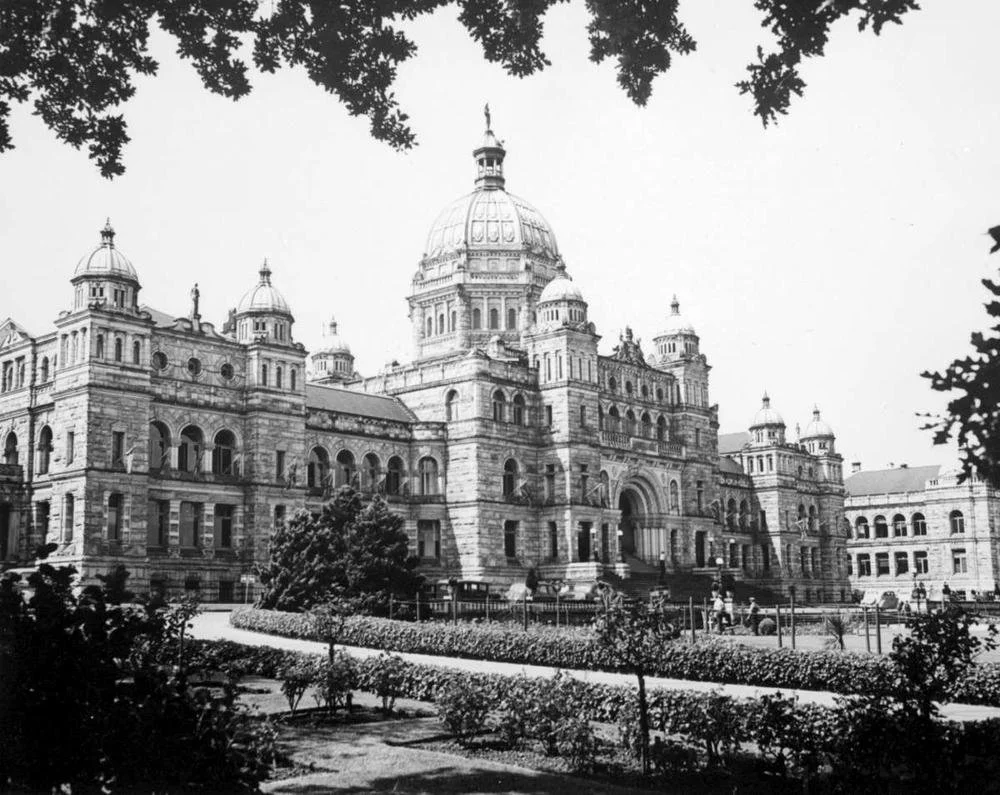
The buck (at least the correspondence) stopped here, in the attorney general’s office in the Parliament Buildings where letters were filed under headings that, today intrigue the historical researcher. —BC Archives
In last week’s BC Chronicles I promised to prove to skeptics once and for all that history is anything but boring. Guaranteed or your money back!
* * * * *
How, you ask? It's easy. I'm going to use a single example—in this case the incoming correspondence files of the BC Attorney General's office.
I don't even need to provide you with the contents of any of the 1000s of letters on file, just the headings that anonymous government clerks attached to them for easy identification. All files were given official numbers, of course, but the trick was to condense their contents into a single concise heading that summarized their subject matter in a way that would be meaningful to someone wanting to retrieve the file at a later date.
What follows is just a sampling of these long-ago entries.
Most of the letters were written by government officials, officers of the court and officers of the BC Provincial Police, 1873-1905. Why that period? Because that's as far as I got after two lengthy research sessions in the provincial archives.
I should explain that the Attorney General's office oversaw the courts, the police, the penal system, “lunatic asylums,” public safety and public health, the latter when it came to enforcement of hygiene standards and dealing with outbreaks of contagious diseases.
So let's get to it. Pretend you're reading a newspaper. Would the following headlines and subject references not grab your attention?
How about “Starving prisoners at Victoria,” in 1874? Or an 1875 police file titled, the “Looking-Glass murders,” or “Prisoner charges for use of his own wagon,” “Gold in Sooke River,” or “Complaints about investigation into death of Thomas Poldur, seaman, at Wellington” (1879)? Or “Dewar’s body found buried in Smart Alec’s cabin, Cherry Creek” in 1862?
The imagination literally leaps into high gear with “Lucy Fisher's feather bed.” (Don’t look at me, a file clerk in Victoria wrote this in 1883!)
We're reminded of our dark past in our approach to crime and punishment by “14-year-old boy on New Westminster chain gang”. That same year, it was decided that an “Irish turnkey [was] unsuitable for Victoria jail,” and we're intrigued by such entries as “Exploits of Crazy Johnny,” and “Shallow Chinese grave on old Departure Bay Road.”
In 1890 there was an “Outbreak of pig cholera or typhoid at Nanaimo,” and the “Riot Act [was] read to Wellington miners” the following year. Father Cherouse was “sentenced to one year for Indian whipping” in 1892, and “Mr. P.M. Butler [was] killed in bear trap at Departure Bay”.
There were “Protests against stinking corpses in Trounce Alley,” in Victoria in 1893, and an up-coast constable named Mike Manson considered “Burdock Blood Bitters an intoxicant” in 1894. Nanaimo Justice of the Peace JP Planta was noted as having settled some monetary situation with the Crown in 1895 with the laconic heading, “pays up”.
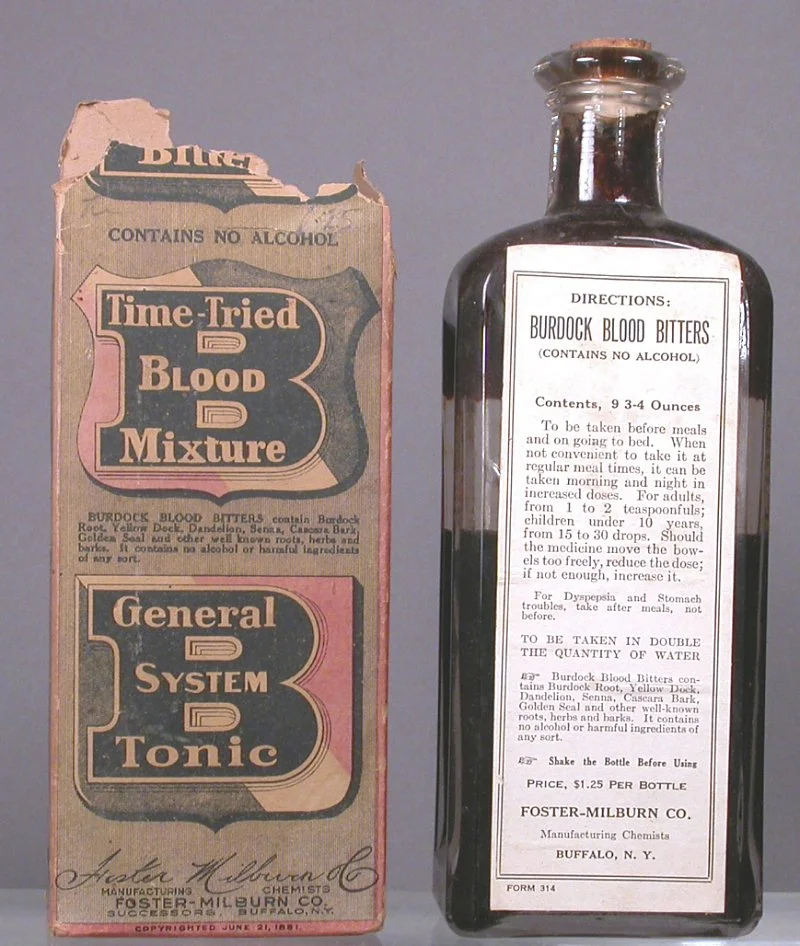
It was commonplace for so-called patent medicines to contain alcoholic—or worse—ingredients. So BC Provincial Police Const. Mike Manson may be forgiven for considering Burdock Blood Bitters—marketed by the T. Milburn Co. from 1877 on as a “blood purifier”—to be an intoxicant. Ironically, he was wrong, if we can believe the ingredients listed on the bottle: Burdock root, yellow dock, dandelion, seneca, cascara bark and golden seal.
There was the case of the “Tyrannical mother-in-law,” and an outstanding mystery was put to rest: “Remains of Henry Woods found—given to medical student," in 1897.
In 1898, the second year of the Klondike gold rush caps, “Pirates [were] held at Nanaimo,” and 1899 was marked by “Sad story of death of three miners.”
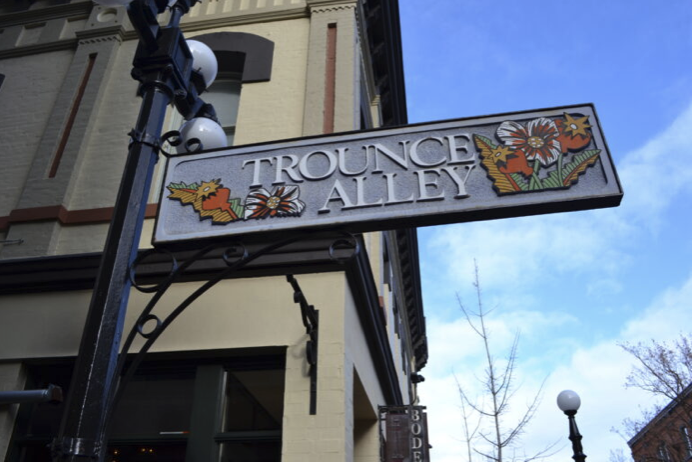
Today, it’s a popular Victoria tourist attraction; back in 1893, the attorney general’s office received “Protests against stinking corpses in Trounce Alley”.
In 1900, there was a “Plot on Parliament Buildings,” but police were even busier in 1901 with “Sentry shoots naval officer," “Hocking bigamy a sad story,” “Peter Trainor’s strange death, Telegraph creek,” “Chinese man runs amok; Ah John kills four in Ladner,” not to mention “Hangman Radcliffe letter,” “Joseph Tarlton's cruelty to a horse, Koksilah,” and “Shooting near naval hospital, Esquimalt”.
A year later, Provincial Police had to contend with a “Crooked American sheriff,” “Witchcraft murder of children at Telegraph Creek,” “Bullets hit war ship near navy hospital, Esquimalt,” and “Mine superintendent’s house shot at, South Wellington.”
Also, much to the BCPP’s embarrassment, there's the file, “Police Constable William Brent in disgrace for cohabiting with prostitute Mary Wilkins at Camp McKinney”.
Crofton settler George Lilley was cited for his “Cruel treatment of orphan Bertie Wilson at Osborne Bay,” and “Louis A. Drover [found] millionaire uncle, Richard Elliott Herrick in insane asylum”. There was official concern “Regarding light sentences for miners having matches in the [coal] mines,” and a hangman was “wanted for Paquette”. Executioner Radcliffe always wanted more money, it seems, this being a recurring theme in the A-G correspondence; perhaps the “Expenses of scaffold repair” accounted for some of his needs.
In 1903, at Chemainus, “Leyland Berrow [ran] away from abusive father,” and, at Trail, “Chinese Ray and Me We were charged with rice tea murder”. “John West’s treasure” was found at Snow Creek, the “wives of Jeffery brothers [were] convicted of sheep stealing,” and “hungry herder George Brown, stole a calf from his employer’s herd at Kamloops”.
What was a clerk thinking as he wrote that an Indigenous child had been “buried alive”?
And, in 1905, another civil servant tersely noted that a prisoner's sentence of “160 lashes [was] reduced to 40”. “Wild Alec murders Hopkins” whets the appetite for more details, and “Sunday baseball at Chemainus” reminds us that there were strictly enforced laws restricting many activities on the Sabbath.
And, speaking of matters religious, there's the entry, “Clergyman's house searched in Mill bay.”
I could go on but I rest my case.
I've hardly scratched the files in Victoria and, in due course, some of these fascinating headlines may become full-fledged Chronicles. Until then, I'll close with my favourite file heading to date, this one from the 1891. Surely the unknown official in the Attorney General's office was smiling, or at the very least had a twinkle in his eye, as he penned, “Spencer complains of being called a ‘long-legged Yankee son of a bitch.”
Do you still think history is dull? If you do and want to take me up on my “guarantee,” sorry, I’ll plead literary license. Or temporary insanity.
* * * * *
As this week’s Chronicle is shorter than usual, I’m going to throw in this nugget as further proof if necessary that history, i.e. ‘truth,’ really is stranger than fiction.
It’s a Canadian Press report by Beth Leighton in September 2018, headlined, Sasquatch suit proves unconvincing:
VANCOUVER - A lawsuit that claimed the B.C. government has committed a “dereliction of duty” by failing to protect the Sasquatch as a threatened or endangered specie has been thrown out by a court.
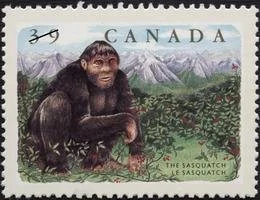
For all you doubters out there, Sasquatch really does exist—on this Canadian postage stamp!—thecanadianencyclopedia
Todd Standing, who describes himself as a wildlife expert and filmmaker, claimed officials within the B.C. Fish and Wildlife branched don't acknowledge the existence of Sasquatch and infringed on his rights as they relate to his concerns regarding the “primate, also known as Bigfoot”.
In response the province called the lawsuit “frivolous,” “an abuse of process,” lacking “an air of reality,” and applied to have the case dismissed, saying Standing’s statements of fact are incapable of proof.
In his judgment posted online Tuesday, B.C. Supreme Court Justice Kenneth Ball finds no issue with B.C.’s lack of Sasquatch recognition, ruling that no duty was owed to Standing to support a view on the existence of any creature.
Ball finds none of Standing’s legal rights have been breached by the province and approves the application to reject the lawsuit, ruling the action has no reasonable prospect of success.
Standing had claimed B.C.’s position breached several of his charter rights, including the right to equal treatment regardless of personal characteristics, but Ball wrote: “A belief in the existence of the sasquatch is not an immutable personal characteristic.”
In striking the claim, Ball also ruled it could not be amended and resubmitted, and he ordered Standing to pay the government legal costs.
Last October, the province said, Standing filed another claim, in Golden, against the Ministry of Environment seeking legal proof that the sasquatch exists and that he could lead groups to interact with that. The province said it was never served with the action.
* * * * *
How could I make any of this up? —TW
