
In Search of a George Cross
(Part 1)
"The KING has been graciously pleased to approve the award of the George Medal in recognition of conspicuous gallantry in carrying out hazardous work in a very brave manner."
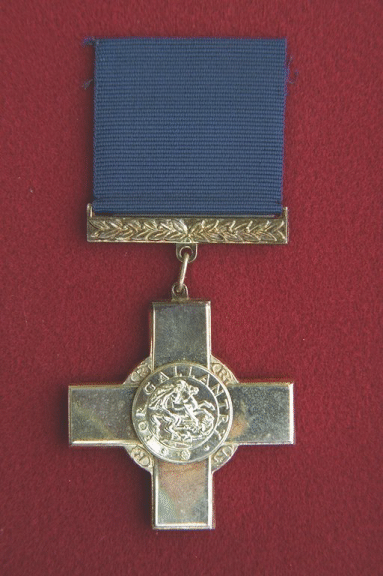
Think of it as the non-combat equivalent of the Victoria Cross, the highest award for gallantry in the British Commonwealth.
To date, 77 Canadians, military and civilian, have earned this distinguished recognition of valour. I’ve been trying to nail down one in particular that was awarded for heroism in the deadly crash of an RCAF bomber at Comox airbase in the early 1950s.
But it’s not listed in the official George Cross Register.
* * * * *
My interest in this story was piqued way back in November 2007 when Oceanside Star editor Brian Wilford emailed me with the suggestion that an attached news story “might be a column for me someday”. Well, here’s the day, and here’s what Brian sent:
“888 (Comox) RCAF Wing of the Air Force Association of Canada will host a reception this Saturday, Nov. 24, in honour of Robert Thomas (Bobby) Waters who was awarded the George Medal for his actions following the crash of an Air Force Lancaster that were instrumental in saving the pilot’s life on that date in 1952.
“Waters, who recently passed away, was not quite 14 years of age at the time, and his widow has graciously donated the medal to the Comox Air Force Museum for permanent display.
“Waters was the youngest person ever awarded the George Medal which at the time was the second highest award for bravery that could be bestowed on a citizen of a British Commonwealth nation...”
The report went on to describe the medal as a significant acquisition for the museum and it was anticipated that “a large contingent of distinguished guests,” including the pilot, local politicians, veterans and serving members would attend.
Fast-forward (well, maybe not so fast) to a few weeks ago when I was sorting through and filing some of the too many emails and newspaper clippings that have piled up over the years. Those that led to a story have been filed accordingly, but 100s of what I call nuggets—one-offs—defy an orderly file system and, homeless, just pile up.
But back to the story of young Bobby Waters’ George Cross.
It so happens that I have registers for both the Victoria and the George medals in my library—but no luck there, so I set Brian’s email aside and completely forgot about it until it turned up recently. This time I tried Google, which gave two hits. Robert Waters’ obituary in the July 12, 2007 Ladysmith-Chemainus Chronicle noted that he was born January 15, 1939, and he passed away peacefully at his home in Chemainus, July 12, 2007. He and Anne, his wife of 45 years, had no children.
But there, amid the list of surviving relatives and “heartfelt thanks to the doctors and nursing staff of the Cancer Clinic in Victoria, the doctors and nursing staff of the Cowichan Hospital,” and others, was what I was looking for—the Bob Waters who’d “worked in the Chemainus Sawmill for years, longshored, and later operated a crane for Seaspan at the Crofton Mill”--the young Comox hero of 1952:
“As a teenager of 14, Bob was awarded the George Cross Medal (for Bravery) for the saving of 3 Air Force men from a burning plane in 1953, being the youngest to receive this Medal. He was also named ‘Canadian Teen of the Year’ in 1953.”
But I wasn’t done with Google; I keyed in “RCAF Lancaster crash, Comox,” and learned that an Avro Lancaster 683, Registration KB 940, crashed on Nov. 24, 1952 with a crew of four and six passengers, of whom eight were killed:
“During an instrument approach to Comox Airbase, while flying in poor weather conditions, the aircraft went out of control and crashed in a swampy area. All seven [sic] passengers were killed while both pilots were injured. It was later confirmed by the RCAF that the Lancaster was scheduled on this flight to replace a Canso that suffered an engine failure earlier that day.”
The crew were identified as F/Officers Ruff F. Johnson and Monte J. Wright; pilot and co-pilot, with F/O Joseph Frederick Doucette, navigator and Cpl. George Stanley Fletcher, flight engineer. Of the six passengers—F/Sgt. Joseph Leo Laurier Maynard, A1c Vernon Joseph McIntyre, Cpl. Freeman Archibald McKay, A1c Wayne Frederick Smith and Ac1 Roy Howard Walsh—only Malcolm G. McLeod was a civilian.
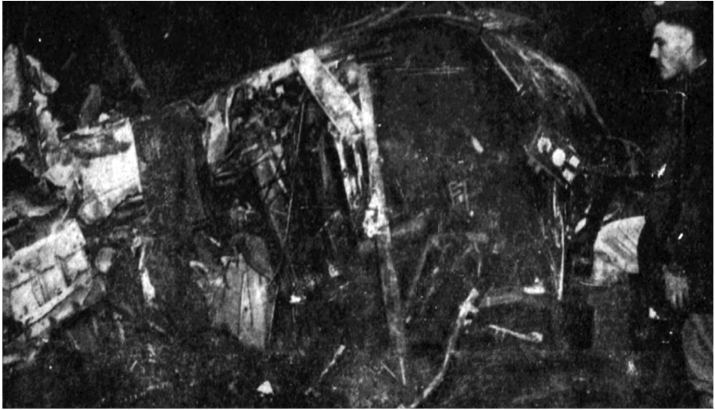
It’s hard to believe that anyone survived this tragedy.—Bureau of Aircraft Accidents Archives
According to https://www.101nisquadron.org/cairn-projects/the-story-of-lancaster-kb-940/, this aircraft was delivered to 407 Maritime Reconnaissance Squadron in August 1952, shortly after Comox airbase was reactivated from caretaker status in which it had been placed at the end of the Second World War.
At 4:56 p.m., on the afternoon of Nov. 24, the Comox Fire Department received a call that a bomber had crashed in a swampy area 800 feet west of Kye Bay Road, adjacent to the southern perimeter of the air base. (Now farmland, the crash site is off-limits to the public.)
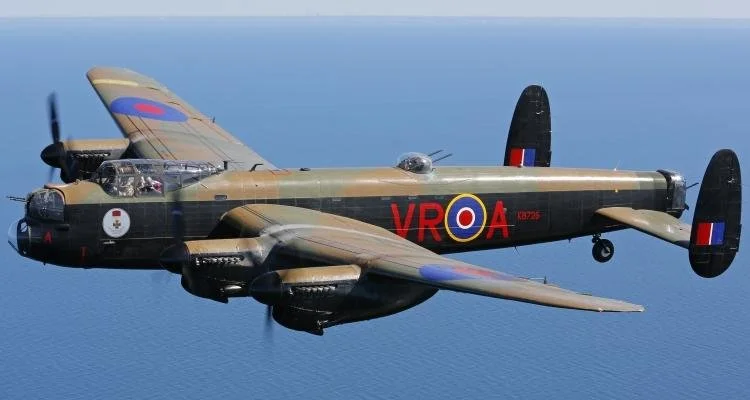
It was a four engine Lancaster bomber such as this that crashed and burned just off the Comox airfield around 5:00 p.m. in November 1952, killing eight crewmen and passengers. —Canadian Warplane Heritage Museum
How ironic—how sad—that there were six passengers aboard. The five servicemen and a civilian had been scheduled to return to Comox on the Canso that had engine trouble, so KB 940 was pressed into doing double-duty on a training flight and as a transport after picking them up in Vancouver. It was while making its approach to the Comox airfield that the Lancaster also suffered engine failure and the crash occurred.
Because Lancasters had a limit of 10 crew and passengers, a seventh airman had been left in Vancouver. He returned to the Island by boat.
According to The Story of Lancaster KB 940, one of those passengers was F/Sgt. J.J.L. Maynard who’d just been assigned to Comox as the NCO in charge of reopening the base maintenance workshops. A metalworker who’d served in the war, he’d re-enlisted in October 1946, and had gone to Vancouver with another airman to rent a Santa Claus suit that he was going to wear at the station’s Christmas party.
Cpl. F.A. McKay, of 407 Squadron, had served in Italy Africa during the war, and AC2 Vernon Joseph McIntyre of Glace Bay, N.S., was just 17 years old. AC2 Wayne Frederick Smith, Lunenburg, and AC2 Roy Howard Walsh, Regina, both 20, had been returning from weekend leave in Vancouver.
Malcolm G. MacLeod, Chilliwack, was a civilian meteorologist who’d recently transferred from the weather office in Winnipeg to be a forecaster at RCAF Station Comox.
F/O Joseph Frederick Doucette, KB 940’s navigator, 21, had just joined the Squadron following training. Cpl. George Stanley Fletcher, 26, the Lancaster’s flight engineer, was approaching his the end of his sixth year in the RCAF.
Both F/O R.F. (Ruff) Johnson, pilot, and F/O M.J. (Monte) Wright survived the crash thanks to their being thrown clear of the burning wreckage and exploding ammunition, the point of this Chronicle about the George Cross.
Okay, thanks to Google, I was in business, but I needed much more, in particular details concerning young Bob Waters’ role as a rescuer. It was time for newspapers.com to earn their pay.
The crash was headline news, of course. First of Victoria’s two dailies to go to press the next day, November 25th, was its morning daily, the Colonist, with a full-width EIGHT KILLED IN CRASH. The afternoon Times followed up with ‘Miracle’ Saves Pilots As Plane Crash Kills 8; Catapult Seat Given Credit.
The Times had the advantage of being able to give the tragedy fuller coverage, spread across its front page, and beginning, of course, with details of the actual crash: “The cockpits of Lancasters have special housing which slides off and falls clear in case of emergency. The automatic mechanism for this apparently worked perfectly in the ill-fated plane, and the impact of the crash apparently catapulted the two pilots out of the plane seconds before it exploded.”
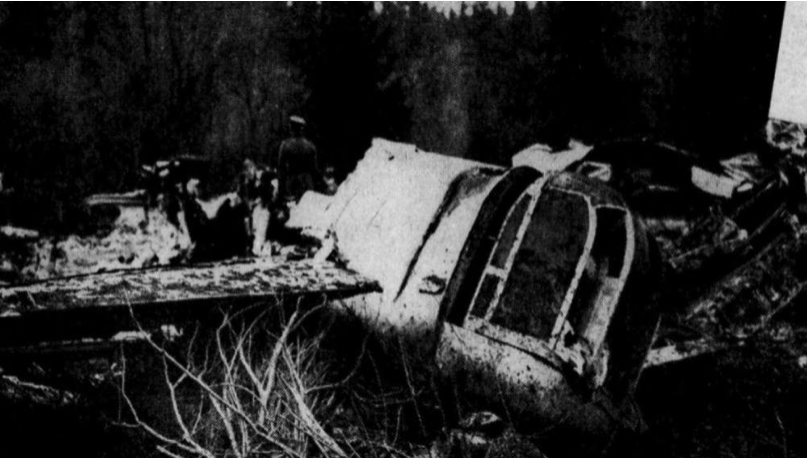
Part of the wreckage after the fire was finally extinguished and the bodies recovered. — Bureau of Aircraft Accidents Archives
This was followed by a list of the victims, which I’d found on Google. What I was looking for was information on the pilots’ rescue, so I moved down the page to the sub-headline, Worker Was Helpless to Aid Plane Members. Now I was learning about a man and his son who’d responded promptly and heroically—but neither of them was Bobby Waters:
“An air force civilian employee [works as [a] steam fitter at the air station]
William Riddoch, Sr., and his 13-year-old son, Clifford, were the first persons to reach the scene of the crash of the Lancaster bomber here late Monday afternoon. The swamp where the plane crashed is about a quarter of a mile from their home on Kye Bay Road. There are no other houses close by.
“”I’d just got home from work, and was getting ready to get out of my clothes when I heard the crash,” he related afterwards. “The boy (Cliff) and I went over right away and my other boy, William Jr., got in the car and went racing to tell them at the station.
“There was nothing we could do.
“I could hear screaming. The plane had exploded and was burning up. I couldn’t get anywhere near. The mud was so deep it seemed I was wading up to my ears. I stumbled across one fellow [either pilot Johnson or co-pilot Wright] and pulled him away. I could hear the [other survivor] hollering somewhere behind.”
Mr. Riddoch later elaborated on the moments before the crash when the bomber passed overhead: “I heard the plane circling around right over our house. I noticed it because the engines didn’t sound right to me. I listened carefully and then I heard the crash and explosion. By the time I got outside the door, flames were leaping high into the air.”
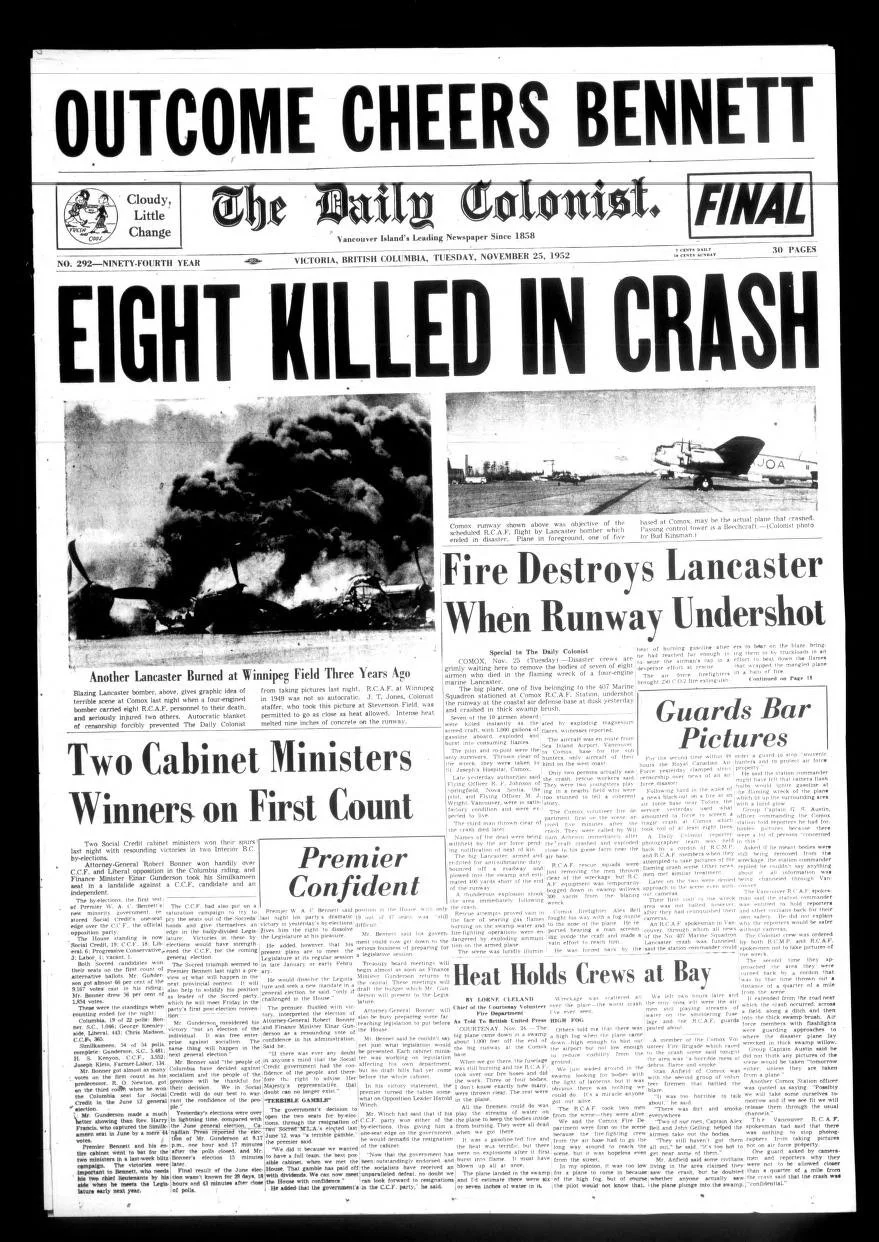
The grim news that met early morning readers of the November 25, 1952 edition of The Daily Colonist. —www.newspapers.com
Air force personnel and members of the Comox fire department responded immediately and were on the scene within minutes, the latter armed with CO2 extinguishers, although their truck bogged down in the swamp. But firefighters were able to discharge both of their pumper trucks, one of 600-gallon, the other of 500-gallon capacity, trying to douse the flames which had consumed the aircraft. Then, in desperation, they dammed a ditch and began pumping swamp water.
By midnight, the wreckage, its victims inside, was still smouldering.
Among the first to respond were some photographers who were barred from approaching the wreck by RCAF personnel; the Times later cried censorship.
Six hours after the crash, the Times interviewed “gaunt, grey-haired” Comox Volunteer Fire Department Chief Ted Dawson, 41, in his home. He was still dirty and covered with mud. “It was the worst experience I’ve ever had. It was awful. We did all we could. We couldn’t have done any more no matter what equipment we had. I’m proud of my men.
“We got the alarm a few minutes after 5. Our alarm sounded and I hit the telephone. The operator connected me right to [A.V. Acheson] who...had phoned in the report. He said, ‘There has been a plane crash. Get here quick.’ We got away immediately and as soon as we hit the highway we could see the blaze.
“I guess we’d have heard the explosion if we didn’t have the sirens going.
“It was a bad place to go to. We followed a sort of dirt road that ran along a big drainage ditch. We got within 700 feet and laid hoses... They were just bringing out one of the men. We ran a line right in as far as we could. While we were spraying the plane with a fog, the air force fellows found another one [survivor] and improvised an aluminum ladder to use as a stretcher...
“The thing was burning furiously.
“We were told that if anybody was left, they’d be in the nose. Alex Bell, the assistant chief, got right up to the nose under a fog nozzle and reached one of the chaps. He was alive and pinned in. Alex reached in and got his hat and earphones, I think....”
But here I am, running out of time for this week’s deadline and so far without a 1952 mention of Robert Thomas (Bobby) Waters who’d later be awarded the George Medal for his actions immediately following the crash.
Curse you, Brian Wilford.
I’m going to have to go back to the drawing board. And you, readers, are going to have to wait until next week for the conclusion to my “Search for a George Cross.”
(To be continued)
