
In Search of a George Cross
(Conclusion)
Last week, I introduced you to the George Medal, one step short of the George Cross which is the non-combat equivalent of the Victoria Cross, the highest award for gallantry in the British Commonwealth.
To date, 77 Canadians, military and civilian, have earned this distinguished recognition of valour. I’ve been trying to nail down one in particular that was awarded for heroism in the deadly crash of an RCAF bomber at Comox airbase in the early 1950s.
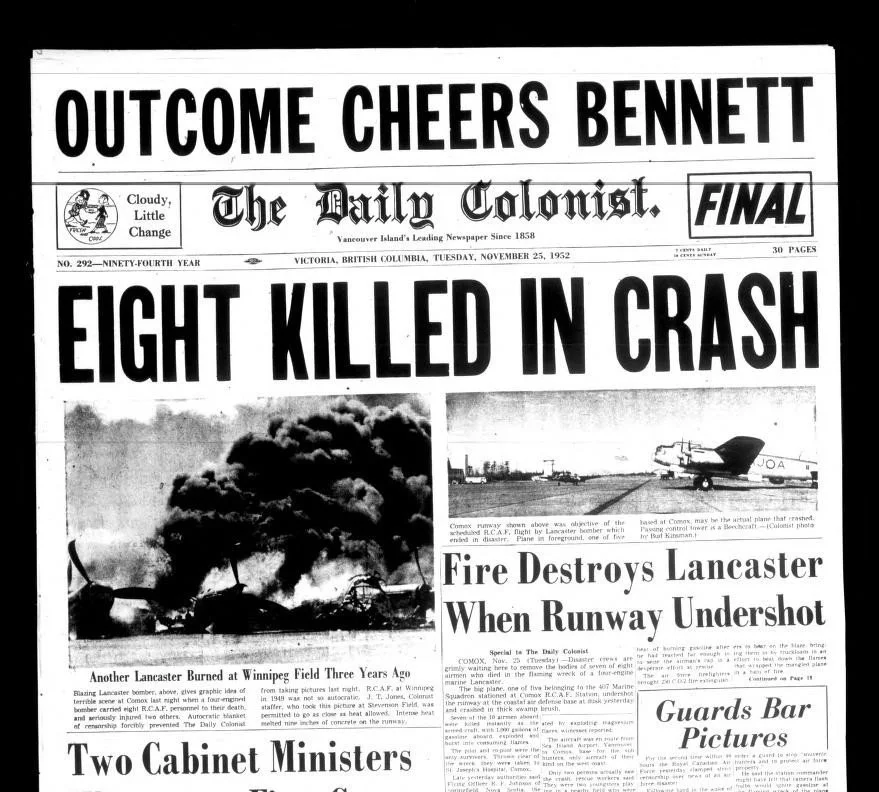
The grim news that met early morning readers of the November 25, 1952 edition of The Daily Colonist. —www.newspapers.com
My interest in this story was piqued way back in November 2007 when Oceanside Star editor Brian Wilford emailed me with the suggestion that an attached news story “might be a column for me someday”:
“888 (Comox) RCAF Wing of the Air Force Association of Canada will host a reception this Saturday, Nov. 24, in honour of Robert Thomas (Bobby) Waters who was awarded the George Medal for his actions following the crash of an Air Force Lancaster that were instrumental in saving the pilot’s life on that date in 1952.
“Waters, who recently passed away, was not quite 14 years of age at the time, and his widow has graciously donated the medal to the Comox Air Force Museum for permanent display.
“Waters was the youngest person ever awarded the George Medal which at the time was the second highest award for bravery that could be bestowed on a citizen of a British Commonwealth nation...”
A few weeks ago, while sorting through some emails and newspaper clippings that had piled up over the years, I found Brian’s email about the story of young Bobby Waters’ George Cross.
But I didn’t find Bobby Waters in my copy of the George Cross Register. So I tried Wikipedia and Google, which gave two hits. Robert Waters’ obituary in the July 12, 2007 Ladysmith-Chemainus Chronicle noted that he was born January 15, 1939, and he passed away peacefully at his home in Chemainus, July 12, 2007. He and Anne, his wife of 45 years, had three children.
The second entry hit the target: “As a teenager of 14, Bob was awarded the George Cross Medal (for Bravery) for the saving of 2 Air Force men from a burning plane in 1953, being the youngest to receive this Medal. He was also named ‘Canadian Teen of the Year’ in 1953.”
So I keyed in “RCAF Lancaster crash, Comox,” and learned that an Avro Lancaster 683, Registration KB 940, crashed on Nov. 24, 1952 with a crew of four and six passengers, of whom eight were killed “during an instrument approach to Comox Airbase. While flying in poor weather conditions, the aircraft went out of control and crashed in a swampy area. All seven [sic] passengers were killed while both pilots were injured.”
At 4:56 p.m., on the afternoon of Nov. 24, the Comox Fire Department received a call that a plane had crashed in a swampy area 800 feet west of Kye Bay Road, adjacent to the southern perimeter of the air base. (Now farmland, the crash site is off-limits to the public.)
So far, so good, but I needed much more, in particular details concerning young Bob Waters’ role as a rescuer. It was time for newspapers.com to earn their pay.
What I was looking for was information on the pilots’ rescue, and I read how air force civilian employee William Riddoch, Sr., and his 13-year-old son, Clifford, were the first persons to reach the scene of the crash site in a swamp about a quarter of a mile from their home. An older son drove to the airfield to raise the alarm.
“There was nothing we could do,” said Riddoch, Sr. “The plane had exploded and was burning up. I couldn’t get anywhere near. The mud was so deep it seemed I was wading up to my ears. I stumbled across one fellow [either pilot Johnson or co-pilot Wright] and pulled him away. I could hear the [other survivor] hollering somewhere behind.”
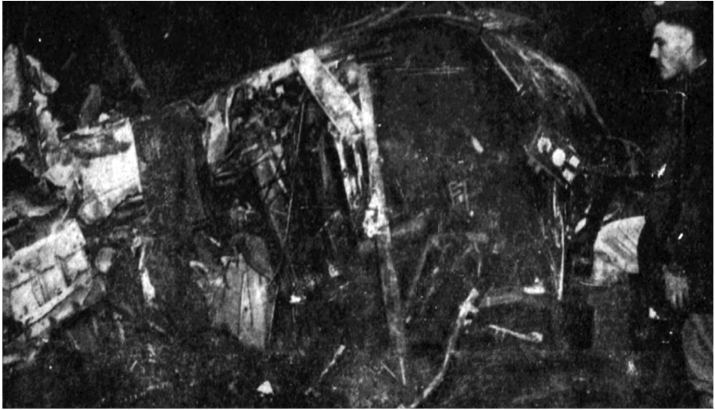
It’s hard to believe that anyone survived this tragedy.—Bureau of Aircraft Accidents Archives
Hours later, Comox Volunteer Fire Department Chief Ted Dawson, 41, described the crash as “the worst experience I’ve ever had. It was awful. We did all we could. We couldn’t have done any more no matter what equipment we had. I’m proud of my men.”
“Alex Bell, the assistant chief, got right up to the nose under a fog nozzle and reached one of the chaps. He was alive and pinned in. Alex reached in and got his hat and earphones, I think....”
Heroes all but, so far no mention of Robert Thomas (Bobby) Waters who’d later be awarded the George Medal for his actions immediately following the crash.
Darned if another name didn’t come up, that of Albert DeCuyper, 32, who, too, earned a George Medal that day!
So let’s start with him. His citation tells us that he was working on a farm nearby and, on hearing the crash or seeing the flames, raced to the site in the company of a 14-year-old boy [Bobby Waters]. “In order to reach the flaming aircraft, it was necessary for them to fight their way through heavy bush and swamp.
“On reaching the burning wreckage Mr. DeCuyper noticed one of the occupants of the aircraft who later was identified as the second pilot, endeavouring to free himself and immediately went to his aid.
“As he reached the port wing of the aircraft, he was hurled into the air by the force of an explosion but was uninjured. Undaunted by his narrow escape from serious injury, Mr. DeCuyper unhesitatingly approached the now blazing inferno and was successful in removing the injured occupant from the crash.
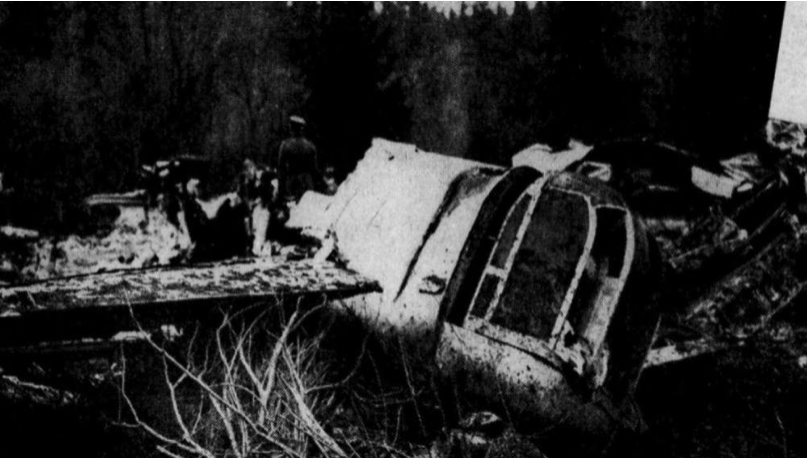
Part of the wreckage after the fire was finally extinguished and the bodies recovered. — Bureau of Aircraft Accidents Archives
“Mr. DeCuyper, by his unselfish act of heroism, during which he twice hazarded his own life, was undoubtedly responsible for the saving of the second pilot’s life and is worthy of the highest recognition.”
His George Medal is now in the possession of the Glenbow Institute, Calgary. (He and Bobby Waters were the sixth and seventh Canadian recipients of the GM, it should be noted.)
Well, try, try again. News of Bobby Water becoming the youngest Canadian to receive the George Medal was picked up by newspapers across the country, in the U.S. and in Great Britain.
Finally, I learned that Bobby witnessed the crash and summoned farmhand DeCuyper from a nearby field. After fighting their way through the swamp, they reached the wreck just as there was an explosion and the plane burst into flame. DeCuyper managed to pull F/O M.J. Wright free while “young Waters pulled the pilot, F/O R.F. Johnson, to safety despite the fierce heat and the danger of another explosion.”
There we have it. As noted last week, the Lancaster’s nose was designed to separate from the body of the aircraft and the pilots had been thrown some distance from the main wreckage which had begun to burn.
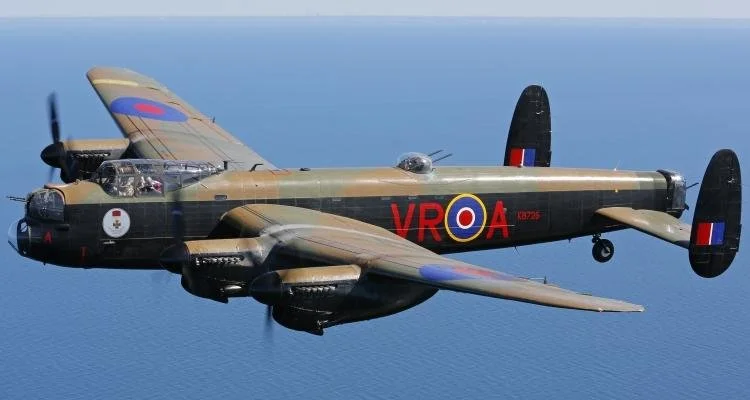
It was a four engine Lancaster bomber such as this that crashed and burned just off the Comox airfield around 5:00 p.m. in November 1952, killing eight crewmen and passengers. —Canadian Warplane Heritage Museum
Eighteen years ago, the Comox tragedy was recalled by the Winnipeg Free Press beneath the headline, “Two Manitoba men linked to B.C. crash.” The article referred to Albert DeCuyper, from Norwood, Manitoba, and one of the victims, Dauphin-born Cpl. Freeman Archibald McKay, the father of a five-year-old son and three-year-old daughter, who worked at the Comox airbase as a mechanic.
A First World War veteran, he’s the passenger I wrote of last week who’d gone to Vancouver to be sized for a Santa Claus suit for an upcoming Christmas party. His daughter Laura, 59 in 2008, expressed her gratitude that her dad was finally being memorialized.
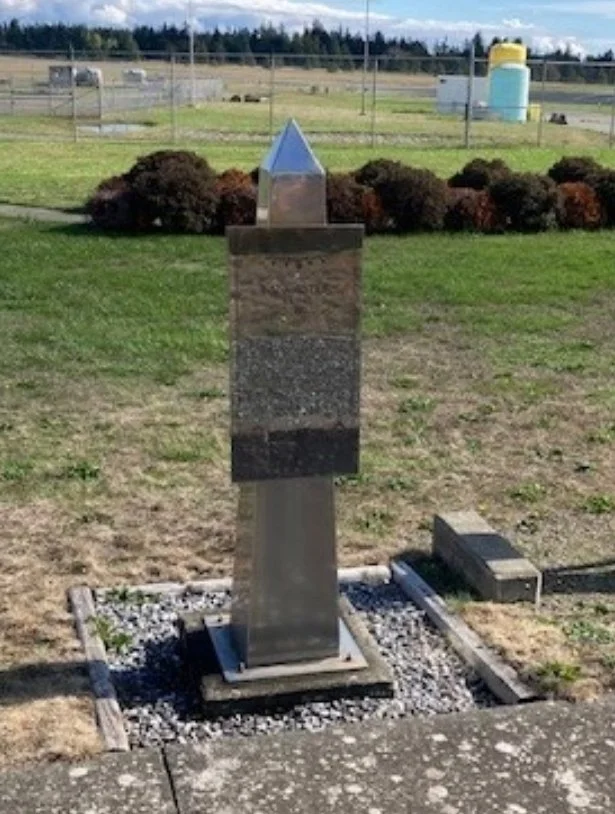
Unveiled on June 1, 2008 by 888 Wing Royal Canadian Air Force Association, the memorial is a stainless steel obelisk on a concrete slab. It is dedicated to the crew of the Lancaster 940. —Veterans Affairs Canada
In Memoriam
Flying Officer Joseph Frederick Doucette 1931-1952 born Prince Edward Island
Corporal George Stanley Fletcher 1926-1952 born Alberta
Flight Sergeant Joseph Leo Laurier Maynard 1919-1952 born Quebec
Aircraftman 1st Class Vernon Joseph McIntyre 1935-1952 born Nova Scotia
Corporal Freeman Archibald McKay 1919-1952 born Manitoba
Aircraftman 1st Class Wayne Frederick Smith 1932-1952 born Nova Scotia
Aircraftman 1st Class Roy Howard Walsh 1932-1952 born Saskatchewan
Civilian Meterorologist Malcom G MacLeod abt 1929-1952 born British Columbia
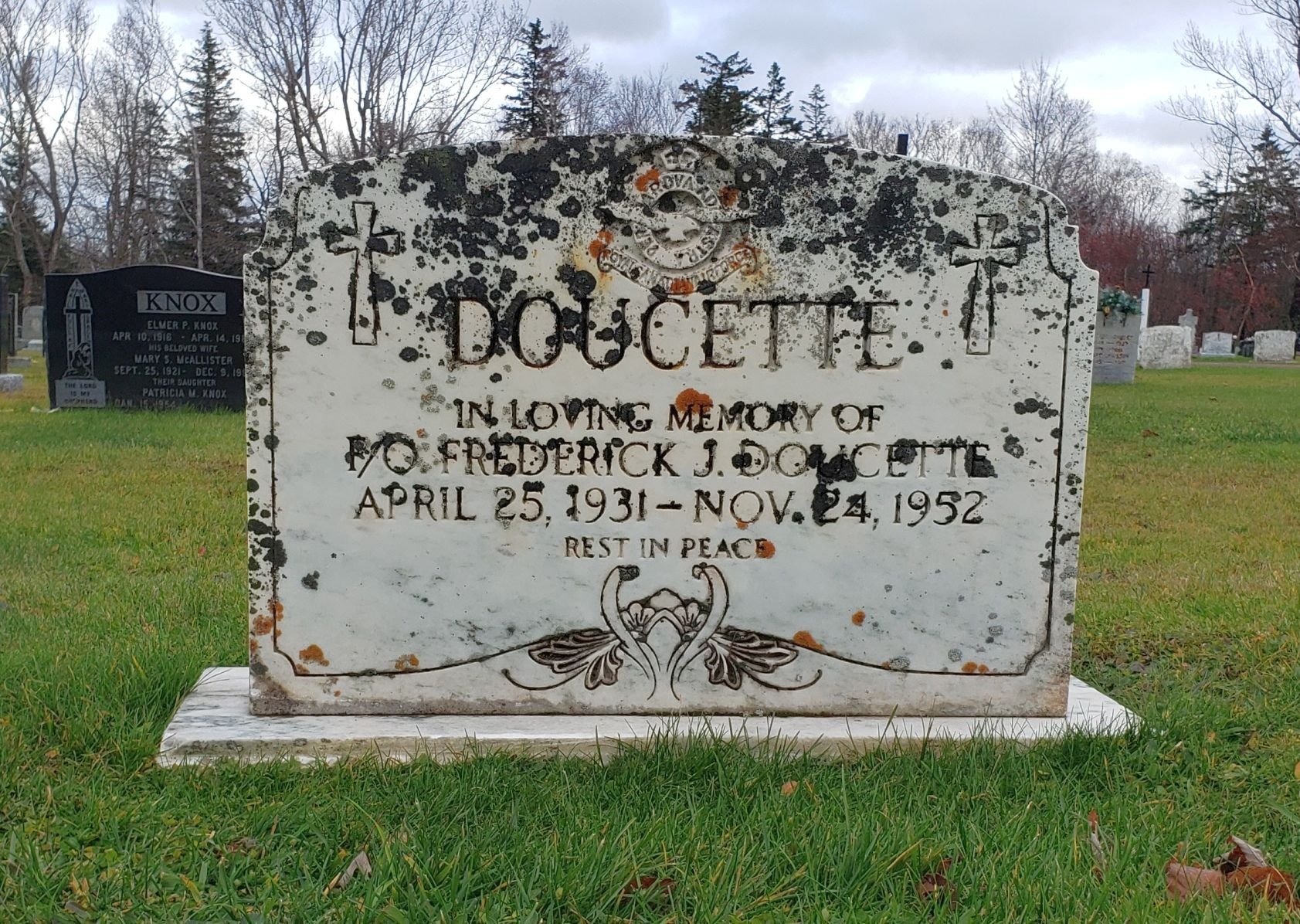
— findagrave.com
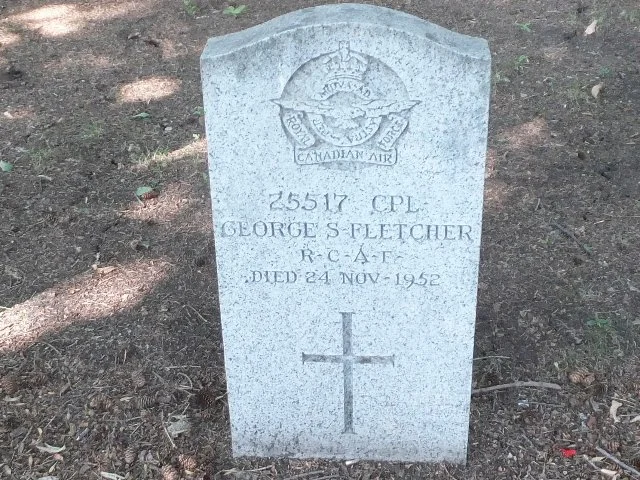
— findagrave.com
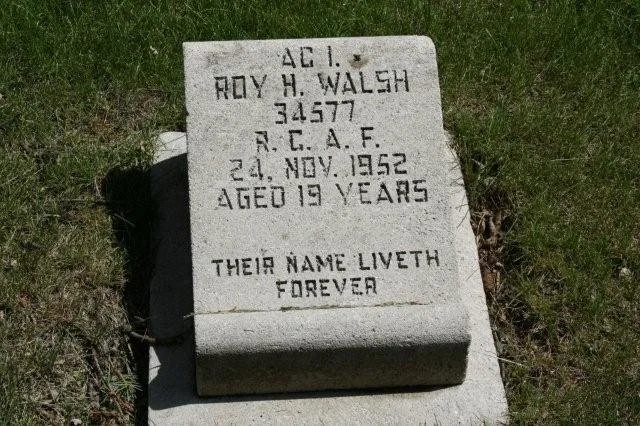
— findagrave.com
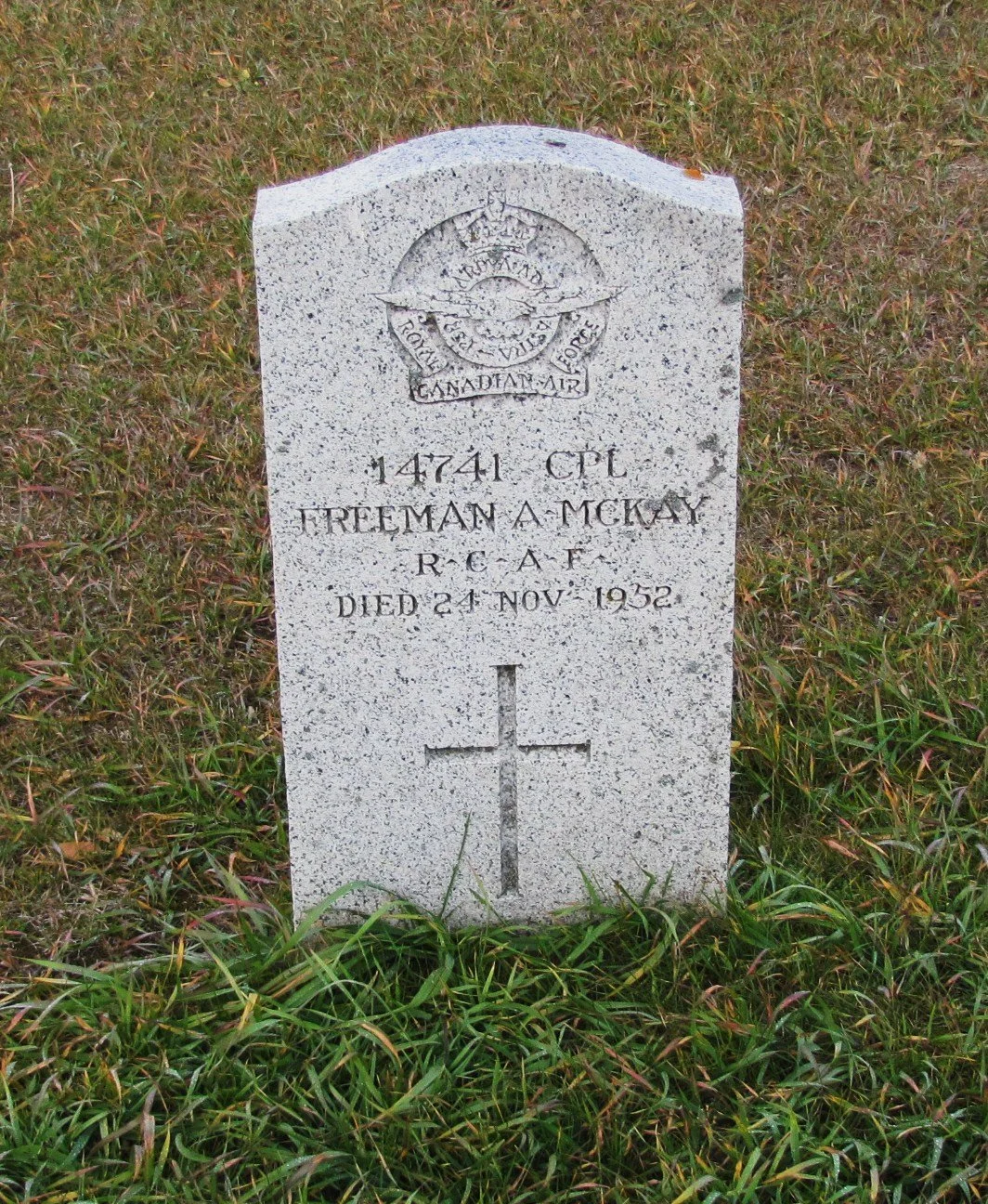
— findagrave.com
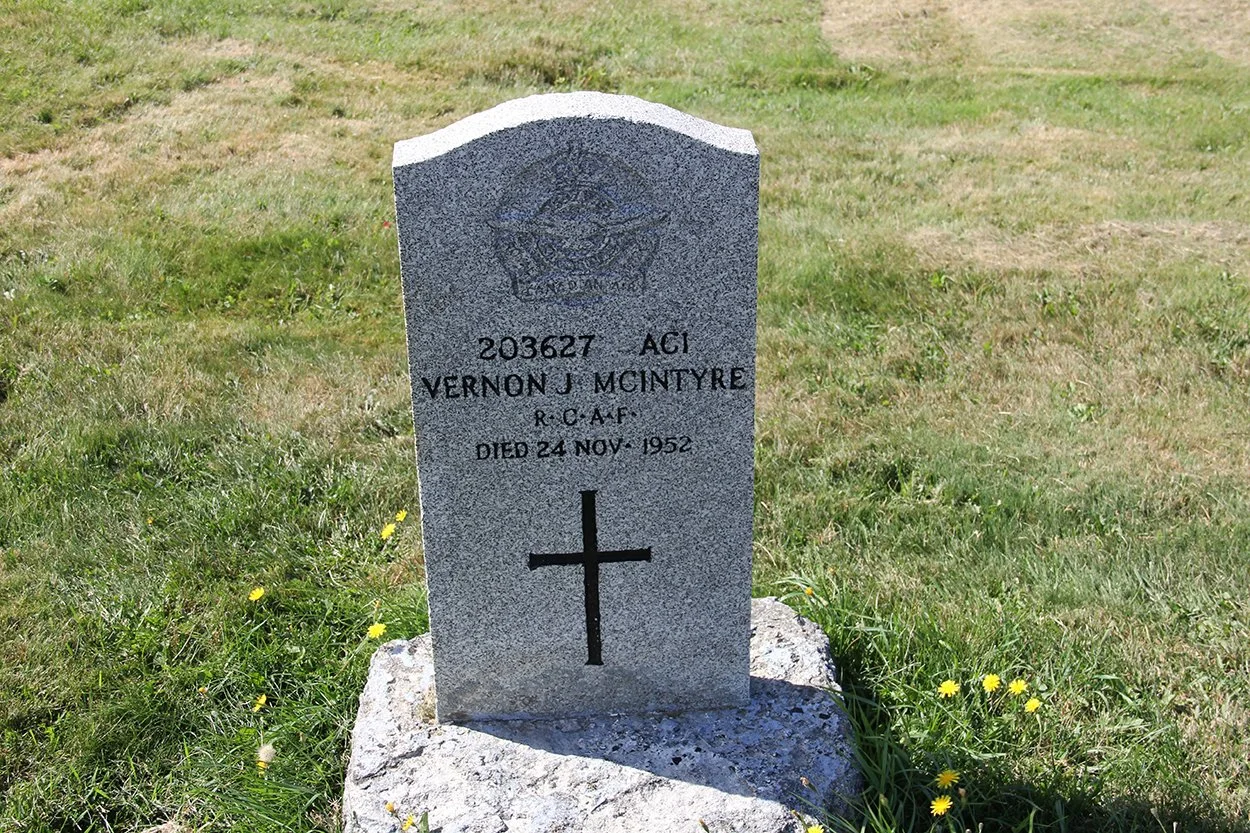
— findagrave.com
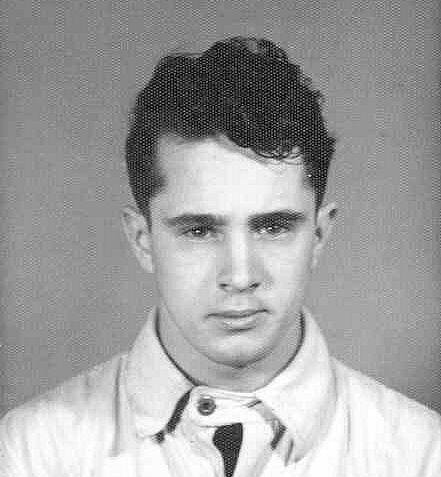
Wayne Frederick Smith—Canadian Virtual War Memorial
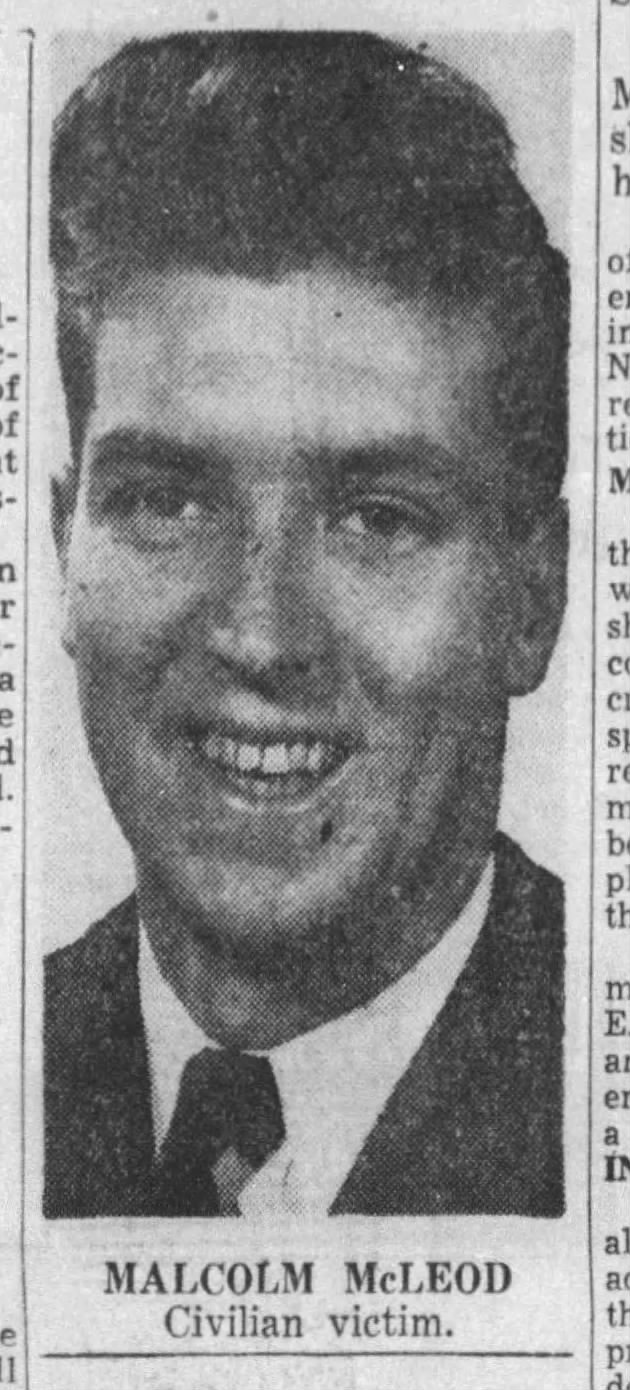
—newspapers.com
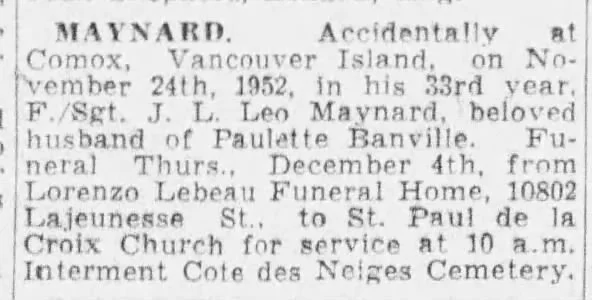
—newspapers.com
F/O Wright, co-pilot of KB 940, left the RCAF in 1964 and died in 1996 but Ruff Johnson remained with the service until his retirement as a colonel after having flown every type of postwar Maritime Patrol aircraft, the Lancaster, the Neptune, the Argus and he Aurora.
