
Henry Rose, Last Man Hanged in Nelson
How many British Columbia communities commemorate a murderer?
Here is irony at its best. Legions of men and women who spent their lives working and contributing to the building of this province have faded into history and are forgotten. But at Gray Creek, on the north shore of Kootenay Lake, a fancy signboard marks the site of Henry Rose’s cabin. Only the chimney remains and it has become a popular geocache site.
Incredibly, his victim’s house is still standing, too—without a marker.
Henry Rose’s dubious claim to fame is his distinction as the last man hanged in Nelson.
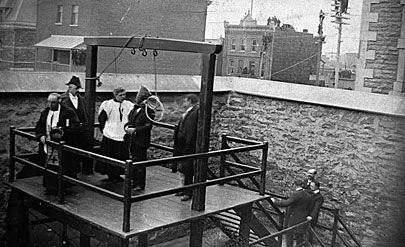
The execution of Stanislas Lacroix by Radclive on March 21, 1902, at Hull, Quebec, was said to be the last public execution in Canada. Eight months later, Radcliffe would be in Nelson to attend to Henry Rose’s dispatch. —Wikipedia
Murderer though he may have been, it must be said that Rose died bravely, even gracefully; let him be remembered for that...
* * * * *
What most intrigues us about Henry Rose is that he appears to have been two different men, sort of a before—before he killed his business partner John Cole in a drunken rage—and after—when he gained the friendship, even respect, of his jailers as he awaited his date with the hangman in the Nelson gaol.
Rosemarie Parent, writing for the Arrow Lakes Historical Society, describes him as quarrelsome and generally disliked, John Cole as the heir of a wealthy Eastern family. Unlikely partners, one might think, in a pole-cutting business. Both liked their liquor but arguments over money had soured their relationship and Cole, apparently, only agreed to Rose’s invitation to his cabin because their third partner, Nels Demars, joined them. On the afternoon of June 4, 1902, after tanking up in the bar of the Grand Hotel in Nakusp, on the Upper Arrow Lake, West Kootenay, they bought several bottles of liquor and piled into Rose’s rowboat.
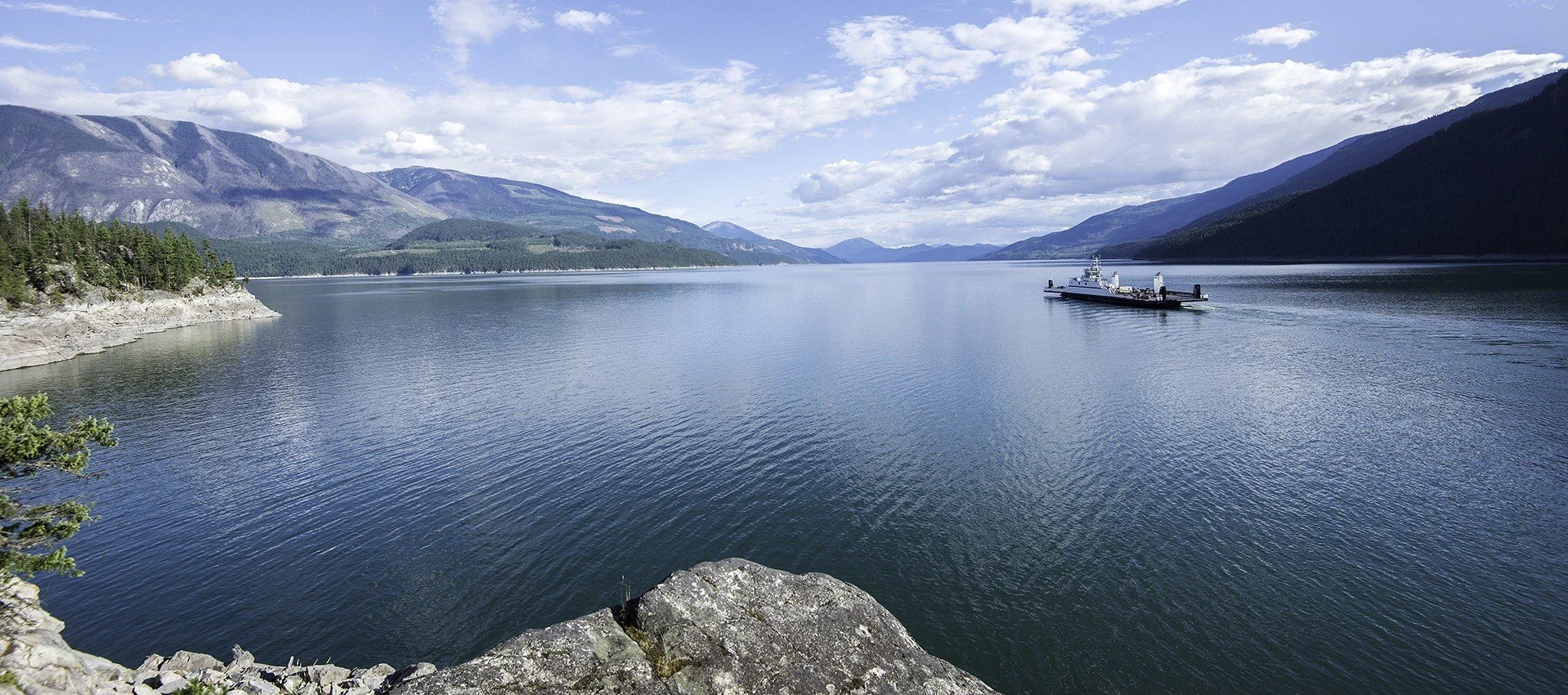
The beautiful Arrow Lakes were anything but smooth on the afternoon that the already inebriated partners set out for more drinking at Rose’s cabin. —westkootenayparks.com
By the time Demars, who was rowing, pulled to shore because of a strong wind, the other two had begun to argue.
What followed, as came out in court during Rose’s trial, is made confusing by Nels Demars’ testimony, both because of the extent of the injuries he had suffered and, no doubt, by an alcoholic haze. The Nelson Daily News described the scene as described in court, stating that Demars, who was well known in the area as a pioneering prospector, had been “frightfully beaten” and lost an eye. In fact, he was “so badly used up that it was considered doubtful at the time whether the old man could pull through...”
Upon landing, Demar’s demand that they stop arguing, prompted Rose to rush at him and knock him unconscious. Upon coming to, he saw Cole stretched out on the ground. He tried to light a fire only to have Rose stomp it out and strike him again, then head back to Nakusp to report that Demars was injured and required medical assistance. A relief party found the old miner still unconscious and bloodied, Cole dead with a broken jaw and a neck wound that was deemed to have been fatal.
Rose’s version of what happened was farcical: He had left both men and was rowing down the lake when he heard cries of “Murder!” and, upon returning, found Demars injured, Cole dead. “Two men came out of the bush and beat us with clubs,” Demars supposedly told him. Police Constable Walter Scott, not believing a word of it, placed him under arrest. At his trial, Rose accused Demars of killing Cole. But Demar’s advanced age, the fact that his eye injury would have rendered him unconscious for hours, and Cole’s crushed windpipe, the cause of death, all pointed to Rose. His lame defence that they had fought each other, failed to convince the jury and he was convicted and sentenced to hang.
Nels Demars lived another six years but never fully recovered from his injuries.
* * * * *
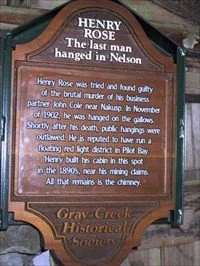
This fancy signboard marks the site of Henry Rose’s cabin at the northern end of Gray Creek. —British Columbia Heritage Markers
Like all good stories, that of Henry Rose is multi-layered; some things are never quite what they seem. While awaiting death in the Nelson jail, the man convicted of savagely beating his partner to death and maiming another comes across as a totally different Henry Rose. This fascinating front-page account of the Nelson Tribune of November 22, 1902, bears quoting in full. You would never read anything like it in today’s newspapers:
“Henry Rose was hanged in the jail yard at Nelson yesterday morning at three minutes past 8 o’clock. The execution was witnessed by 30 people, including the sheriff and jail officials. Rose maintained that he was innocent of the crime for which he paid the extreme penalty of the law, and some of the jail officials seem to be of the same opinion; but if Rose did not kill Cole, who did?
“There was no hitch in the proceedings, Radcliffe, the professional hangman of Canada, being the executioner. Rose left his cell at 7:57 and was accompanied to the scaffold by Rev. Father Althoff of the Catholic church, and by no outward sign did he show fear.
“The following statement, signed by Rose, was read on the scaffold by the reverend father: “I die willingly, because it is God's will. I have made my peace with Him. My innocence may be, I pray God, proved someday. For all that, I forgive those who are the cause of my being here. If I have offended anyone, I beg forgiveness. I bid good-bye to all. I would like to say more, but make it short, because it is hard for me to stand here longer. I thank all who have been kind to me in my last days.” This statement had been signed by Rose in the presence of Gordon Lemon and Rev. Father Althoff.
“Besides Rose and the reverend father, sheriff Tuck, hangman Radcliffe and two jail guards were on the scaffold. Those present had a full view of the platform of the scaffold but all below the platform was hid from view by canvas. Underneath the scaffold was a pit four feet deep. The drop was 7 1/2 feet, and there was not a twitch on the rope after the body dropped. Twenty minutes after the trap was sprung, the jail surgeon, Dr. G.A.B. Hall, pronounced life extinct, and the black flag was run up from the staff on the main portion of the jail building, and remained flying for an hour.
“The jurors, who viewed the body after it had been cut down, were W.F. Haniford, Fred Bosquet, Arthur Poole, A. Tregillus, A.J. Marks and B.H. Avery. They returned the usual verdict in such cases, and a certificate for the burial of the body was delivered to the sheriff and by him handed over to the warden of the jail.
“The burial, which took place within the jail enclosure, was conducted with the rights of the Roman Catholic church, and when the body had been lowered into the grave, the lid of the box containing it was removed, and 500 pounds of lime packed around the remains and the work of destruction was commenced. By 10:36 the grave had been filled up and everything pertaining to the execution had been cleared away. Those who were present at the burial were Father Althoff, J.H. Patenaude, J. Harwood, F.W. Laing, John McAlman and R.E. Lemon, the warden of the jail. The pallbearers were John Dooley, C.W. Wilson, J. Lyle, August Christ, John Matson, and W.H. Jones.
“Henry Rose was a man of 64 years, and had he embraced the opportunities which presented themselves to him would have been a very well-educated man. His father was at one time a very wealthy resident of the city of Ottawa, but early in the youth of Rose, his parents moved to Montreal, where they lived till their death. The death of the father of Rose occurred 22 years ago. Rose received the news of his death through the firm of lawyers who had charge of the estate. At the time Rose had two brothers and one sister living. The estate realized $50,000 and Rose advised the lawyers to distribute his shares among his brothers and sister. He says he was at the time employed by the Delaware Mining Company, having charge of the copper properties on Lake Champlain which the company were developing.
“The reasons he gave for refusing to share in the division of his father's estate was that at that time he was himself a comparatively rich man, counting his worth in money and property at about $300,000. One of the odd things in the story of his life, as told by himself, is that after he gave up the share of his father's estate Rose never had any further communication with his brothers or his sister, and consequently did not know whether they were alive or not. Sometime after this Rose says he was sent by the company in whose employ he was to open up the well-known Delaware copper mine on Lake Champlain, New York State.
“Rose never explained just how he came to sever his connection with this company whom he served as manager and foreman, and he intimated that his coming to British Columbia in 1890 was in a measure due to the death of his young wife who died in childbirth about a year after his marriage. Neither did he ever explain what became of the property values which he had at the time of his coming to this province. He says he had some money, and that for a considerable time thereafter he was backed in a financial way by certain members of the mining company with which he had been connected in the state of New York. Those who have known Rose for the past 10 years agree that he always seemed to be able to raise money whenever it was necessary, although he never appeared to be flush.
“Since his advent to the province, Rose said he had employed his time prospecting and examining properties and reporting on them for Eastern people.
“He claimed to have been the discoverer of the properties at present owned by the London & Richelieu Company at Crawford Bay, the chief of which is the well-known Silver Hill Mine, but he admitted that he was not the locator. During the boom period of the Rossland Camp he gave considerable attention to the prospects in it and reported upon several of them. Rose claimed to have mining properties scattered throughout the different camps of West Kootenay, particularly at the head of Kettle River, and on Caribou, McDonald, Beaver and Sargeson creeks. He had also taken up a preemption opposite to the outlet of the Upper Arrow Lake, on which he had made a number of improvements, but at the trial for the murder of Cole he was without money, and the witnesses for the defence were all paid by the Crown, he being declared a man without means.
“And speaking of the disposition of Rose, as evidenced since his confinement, the warden of the jail said of him, last evening, that Rose was one of the best prisoners he had ever had in the jail. When Rose was first received the officials of the institution received a number of warnings from the outside to the effect that Rose was a very desperate man, and that he would not stop at anything to attain his ends or secure his liberty, but at no time during his imprisonment was there the slightest indication that Rose was inclined to give trouble.
“When the sentence of death was passed upon him, Rose never for a moment lost heart, and although the odds were very much against him he continued to have hope in the efforts of his counsel to secure either a new trial or at least a commutation of his sentence to life imprisonment. When his last hope failed, and the word came from Ottawa that the sentence of the court must be executed, Rose received the news like a stoic. Apparently, it made no difference whatever in his conduct. He never complained, nor was he sullen for a moment. He spent his time in conversation with the members of his death watch or such of the prison officials as happened to be near him and had an unfailing fund of stories to relate concerning incidents in his long career on the frontier, and his prospecting and hunting trips since 1890.
“The greater portion of his evenings were spent in playing whist and euchre with the men on the death watch and the prison officials.
“On the night prior to his execution Rose played cards much longer than usual, and it was 2 o’clock on the morning set for his execution when his last game of cards was finished, and the condemned man sought his bunk. Those who took part in the game say Rose was the most composed man of the party. He gave the closest attention to the game and never overlooked his hand.
“From 2 o’clock until 3 o’clock Rose appeared to be asleep, but after this he was awake. At 5:30 o’clock Father Althoff entered his cell and held Mass and remained with the prisoner from this time until the end. Rose breakfasted at 7:10 and partook of a good meal, consisting of a couple of eggs, some toast and a cup of strong coffee. Just before the executioner entered the cell to bind the arms of the condemned, as a preliminary to the march to the gallows, Father Althoff asked for some stimulants for the prisoner. He was given about a tablespoon full of brandy, which is the only stimulant Rose had during the whole period of his imprisonment.”
* * * * *
All of which runs totally counter to Rose’s alleged reputation as being quarrelsome, unpopular and, according to his historic plaque, having “run a floating red light district in Pilot Bay”. This occupation, were it so, would have been before his settling into his cabin at Gray Creek.
But what do we make of his “obituary” notice as posted by ‘Colonel’ R.T. Lowry whose legendary journalistic legacy is one of satire and caustic wit? As suggested by the Tribune’s death-house account, Rose had acknowledged squandering two fortunes and his career as a professional miner. After acknowledging Rose’s stoicism in his final days, Lowry unsympathetically wrote that his life had been shortened by liquor (Lowry was a notorious alcoholic), “insensitivity and the law of the land... He has probably gone to heaven, as his spiritual advisor kissed him and said prayers over him just as the hangman dropped him to Jesus. It seems like a refined cruelty to give a man a good breakfast, with a side dish of prayers, and then push him out on the air with a tightened neck-tie...”
* * * * *
The signboard erected at the site of Henry Rose’s cabin at the northern end of Gray Creek by the Gray Creek Historical Society reads: “Henry Rose was tried and found guilty of the brutal murder of his business partner John Cole near Nakusp. In November of 1902, he was hanged on the gallows. Shortly after his death, public hangings were outlawed. He is reputed to have run a floating red light district in Pilot Bay. Henry built his cabin in this spot in the 1890’s, near his mining claims. All that remains is the chimney.”
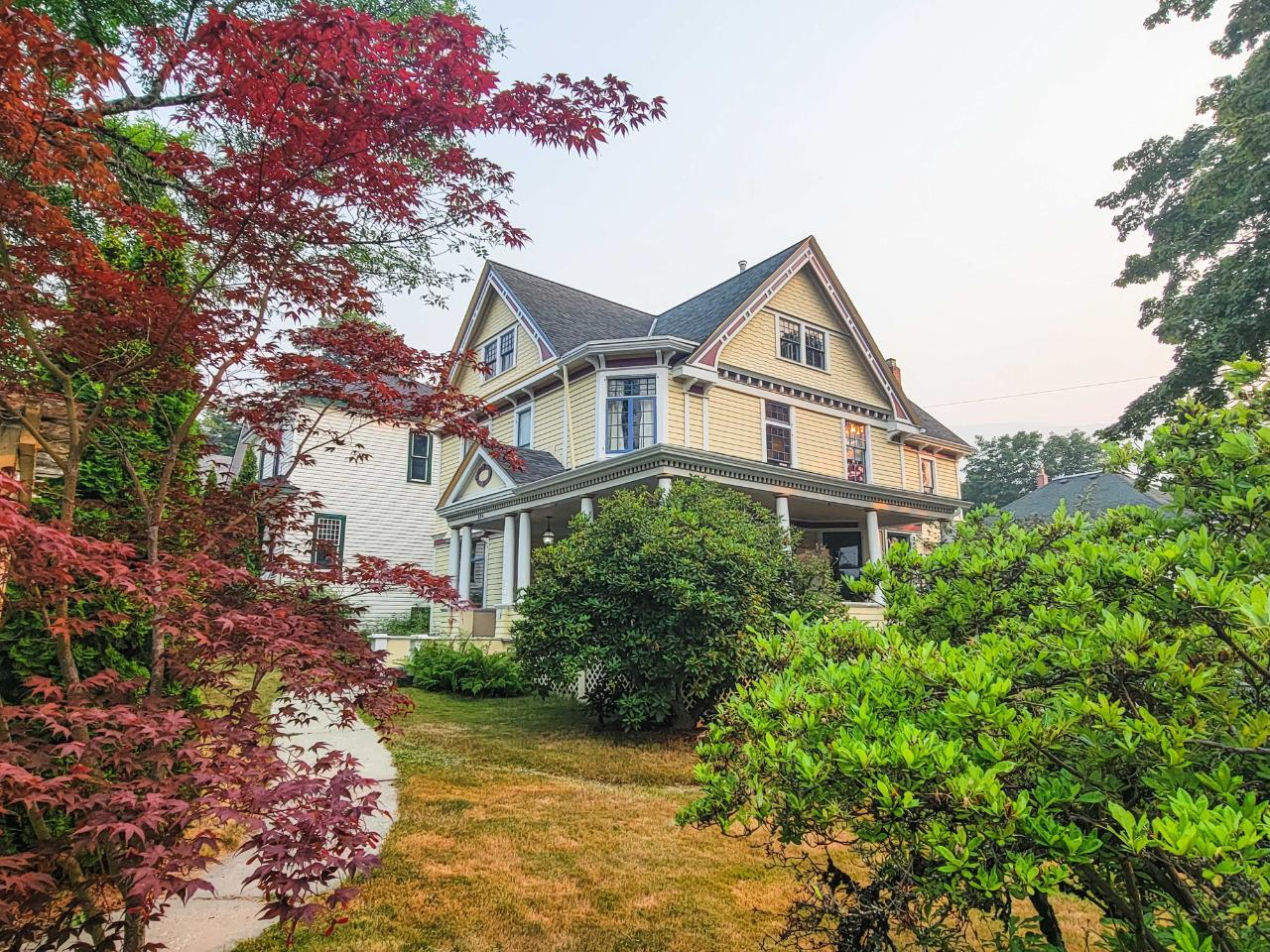
There is another, much more imposing, landmark linked to Henry Rose, this one in Nelson City. 804 Stanley Street, a magnificent Queen Anne style house, was once owned by William A. Macdonald, Q.C., the Crown Prosecutor at Henry’s trial. —Arcuri-Precious Real Estate, Nelson, B.C.
