
Service just ain’t what it use to be
They’re among those indelible imprints of childhood, now just fleeting wisps of memory, ghosts even, from what is rapidly becoming the oh, so distant past. The strongest goes back to my family’s brief tenure in Parksville.
More accurately, my mother’s and my stay in Parksville, as my father was off in the Navy for most of those nine months, and my few memories include only my mother. As for downtown Parksville, such as it was then—the ‘main street’ (the new Island Highway) and its 90-degree turn onto the old Island Highway – let’s see, there was the Rod & Gun Hotel (only in adulthood would I get to savour its Chinese food), the Rainbow (I think) Café, a theatre, at least one gas station, the Overwaitea, a jeweller and the Island Hall Hotel.
And, immediately next door, its beaches-miles and miles of white sands whose low tides allowed even a toddler to walk out to what seemed to be halfway across the Strait of Georgia.
Another vivid memory is French Creek boat basin, where Uncle Warren tied up his troller, and where my cousins and I (years later, during my return visits) would jig for hapless bullheads and shiners, too often (as I realized now) with deadly accuracy. And summer was never complete without days spent down below the silver bridge spanning Englishman River.
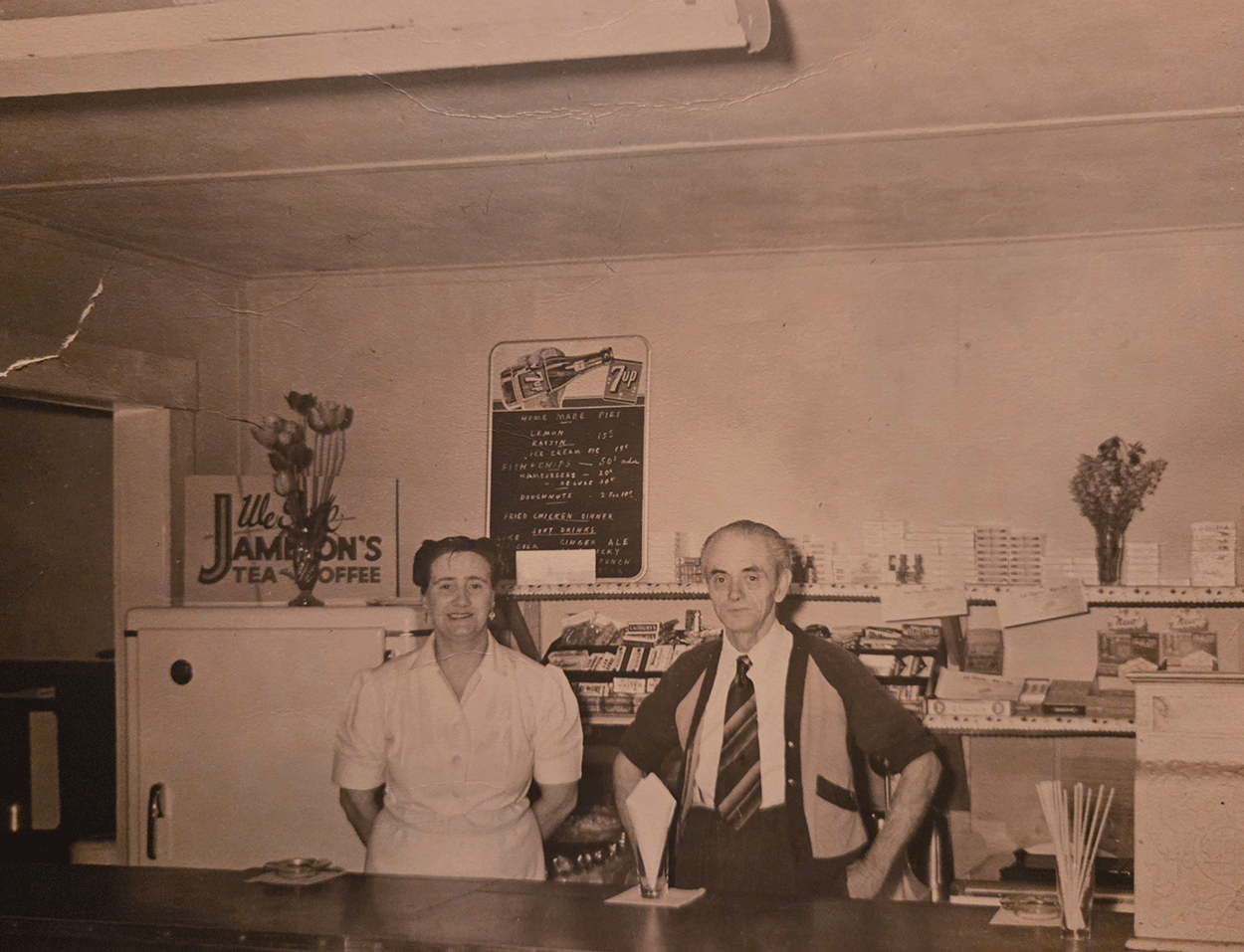
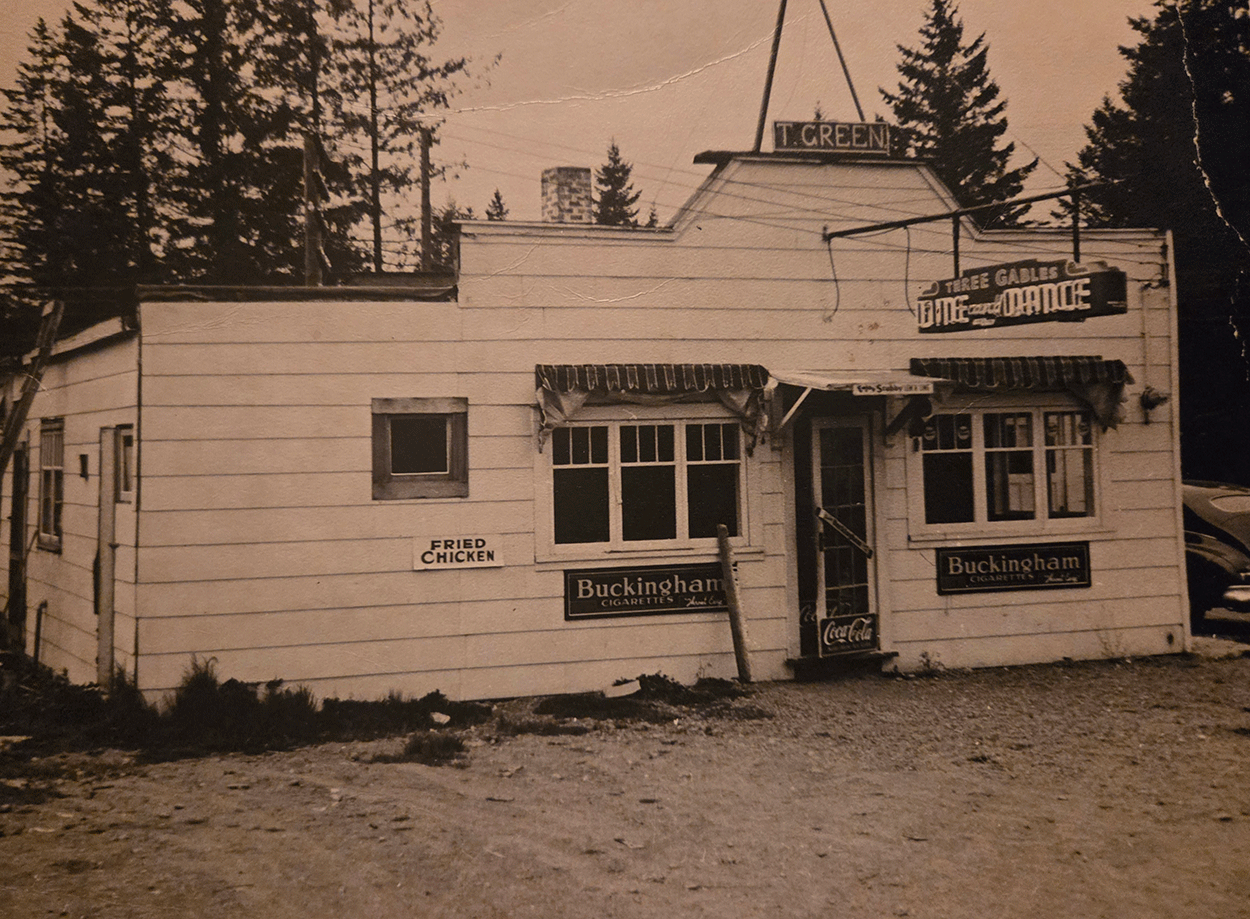
To get there, we’d brave highway traffic (did it never stop?) to pass the Teepee, a landmark, third-dimensional plywood sign. This, after leaving the Green Gables cafe, where my grandparents, Ellen and Tom Green, also operated a small store and offered the best hamburgers in the whole world.
— Authors collection
To this day, I can clearly hear the tap!tap!tap! of Granny's knife (a regular, dull table knife) as she formed patties by hand. How many times I'd watched in awe as she tap!tapped! them, one after another, again and again and again, into perfectly shaped and sized rounds of mince, and layered them between their squares of wax paper, for the next day.
There's another childhood memory of meat that stands out and which, in its own way, contributed to the theme for this Chronicle.
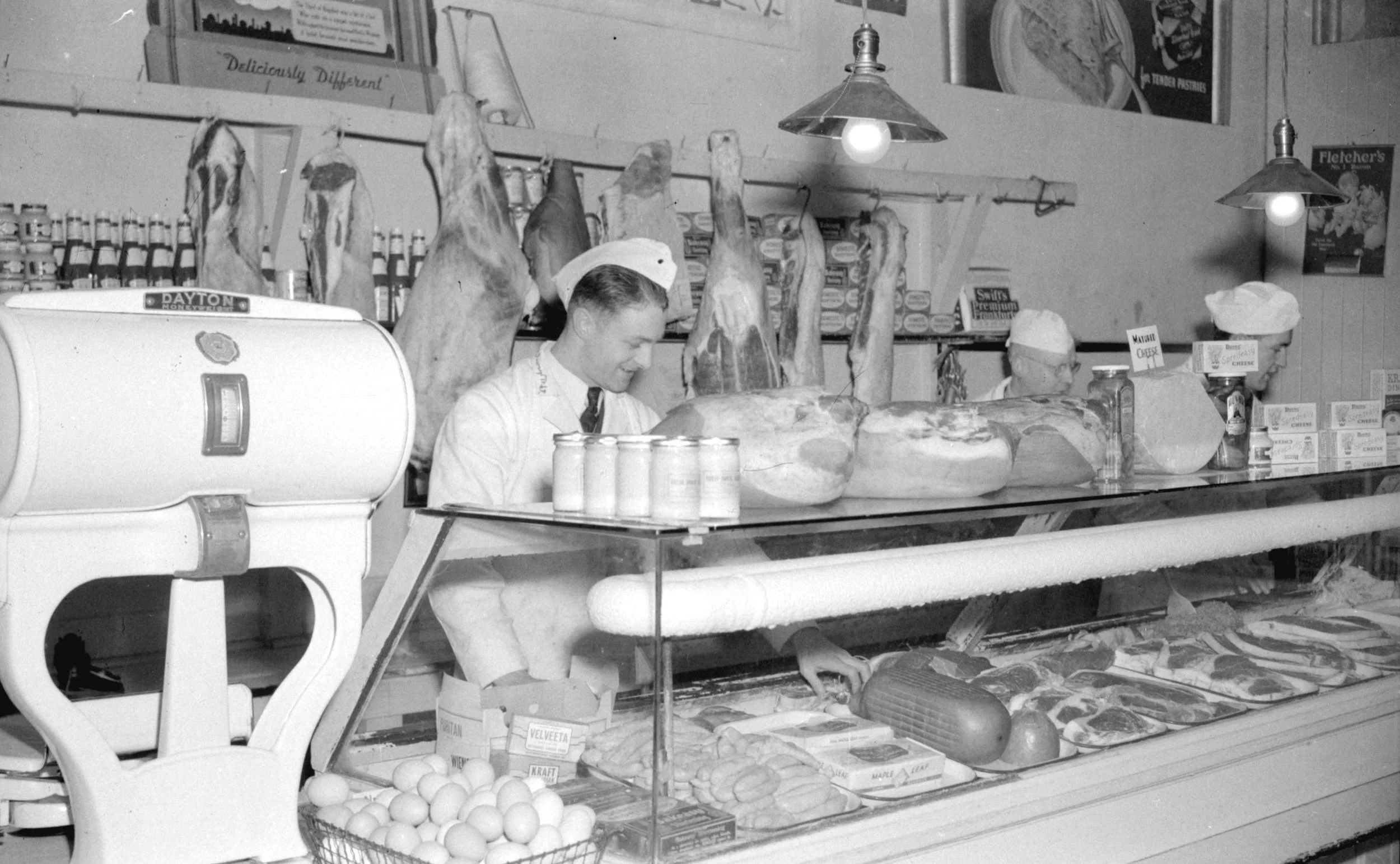
I can just remember following my mother into the meat market, that it was dusk (indicating winter was upon us), that the floor was deep in sawdust, something I'd never before encountered other than in a barn or paddock.
— City of Vancouver Archives
There was a distinct smell, or smells, too, but here my memory gets fuzzy; just a man in a white smock behind the glass counter with its display of cuts. I remember him because he turns – to me – with a smile – something I don't recall previously encountering as a child in a store – and he says something to my mother. I don't catch what it is but, a moment later, he’s thrusting something at me.
It's a wiener. My mother peels it and hands it to me, then concludes her purchases as I contentedly devour this treat.
I've eaten a few hotdogs since but never one tastier than that offered a small boy by the Parksville butcher, to whom I'm internally grateful for one of my few memories of our up-Island stay.
I was further reminded of these phantoms of my past while standing recently in the checkout lane of a ‘supermarket’. As I stood, glancing around, it suddenly struck me: When did they start selling motor oil, lawn furniture, garden supplies, mortgages, in a grocery store? When did they stop employing sufficient clerks to answer your queries, to help you make your purchases, to help you carry them out? When did they stop offering working conditions that encourage staff to stay, to become part of the team, to become acquainted with regular customers?
When did stores become so big, so impersonal, so cold? When did we start pumping our own gas? When did we go wrong?
Ah, but that's progress, some will argue. Many are so young they've never known the ambience of a store without chrome and plastic, with real people working in the aisles and behind the counters as well as the cash register. Now it’s almost an alien concept. But it did exist, and well into the lifetimes of many reading this Chronicle. For every so-called supermarket there were dozens of mom-and-pop corner stores, whose owner-operators knew every customer by name.
— Authors collection
For us, upon moving to Saanich, it was Mr. Christie.
Outside, the single glass-bowled gas pump with its one octane fits all, and but rarely used; inside, almost everything a household needed on a daily basis. All to be wrapped in brown paper and tied with thin, white string that dangled down from a spool near the ceiling, and was cut with a single hooking motion when of desired length.
Front and centre, the very showpiece of his main counter, was the candy department. Gumballs, jawbreakers, day-long suckers and bubble gum – enough sugar to overdose every kid in the neighborhood. It was great!

— City of Vancouver Archives
But the good old days, alas, are gone. So, too, for the most part, is the very essence of what we now call merchandising – service with a smile by genuinely friendly, knowledgeable and caring staff. This isn't meant to imply that it has vanished altogether, but it does seem to be on the endangered species list. Who is to blame? We consumers are, unfortunately, having long ago opted for online one-stop shopping, for convenience, for mall parking, for the best-bang-for-the-buck bargains from no-frills shopping barns and now more than ever, online.
We’re just getting what we pay for —in more ways than one.
* * * * *
‘Sinning against your home town’
All of which got me thinking about the controversy of box stores vs. local businesses. It seems to have receded in recent years, most smaller merchants apparently having managed to adjust to the realities of the global marketplace.
And not for the first time, either. Long, long before the advent of multinationals moving in to compete against mom-and-pop operations, the fuss was about buying locally. If you go all the way back to the 1860s, long before the completion of the E&N, many Cowichan Valley consumers had no choice but to do their shopping in Victoria, Nanaimo and even Vancouver.
That's because “downtown” Duncan as such didn't even exist. Not until a business community developed at Duncan’s Crossing did consumers have a local and central selection of goods and services.
Which is when the fuss began, slowly but with ever-increasing insistence.
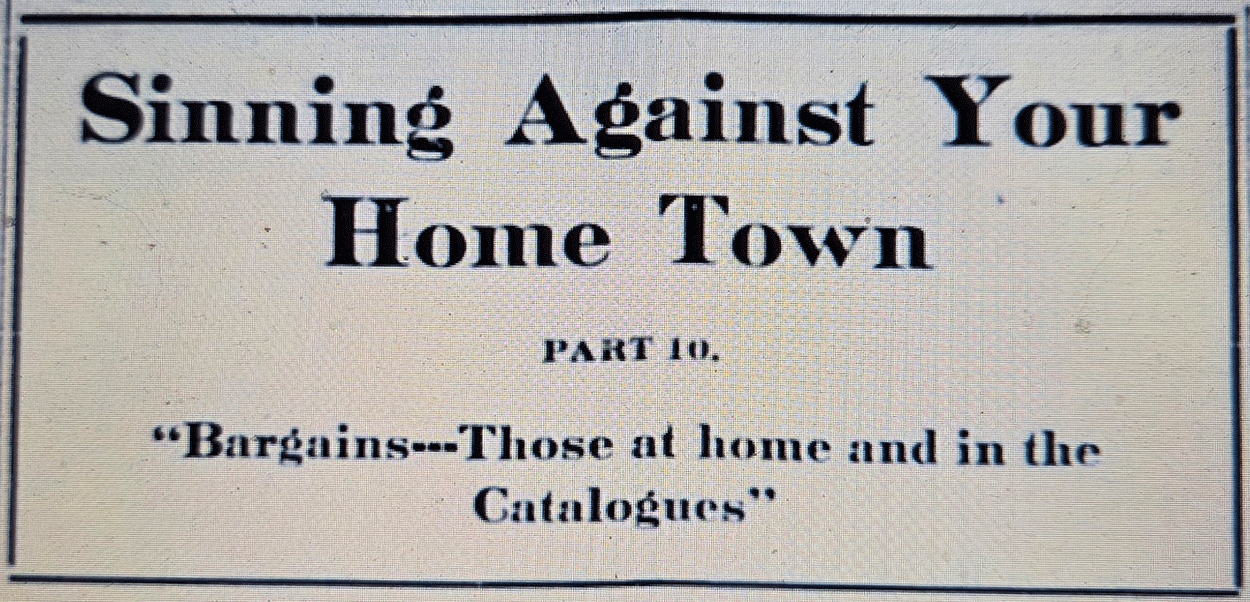
Why, with customers ordering by mail or taking the train to shop personally, it was all a tax-paying Duncan merchant could do to survive when up against those sharks in Victoria or Nanaimo! Hence, in 1914, a serious propaganda campaign was begun by the editor of the Cowichan Leader who, to encourage local commerce, dedicated nothing less than half a page over several succeeding issues to appeal to his readers’ loyalty to their own community.
— VIUSpace
He didn't mince words, either, writing “concisely and straight from the shoulder.” Duncan, with a population of 1,700, was the commercial, administrative and the social centre of the Cowichan District. If you bought elsewhere, you were (this in bold black type)”Sinning against your hometown.” And if you still didn't get the point, he quoted Webster’s Dictionary on sinning: “violating duty.”
Simply, “Every dollar spent outside the district means a dollar less in circulation in the district in which you live and have to get a livelihood.
“There are very few things -- from tin-tacks to automobiles, riding breeches to visiting cards [a plug for his own commercial printing department] -- that you cannot procure from Cowichan people. Their prices are reasonable. The quality, in more lines than you perhaps think, is better than you get elsewhere. Why not keep your money among your own neighbours and thus promote, not only their well-being, but your own?”
When the Duncan businessman deposited his earnings in a Duncan bank, paid his rent to a Duncan landlord, bought supplies and services for himself and his family from other Duncan suppliers, the dollars that originated with his customers - Valley citizens – stayed in Duncan. Contrarily, if that dollar were spent elsewhere, “the landlord might not get his rent, last year’s suit would have to do...the new addition to the home would have to go, etc. All because the dollar went out of Duncan when it might have stayed at home!
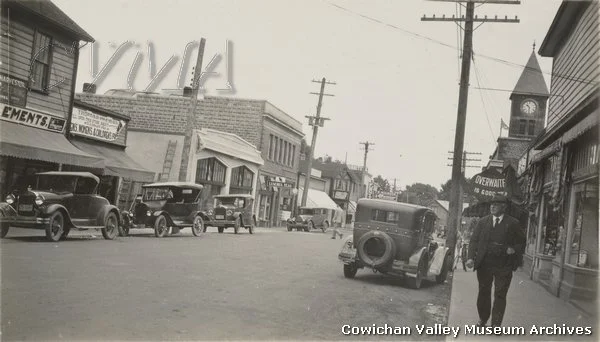
— Cowichan Valley Museum Archives
“It is the duty of every man, woman and child in Duncan to help build up the city - to make it prosperous and make it grow - to encourage outsiders to come in. When you send east or north or south or west to 'replenish your wardrobe’ - to purchase ‘new furniture for your home’ - when you send your money to mail-order houses - do you realize that you are SINNING AGAINST YOUR HOME TOWN - that you are VIOLATING YOUR DUTY TO DUNCAN?
“Well, you are. You are laughing at your local merchants - prolonging the needed municipal improvements - decreasing the value of British Columbia soil - discouraging the most worthy efforts to cater to your every wish - fooling yourself by sending that dollar out of Duncan... It is natural for every person living in Duncan to desire to purchase the best of all that makes life worth living [and] no one gainsays you this privilege - but would it not be better for you to buy...in Duncan if you can supply your wants just as well and at the same price? By doing this - by keeping that dollar in Duncan you encourage the development of the city of Duncan and your home town.
“By this action of yours in recognizing merit - you warrant the entrance of new industries, the expenditure of huge sums to start them. Such improvements attract attention to this city of yours - it attracts investments in its possibilities and its future possibilities and its future probabilities. You are hurrying forward the time when Duncan will come into its own - when the province and country will recognize its advantages. By keeping this dollar at home you are helping yourself - the coming generation and the future recognition of Duncan.
“We believe it is your duty to give this subject serious consideration. We ourselves believe it is so serious that...following articles will contain the experiences, ideas an suggestions of over 500 merchants and business men in the Northwest, as to what they think the result will be when we are no longer ‘SINNING AGAINST OUR HOME TOWN’.”
And so it went, week after week, on the same theme. Obviously, it must have had effect — downtown Duncan is still with us and, to all appearances, alive and well! All of which begets this question of you, dear reader: Do you support local businesses or are you a SINNER?
