
Stalwarts of Darkness
(Conclusion)
It was in the Extension area. We were following an old, indistinct trail through the woods on our way to examine the remains of a fan shaft, when I spotted them. In the mud were the circular impressions of hoof prints, faint but discernible, and it suddenly struck me: pit ponies!
It was like seeing a ghost.
They were just the tracks of some local equestrian who’d passed that way, of course, but for a moment or so it was fun to turn back the mental clock to when these woods were busy with activity. Busy not just with coal miners but with their work animals, those unsung heroes of the deep until mechanization finally put them out to pasture for good.
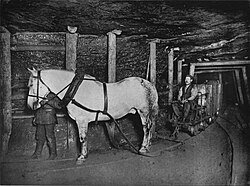
A “pit pony,” in this case what appears to be a full-size horse, in a German mine in 1894. —Wikipedia
Those prints reminded me of the two harness bells and the hames that I’ve dug up over the years, of the hump of rust the size of a car, all that remained of 100s, even 1000s, of wires cut from hay bales where a large stable once occupied the site, and where the late Ray Knight unearthed an enamelled sign which had identified a certain stall: Queenie.
Last week in the Chronicles, “guest columnist” William Johnstone, a career coal miner whose life story was published by the BC Archives in 1980, told you that women and children were the original workhorses in British coal mines because of their ant-like passageways. As mines became bigger, small horses—specially-bred Shetland and Welsh ponies—took their places.
Here, in BC, coal mines were always bigger and more open; instead of ponies, full-size horses and mules imported from select breeding farms in Kentucky, did the job of hauling “trips” of ore cars, several at a time, in and out of the mines.
So, in this issue of the Chronicles, Mr. Johnstone resumes his tribute to these hardy miners of old who shared the hardships and dangers of working underground, far removed from blue skies and green grass...
* * * * *
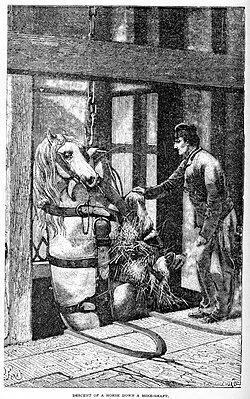
A horse being lowered into a mine. Poor Dobbin. —Wikipedia
To many people the life of a pit pony conjures up visions of overwork, abuse and misery; while cases of cruelty have been reported, they are the exception and not the rule. These working animals were an essential part of the production system, and apart from humane considerations, it was only good management to keep the ponies healthy and in good working condition.
To this end they received the best of care, often much better than some of their overworked brethren on the surface.
They were only allowed to work an eight-hour shift, blacksmiths were on hand to attend to the shoeing, and it was the duty of the grooms to see that the collars and harness fitted each animal perfectly.
At the end of each shift, as the ponies entered the stables, they were taken in hand by a groom whose job it was to hose down the legs and belly of every animal, removing any clay or mud that may be stuck to them. They were then examined for cuts and bruises before proceeding to their stalls, and if any were found, the driver was held responsible. If neglect or abuse was found to be the cause the driver could be fined or discharged.
The underground stables were equal and better than many on the surface.
Their concrete floors, whitewashed brick walls and electric lights throughout their length dispelled the reality that they were 100s of yards below the surface of the earth. The stables, by means of regulated ventilation, were kept at a constant and comfortable temperature providing a restful haven for the animals when not working.
Clean drinking water was supplied to to numerous water troughs by being piped down from a surface supply. The ponies were fed a balanced ration of chopped hay, crushed grains, and sliced carrots. This fare with the addition of a salt block kept the animals healthy. Their stalls were cleaned every day and a fresh bedding of peat moss provided them the needed softness when lying down.
But despite such good care there were some things that they must have missed: a good roll in a dusty field or the wind blowing through their manes and the warm sun on their backs.
It was inevitable that when young lads drove a pony for any length of time a bond of affection would grow. It was rare the driver who didn't have a daily treat in his lunch bag for the pony. Some drivers have been known to refuse other jobs or promotions rather than leave their pony in another's hands.
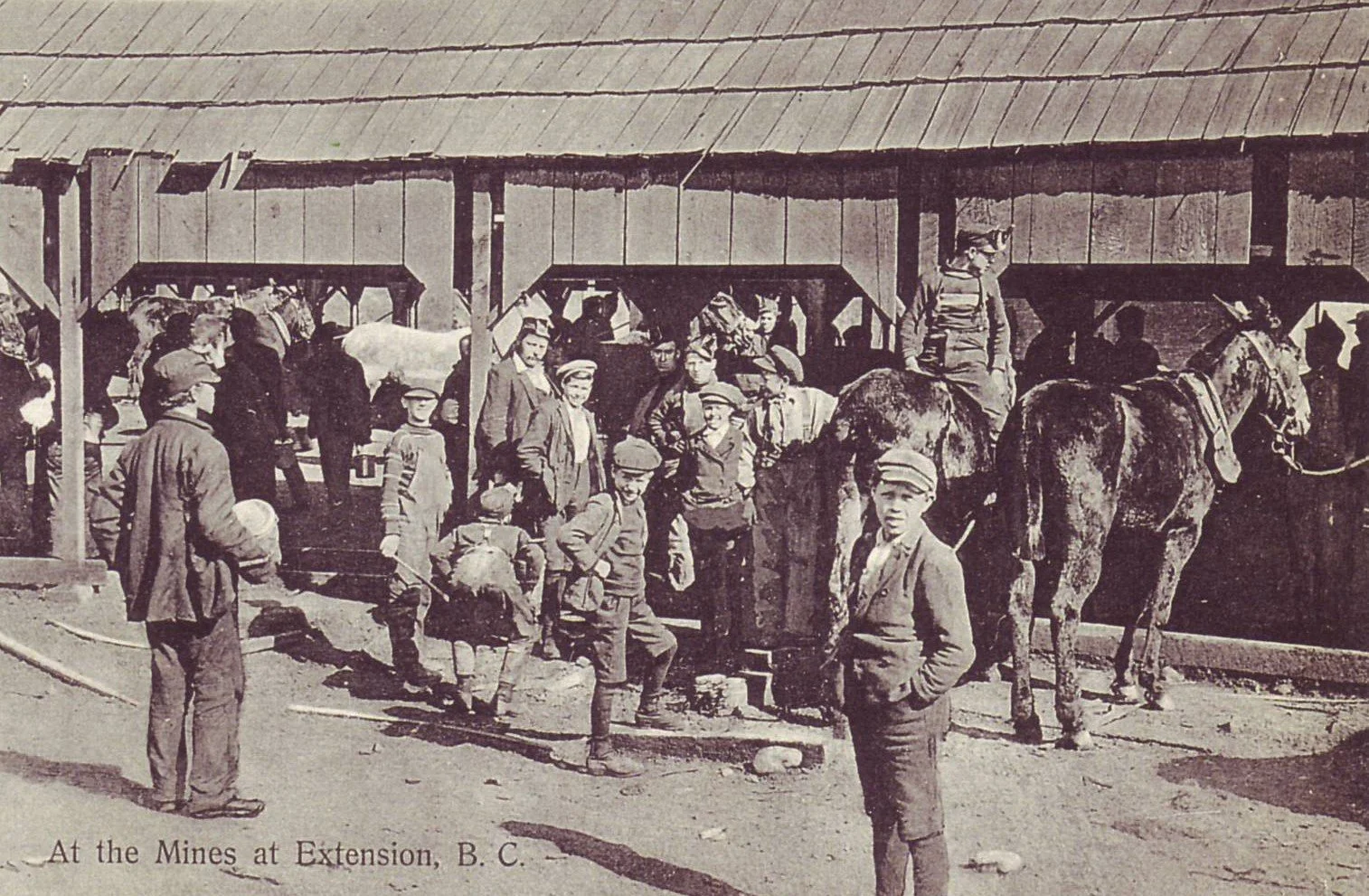
Many a lad who began his mining career tending to the pit ponies and mules bonded with his four-footed charge, even to the point of refusing promotion as it meant their separation. —BC Archives
Although ponies were in universal use in the Old Country, very few found their way into the mines of North America. Here, unfettered by the narrow and low haulage roads established by the primitive methods of another day, the mines in America and Canada were developed with an eye to using large capacity mine cars and wider track gauge.
To move such heavier loads required heavier animals than the tiny Shetland and its ilk, consequently that work-tried animal, the mule, became the favourite draft animal in the mines of this continent.
They had already proven their mettle on the battlefields of the world, and were proving their worth in the coal mines of Kentucky, West Virginia and Pennsylvania.
With Canadian patterns being strongly influenced by our large neighbour to the south, it was only natural that the mule would find its way into the Canadian mines.
The discovery of coal seams at Nanaimo in the 1850s marked the beginning of a viable coal mining industry on the west coast of this continent, and until 1898 the mines of Vancouver Island were the only producing mines in British Columbia. At that time Vancouver Island was an outpost of the Empire, remote, far from the populated centres of the world and established trade trade routes of the sea. Consequently the first miners and machinery were brought in by ship by way of Cape Horn, from the United Kingdom.
A supply of animals to serve the mines was closer at hand and as the industry flourished mules were purchased from the breeding farms of Kentucky and Missouri. It was from these farms that the best mules were found, for over the years they had built a reputation for having the best mules in the world.
The mule developed for mining had an average height of 1,200 pounds, with relatively short legs and long body. This then was the animal that came to be used almost exclusively in the mines at Nanaimo and Cumberland.
Animals were never used in the Island mines in such large numbers as the British mines. This was partly due to the Island mines being smaller than those in Britain, and also one mule could pull as much as three or four tiny pit ponies. There were, however, enough animals working in the mines at Nanaimo and Cumberland that the company found it expedient to develop farms at both sites to raise fodder for their animals.
The mule: the offspring of the jackass and mare, and synonymous with stubbornness, is a much maligned animal. Strong and tenacious, endowed with an inherited wisdom passed on from its antediluvian ancestor, the ass; it was equal to the rigours of underground mine work.
Their supposed obstinate behaviour was often the evidence of an inherited prudence, as many examples of their actions attest to a high degree of commonsense. Unlike horses that would work till they dropped, mules, when they feel their strength is being overtaxed, will stop, and no amount of persuasion will prompt them to move until they have rested.
Some mules were so wise that even if they thought they were being overloaded they would refuse to move, although the load could well be within their capabilities.
llustrative of this trait is the case of a mule that had worked in one section of the mine for years.
Day after day it had performed the same task of pulling five empty cars out to the landing with complete composure. One day an extra car was inadvertently switched onto the landing. The driver, knowing that the odd car couldn't be left, coupled it to his regular five-car trip, then giving his customary chirp that signalled the mule to go, he jumped in the front car as usual.
The mule leaned into the collar, the cars began to move, but instead of four clicks indicating the tightening of four couplings of a five-car trip, it heard an extra click and knew it was an added load. With a nod of its head it turned its neck, looked at the driver and came to a dead stop.
The driver—a taciturn muleskinner with years of experience—nonchalantly walked to the last car, rattled the coupling chains to bluff the mule into thinking the car was being uncoupled, then putting his back against the car pushed it back until the coupling was taut.
With the stage now set, he chirped to the mule to go. It turned its head to see where the driver was, then pointing his ears forward, leaned into the collar. Hearing only four clicks of the first five cars, and there being no click from the coupling of the sixth car, it figured its point to be made and proceeded to haul the six cars with haughty aplomb.
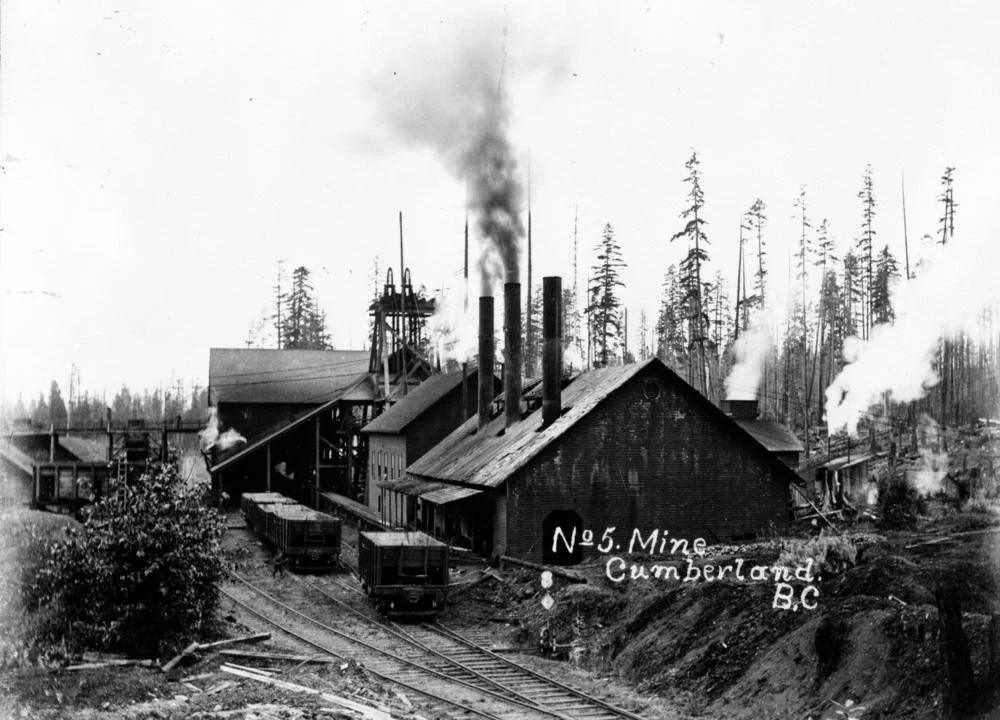
The Cumberland mines were among the last to use mules on Vancouver Island. —BC Archives
Although this driver had driven mules for years he never never even raised his voice at any time; his commands were just a series of clicks and chirps. When asked by one young driver what were the requirements of a good muleskinner, his succinct reply was: three things, Sonny, patience, tolerance, and think like a mule.
Several cases have been known of these canny animals pulling their loads along the galleries and suddenly coming to a dead stop, and refusing to budge despite the proddings of the drivers.
Then without any warning, the roof immediately in front of the mule falling and blocking the road. Such a sense not only saved the mule but also the driver, and indicates that these animals had an extra sense that forewarned of danger.
Throughout the years as mining technology improved, the use of animals underground became less and less. With the advent of small portable hoists, fares and smaller cars, mules became redundant. By 1949, all the animals were gone from the mines in Nanaimo, and there were only seven at work at No. 8 mine at Cumberland; however at the end of that year the last mule was brought to the surface.
Thus after nearly 100 years of animal haulage in Vancouver Island mines an era came to an end. From that time on until a cessation of mining on the island in 1966, no animals were ever again used underground.
