
Stalwarts of Darkness
(Part 1)
How many times I’ve written about coal mines and coal miners.
Usually with only a passing reference to their four-legged workmates, the horses and mules—the indispensable ‘pit ponies’—who also worked deep underground, far from their natural sunlight and pasture.
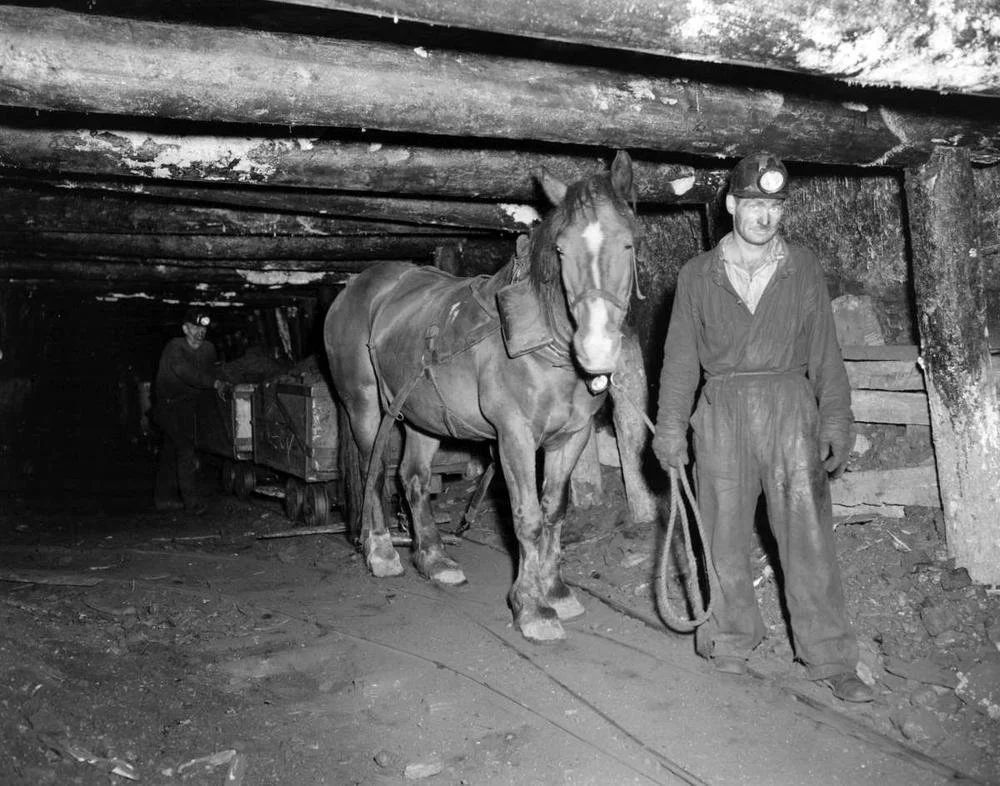
A miner risked his life underground by choice; not so poor Dobbin. —BC Archives
Theirs, too, was a claustrophobic and dirty job. How did they fare in such an alien environment? How were they treated?
The answer is, they were treated well—so well, in fact, that many miners were convinced that the company valued its livestock more than the men themselves. After all, a good horse or a mule was worth a lot money and a man, well, he could be replaced at no cost.
For today’s Chronicle, I’m going to hand the editorial reins to a man who spent his life working in the coal mines, first in England, then on Vancouver Island.
In 1980, the BC Provincial Museum published Coal Dust In My Blood: The Autobiography of a Coal Miner, by Bill Johnstone. According to assistant curator and editor Robert D. Turner, Johnstone “began his career as a hand miner in England when he was 13 and, with the brief interruption of a few years farming on the [Canadian Prairies], spent his working life in the industry.
“Gifted and ambitious, he studied and he eventually became, not long before his retirement, District Superintendent of the mines at Cumberland operated by Canadian Collieries (Dunsmuir) Ltd., on Vancouver Island. During the intervening years, he worked at nearly every phase of coal mining, from working on the picking cables to shooting explosive charges. He also studied mining engineering and mine rescue and was himself injured in a cave-in.
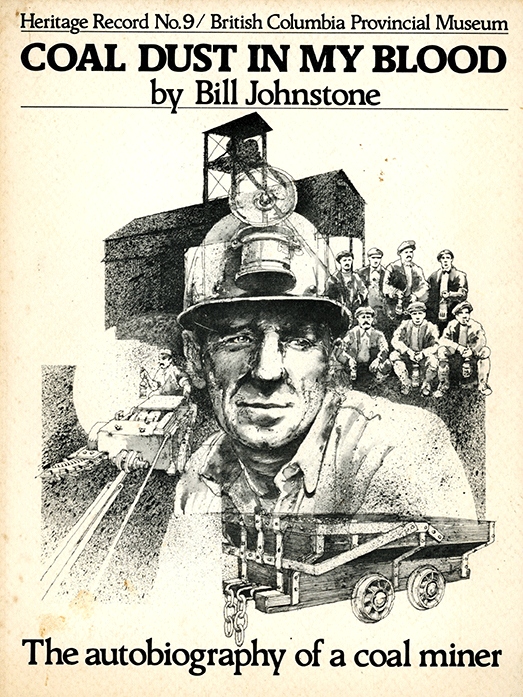
During his life-long mining career, Bill Johnstone obviously came to respect the horses and mules that shared the dangers and discomforts of working underground with their human co-workers. —Author’s Collection
“Bill Johnstone’s story is unusual for a number of reasons.
“The range of his experience provides a broad insight into the life and work of many phases of mining. In addition, it is told by someone with first- hand experience. It is unusual for a miner to have been able to complete the range of training that Bill did through his own dedication and work... This autobiography provides real insight into the life of the miner and how men worked in the mines. It is a story that only a person who has spent his life in the mines could relate and it is a most valuable record.”
That same year, Mr. Johnstone wrote a two-page article in the Victoria Colonist’s magazine section; entitled “Stalwarts of Darkness,” it’s the only detailed account of the four-footed colliers who shared the discomforts and the dangers of the deep and the dark of BC coal mines that I’ve ever seen.
Here’s his tribute to these unsung underground heroes as he wrote it, 46 years ago.
* * * * *
By William Johnstone, The Islander, Jan. 6, 1980
Toiling beneath the earth's surface, hidden from the eyes of scribes and poets, the life of those draft animals of the mines: the pit pony and the mule, is relatively unknown. Their use today except in rare cases is a thing of the past, but their contribution to the industry they served so well is worthy of recognition.
History has recorded the mining of coal in Great Britain as early as the 13th century when shallow deposits and outcroppings were worked by the monks. But it was not until the middle of the 16th century when wood became a scarce commodity, that coal mining became an industry of importance.
During these early times when the use of mechanical power was unknown, the transportation of coal underground was done by women and children. The 16th century was not an age of compassion. The cities and towns of Britain were not places of beauty or comfort for the poor.
It was an age in which a child of seven could be hanged for stealing a loaf of bread; an age when a father could be locked in jail for life for the non-payment of a debt. These and other factors resulted in hordes of orphans and destitute women begging in the streets and whose care the Crown was wholly unprepared to assume.
From the ranks of these unfortunate paupers were recruited the workers of the infant coal industry. Toiling long hours under the most deplorable conditions for a bare existence, they were the pioneers of the industry that was to make England an industrial nation.
The earliest method of transporting coal underground was by basket. As the diggers filled the baskets they were carried by women and children from the coalface to the shaft bottom. This system was soon followed by sled haulage... The workers were harnessed to the sleds, and, crawling on hands and knees they dragged their loads along the low and narrow galleries to the shaft bottom or to the surface in the case of a drift mine. Eventually the flank wheel wooden rails replaced the sled, but the motive power still remained that of human muscle and brawn.
With the introduction of steam powered pumps early in the 18th century, mines became deeper and larger. Yet despite this new source of power, no engine had yet been developed for underground haulage, with the result the size and extent of mines was restricted by the limits of human endurance.
Then in 1763, after 200 years of using human beings as draft animals, ponies were introduced into the mines. For the first time, no longer limited by the boundaries of human stamina, mines were able to extend their workings and consequently their production.
Although small by draft animal standards, these tiny horses, by their strength and tractability earned a place in the coal industry that would last for 200 years.
Although several breeds of ponies were available in Europe and were used at one time or another in the mines, those of the Shetland and Welsh breeds were found to be most suitable and were favoured over the Galloway and Dartmoor breeds.
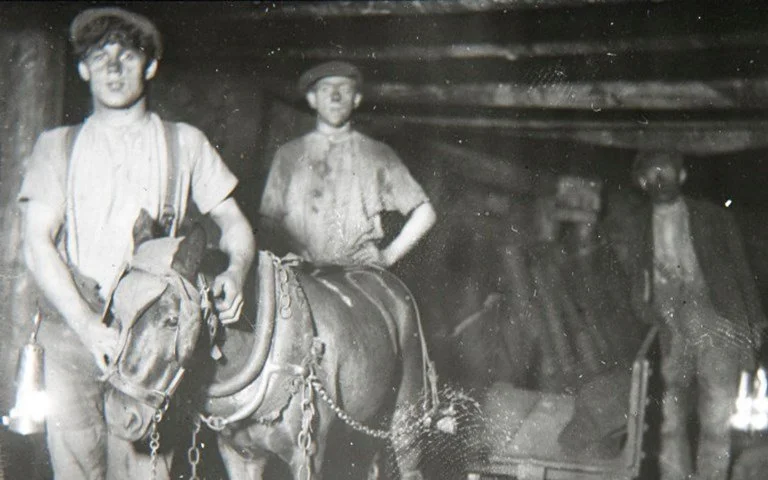
You can see how small Old Country pit ponies were. It was common for boys to begin their careers in the mines by tending to these four-legged locomotives. And it was their responsibility to do it well—or else. —The National Archives image library
The Shetland pony, the smaller of the two breeds, with a height of 9 to 11 hands, proved to be most useful in narrow seams. Hardy as the Isles of its origin, with short legs and stocky body, it had more strength per pound of weight than any other breed. Endowed with a natural wisdom and an independent streak that booked no abuse, the Shetland pony was well suited for the job he had to do.
The Welsh pony standing 10 to 13 hands high was a finer bone structure than the Shetland breed, but, intelligent and docile, and having a wiry strength with the agility of a deer, they proved their worth time and again in the sections of the mine where the height of the seam allowed them to work. Other than their height there was little to choose between either breed. Both responded to kindness with devotion, and many bonds of affection grew between drivers and their ponies.
The introduction of animal haulage to coal mining gave impetus to an already burgeoning industry, and as a result the demand for these small workhorses soon exceeded the supply. Consequently, many of the larger mining companies acquired farms as an adjunct to their mines where the breeding of pit ponies and growing hay and grain to feed them were the only features.
At the beginning of the 20th century, 1000s of ponies were in use in the mines of Britain and Europe. One company in the northeast of England had seven mines in operation in which more than 2,000 ponies were in use underground, all of which were stallions and geldings. In addition, a herd of some 500 mares were kept on the farms for breeding stock. Such an operation provided replacement stock for their own mines, in addition to having surplus ponies to sell to those companies that were without stock farms.
With acres of green pastures to roam, and comfortable stables to shelter them from winter storms, the mares led an ideal life. Well fed, groomed and free, they presented a picture of pastoral bliss, as, heads down they nibbled at the rich grass while keeping a wary maternal eye on their frisky foals.
Far removed from the general concept of a pit pony's life comet this idyllic setting was only one side of the coin, for 100s of yards below the verdant fields their male counterparts lived and worked in another world.
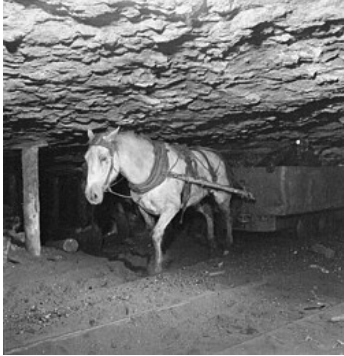
Pit pony and miner in a mine in New Aberdeen, Nova Scotia, August 1946. The last working pit pony was brought out of the Drummond Coal Company colliery at Westville in 1978. —Wikipedia
Spending their lives in relative obscurity, it was inevitable that fallacies and misconceptions about the life of pit ponies would flourish. One that is often heard to this day and believed by many is: when ponies are brought to the surface after a stint underground they are blind. Of course, this is completely untrue, for working ponies must rely upon the light of their drivers’ lamps to see bends in the roadways and to avoid obstacles that may be in their paths.
In cases where two ponies are worked in tandem, it was common practice to have a headlight on the lead pony's head, the light being powered by a battery attached to the backpad. Their eyes respond to light and darkness much the same as man's, dilating in darkness and contracting in light.
* * * * *
In her history of South Wellington, resident historian Helen Tilley mentions the care and affection that was given the animals that worked in the mines. How, at quitting time, they’d be brought to the surface and simply turned loose to gallop, eagerly and unharnessed, back to their barns for their dinners and, probably, a rub-down.
Years ago, when researching one of BC’s many colliery disasters, my attention was caught by a curious comment buried within a mine inspector’s annual report. He was writing for the record about a tragedy that had claimed lives. He’d been on-site, had seen the horrors of bodies being recovered and identified, yet he couldn’t resist an aside:
How is it, he marvelled, that men working in a coal mine come out as black as the coal? But a white horse that worked the entire shift alongside him, returned to the surface still white? That innocuous question was so out of keeping with his description of a major tragedy that I wondered how it ever got by the editor. But there it was, in the Annual Report, and it’s been in my memory bank all these years.
(To be continued)
