
‘Westminster Horror’
Violent death—accidental or otherwise—has always played a grim role in our past. Time and again, newspaper headlines have heralded tragedy.
Certainly one of the saddest cases on record is that of the ‘Westminster Horror.’
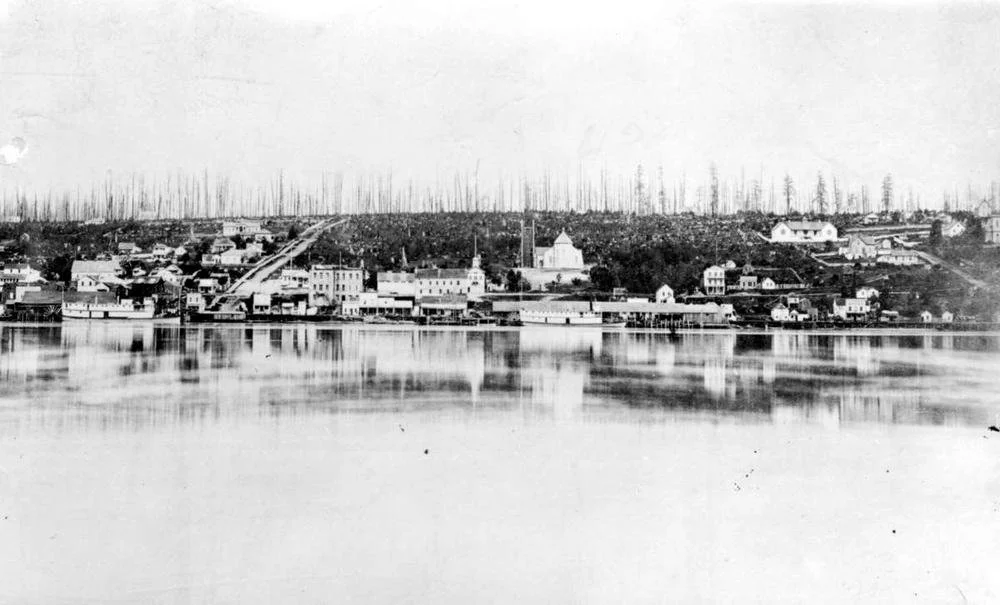
New Westminster where poor Jenny Anderson met her end at the hands of a drug-crazed killer. —BC Archives
This particularly brutal crime had begun months before in Australia where Jenny Anderson had succumbed to the charms of an unnamed Lothario. Upon her accepting his proposal he’d paid for her passage to BC where they were to be married.
Alas, what awaited her in Vancouver was anything but that which she’d hoped for.
* * * * *
In due course, the eager and blushing bride had landed in Vancouver. But, alas, contrary to popular belief, absence and distance hadn't made the heart grow fonder; at least not the heart of her fiance, who declined to honour his proposal.
Crushed, Jenny took a suite over Knowles’ store and, in short order, she accepted the attentions of a young seaman from Marseille. Tall, handsome and a flashy dresser, Donald Perrier, who sailed on the Canadian Pacific liner Empress of India, had originally met Jenny when Down Under.

Young Perrier, a seaman on the CPR passenger liner Empress of Asia at the time of the murder, met Jenny In Australia —Wikipedia
Whatever Ms. Anderson's moral standing while in her homeland, upon her arrival in Vancouver and her lover’s rejection, she’d embarked upon “an abandoned life... Alone and friendless [and] 1000s of miles from home, [she] went over to New Westminster to a well-known sporting house there.”
On the evening of Nov. 30, 1898, young Perrier followed her to her new quarters, entered her room and locked the door. According to other occupants of the house, he and Jenny were heard to quarrel bitterly. Then Jenny began to scream. Before anyone could move to break down the door, Perry unlocked it himself and emerged with the remark, “I have made a sure job of it.”
To the others’ horror, they saw that he was covered with blood and, upon entering the room, they found Jenny sprawled on her bed “literally hacked to pieces”.
Within an hour, news of the atrocity swept the city, it being reported that residents of the Royal City were, understandably, horrified. As was to be expected, by morning, sensational headlines graced most daily newspapers. The Victoria Colonist reported “Westminster murder...young woman from Australia literally hacked to pieces by her lover—she had come to Vancouver to wed another but something went wrong—deserted she entered upon a life of sin—the crime deliberately planned.”
First details of the murder were sketchy, and it wasn't until the subsequent editions that the morning daily was able to report that Perrier had appeared before a New Westminster police magistrate. Although he’d attempted to make a statement, Magistrate Corbould had refused to hear him as he hadn’t been represented by council.
Police, in the meantime, had succeeded in piecing together some of the events which led up to the tragedy. The cause of the fatal quarrel, they heard, was money. Young Perrier, it seems, was “a physical wreck from the use of morphine and liquor”.
Just returned from a voyage, he’d allegedly blown his wages in Seattle on drugs and booze. When in need of more, he demanded that Jenny give him money. She’d refused and he’d lost his temper and attacked her with the knife. According to the examining physician, Jenny had been slashed nine times, five of the wounds being termed fatal, the most severe of which was in her abdomen.
Other evidence indicated that Jenny had been “working” her way to the Klondike when Perrier became infatuated with her and persuaded her to remain in Vancouver. But, due to the young seaman’s vices, Jenny had broken off with him. On the night of her death, it was alleged he’d been maddened by drugs, jealousy and the need for more money, and her refusal to surrender her purse had provoked the lethal assault. An almost new knife, found 50 yards from the death scene, had being identified as the murder weapon.
At the coroner's inquest, it was determined that Jenny had been quite well known as “Australian Jenny,” and that she’d used the aliases Andrews, Fraser and Rogers.
By this time, Perrier claimed to remember nothing of the murder, saying that he was drunk, and requested time to produce evidence to this effect.
Four months later, the Spring Assizes opened in the assembly rooms in the rear of New Westminster's new Opera House. The pioneer population of the Royal City seems to have been quite law abiding, for only two cases were on the docket: Donald Perrier, charged with murder, and Eva Bradshaw, charged with theft. The appearances of both were brief, the grand jury returning true bills in each case.
Perrier’s trial was almost as swift for, the very next day, it was reported that he’d been found guilty of the “cruel butchery” of Jenny Anderson.
Throughout his trial, done in a day, Donald Perrier had maintained his composure, something which Chief Justice McColl, when sentencing him to hang on May 10, 1899, had been unable to do. Upon McColl's emotional address, the convicted murderer of Jenny Anderson had calmly remarked, “If I have to go to the gallows, I go as a man, not as a criminal.”
The main reason for the trial’s brevity had been Perrier's total lack of a defence. His only apparent argument, slim as it was, was that Jenny had been reaching for a revolver and that he’d killed her in self-defence. He made no attempt to explain the number of knife wounds, expressed no repentance for the deed and, during graphical medical testimony as to the brutality of the attack, provoked all present by smiling.
According to the Colonist’s Mainland correspondent, “The crime was a very brutal one. Perrier was in love with his victim and because she refused to continue to live with him as his mistress, he followed her from Vancouver to New Westminster, and being shown her room entered and locked the door. In a moment afterwards screaming was head inside, with cries for help from the woman.
“Then Perrier came out covered with blood. On being asked what he had done, he said, ‘I killed her because she ruined me.’
“His victim was stabbed in 12 places and anyone of four of the wounds would have proved fatal... "
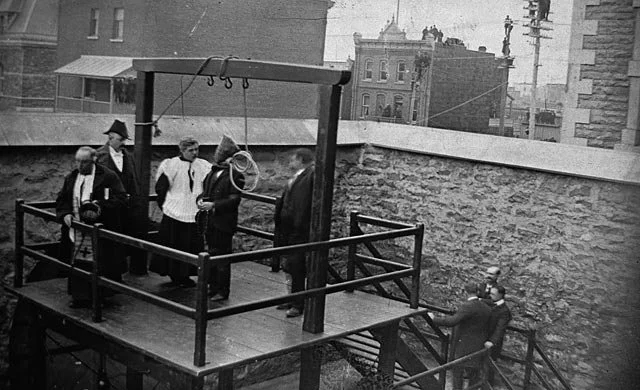
The execution of Stanislas Lacroix by Radclive on March 21, 1902, at Hull, Quebec,is said to be the last public execution in Canada. Onlookers can be seen observing the gallows from surrounding rooftops and telegraph poles. —Wikipedia
Although sentenced to die on the gallows on May 10th, Perrier enjoyed a stay of execution as, on May 12th, he was still awaiting sentence. Throughout his confinement he’d engaged in the writing of "wild, disjointed" letters to the police and press in which he accused the police of having conspired against him, of having encouraged him to commit murder in the first place, and of having inspired his stabbing poor Jenny a dozen times.
Authorities were convinced that his correspondence campaign was a ruse, that he wanted to “make himself out crazy” in hopes of commutation.
Much to the disgust of some, his letter writing had the desired effect; at least, in part, for his sentence was postponed for another month so that an inquiry might be held into his state of mind. “The superintendent and surgeon of the insane asylum will be the board of Investigation; New Westminster’s newspaper the Colombian requested that a new trial be held.
Perrier took his month’s reprieve as a matter of course and asked to be given his freedom to procure witnesses for a new trial.
But, 10 days later, he seemed to have despaired of being adjudged incompetent or innocent, it being reported that he’d attempted suicide. Guard J. Mahoney, upon hearing strange sounds coming from Perrier’s cell, summoned Warden Armstrong. Together, they investigated, to find the prisoner lying on his cot and “fairly weltering in his blood”.
Somehow he’d procured a pen-knife with which he’d gashed his stomach and left wrist. The officials immediately applied a tourniquet to the wrist as Drs. Drew and Walker were summoned and who initially advised that they didn’t expect Perrier to live out the night.
While awaiting further word as to the condemned man's condition, Warden Armstrong launched an investigation into his obtaining of the pen-knife, which was said to be new.
The following day, Sheriff T.J. Armstrong assured the public: "Perrier is not badly hurt. I do not think he intended to kill himself, but used the knife only to create sympathy. How he got it is a mystery, but I have good clues, and have every reason to think that I will discover the person who gave it in a day or so.
“His attempt on his life has made me more careful, and I have three guards on duty. They watch for four hours each, and then have eight hours off. A guard is in the cell all the time and there is a regular guard outside... Perrier is weak and the doctors will not allow him solid food. A most careful watch is being kept so that Perrier will not pull off the bandages and bleed to death.
“In case he must be hanged I am keeping Radcliffe [John Robert Radclive aka Ratcliffe] the hangman] until the end of the month.”
As it turned out, Sheriff Armstrong's caution in retaining Mr. Radclive was the correct course; three weeks later, the date of execution was set for June 30th. Perrier took the news quietly.
On the morning of June 30, 1899, as the rest of New Westminster prepared for the Dominion Day festivities, prison officials completed the last-minute arrangements for Perrier’s hanging.
Making matters somewhat easier for both officials of the New Westminster provincial gaol and hangman Radcliffe was the fact that the scaffold was a tried-and-true veteran, having been used on three previous occasions: in January 1891 for Indigenous murderer Slumach of the legendary Lost Creek Mine fame; in 1894, for double-slayer Hugh Lynn; and in June 1895, for Louis Victor.
As the fateful hour approached, the only official guests, some 15 newspaper reporters and members of the coroner's jury, were admitted to the jail. In his cell the previous day, Donald Perrier had retained his usually calm demeanour and eaten a hearty dinner with the remark that it would be his last.
According to his guards, he’d vowed that his spirit would haunt all of those connected with his imprisonment and execution, and he’d shown no signs of remorse for brutally murdering Jenny Anderson although he’d accepted the ministrations of a priest.
Another visitor to his cell, a heavy-set stranger, had piqued his curiosity and Perrier had asked his guard several times as to the man's identity. Finally, one admitted that the quiet caller was his executioner.
Although Perrier had portrayed a mostly stoic manner throughout most of his confinement (other than his attempt at suicide), Sheriff Armstrong and his staff were sure that he'd break down at the last moment as, from time to time, he'd become quite hysterical. “So certain were the authorities that he would funk at the last, that a chair was got ready, to which Perrier would have been strapped if it was found necessary to carry him to the gallows.”
The night before, he'd engaged in an animated discussion on various subjects with his guards before retiring to a fitful sleep. At 3:00 a.m., he arose and smoked a cigar, then dozed until 6:00. An hour later, he was served breakfast. He refused all but a cup of strong coffee.
Then, with but minutes to live, the young killer remarked to Armstrong, “I feel quiet and contented, and I'm ready to die. I bear no malice towards anyone and when you are ready for me you will find I will go to the gallows quietly.”
At two minutes to 8:00, Radclive, Armstrong and Father Bruneau proceeded to his cell and told him that it was time. Perrier rose silently. Other than a slight involuntary trembling, he showed no fear as Radclive placed straps around his arms, but he gently reproached the hangman for “hurting me”.
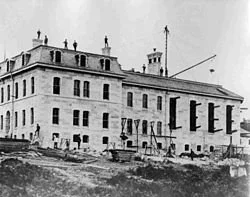
Murderer Donald Perrier met his date with justice in the BC Penitentiary, New Westminster, shown here under construction in 1877. —Wikipedia
At precisely eight, father Bruneau led the small procession to the gallows in the gaol yard where a crowd of spectators waited.
Perrier, looking sad but determined, his face an ashen hue in contrast to his black beard, cast one quick glance at the blue sky, then strode purposefully to the scaffold without assistance, mounted the steps and, at Bruneau's request, dropped to his knees to receive the last rites.
When the priest placed the crucifix before him, he kissed it passionately.
Upon regaining his feet, he stepped over, kissed Bruneau on the cheek then stepped onto the trap. Just as Radclive was about to adjust the noose, he motioned for the crucifix and again “ardently kissed the sacred emblem, after which he raised his chin” so that the noose might be adjusted.
The next moment the black cap was drawn over the condemned man's head and without an instant’s delay the trap was sprung. The rope pulled, and Perry was dead.
When attending doctors examined the still-dancing body, they pronounced that death was instantaneous. This, despite the fact that, “owing to Perrier's remarkable nervous energy," his pulse continued to beat for a further 12 1/2 minutes!
With that, Donald Perry was no more. However, a fascinating footnote was added to this historic homicide when it was revealed that, had he not been captured on the spot, another man might well have paid the supreme penalty for the murder of ‘Australian’ Jenny Anderson.
A friend of Perrier's named Kohler had also been smitten by Jenny's charms. She hadn't returned his affection and, slighted, he’d threatened her and she’d complained to the police. At this, Kohler, enraged, broke into her rooms and slashed her furniture and clothing with a knife.
The very next day, upon hearing of her death, he sailed to Seattle. Had Perrier not been caught red-handed, Kohler, who was said to bear a remarkable resemblance to his friend, could well have been charged with her murder and taken his place in the dock, and, ultimately, on the scaffold.
As a final note, Sheriff Armstrong stated that he’d received more than 250 applications to witness Perrier's date with eternity. More than 200 had been refused.
