
Overland to the Nass
(Conclusion)
Last week, the late Guy Ilstad began to recall his adventures in 1910 when, at the height of a land boom precipitated by the construction of the Grand Trunk Pacific Railway, he and two teenage friends were hired to stake out 10,000 acres in northern BC for an American company.
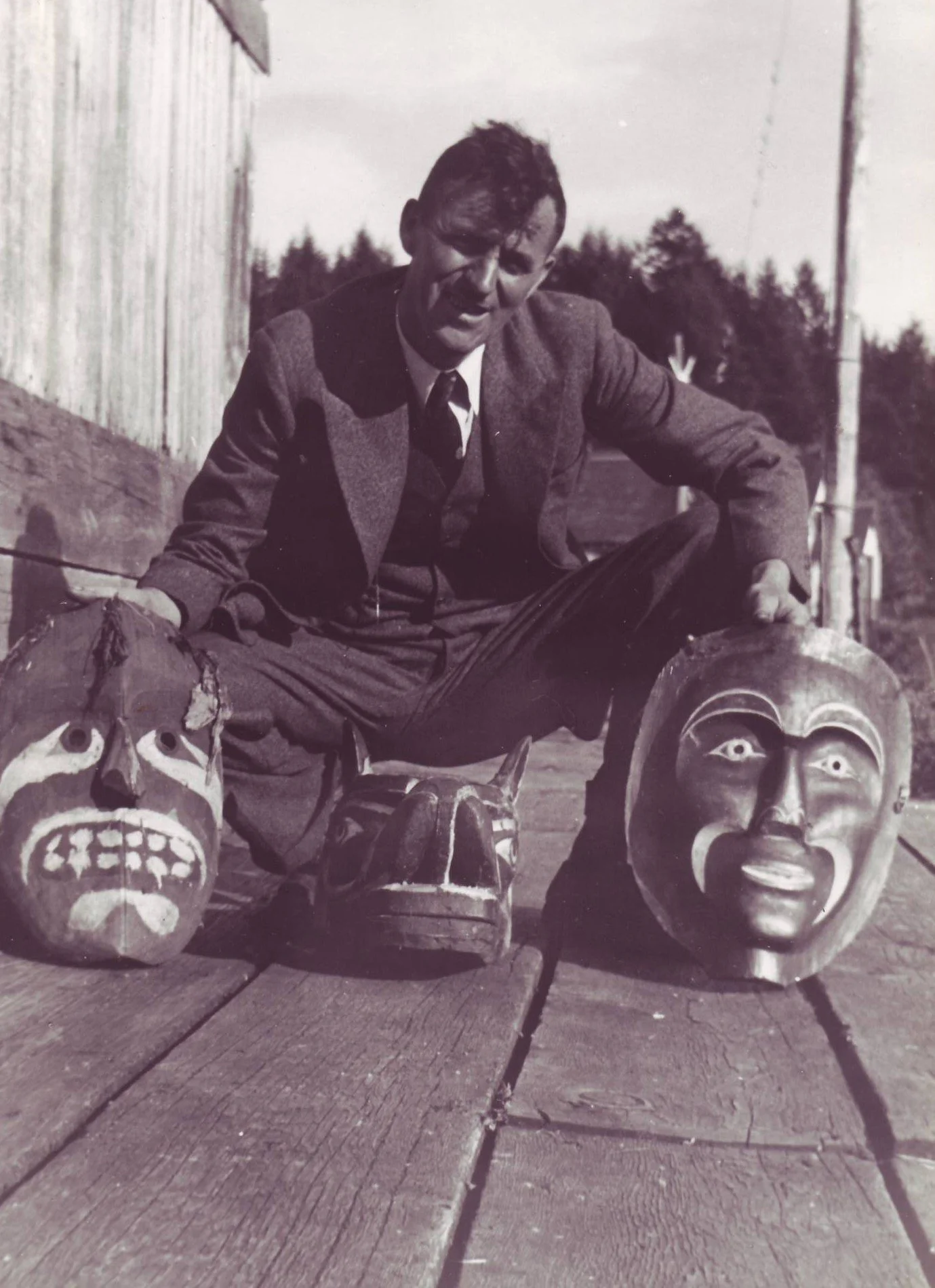
Guy Ilstad of Quatsino posing with several priceless ceremonial masks. —Author’s Collection
Raised on the northern Vancouver Island frontier, they were young, hardy and convinced of their ability to survive in the bush. That their optimism bordered on foolhardiness soon became apparent—they’d set out too late in the season. As they hiked inland from Stewart, a surveyor on his way out bluntly warned them, “You boys are heading the wrong way. Snow can be expected any time now and without snowshoes you'll starve before you get out. Better turn around.”
But, with all the confidence of youth, they boldly pressed on.
Mr. Ilstad’s firsthand account, which he wrote in 1969 and entitled “Overland to the Nass,” brought him, last week, to the point where he and his comrades had had to admit, with the first snow beginning to fall, they had no choice but to turn back...
Note: Mr..Ilstad’s reference to “hostile Indians” was his and his companions’ perception of one of the dangers facing them in the wilds after they’d heard stories that the local First Nations peoples bitterly resented the invasion by railway crews and speculators.
* * * * *
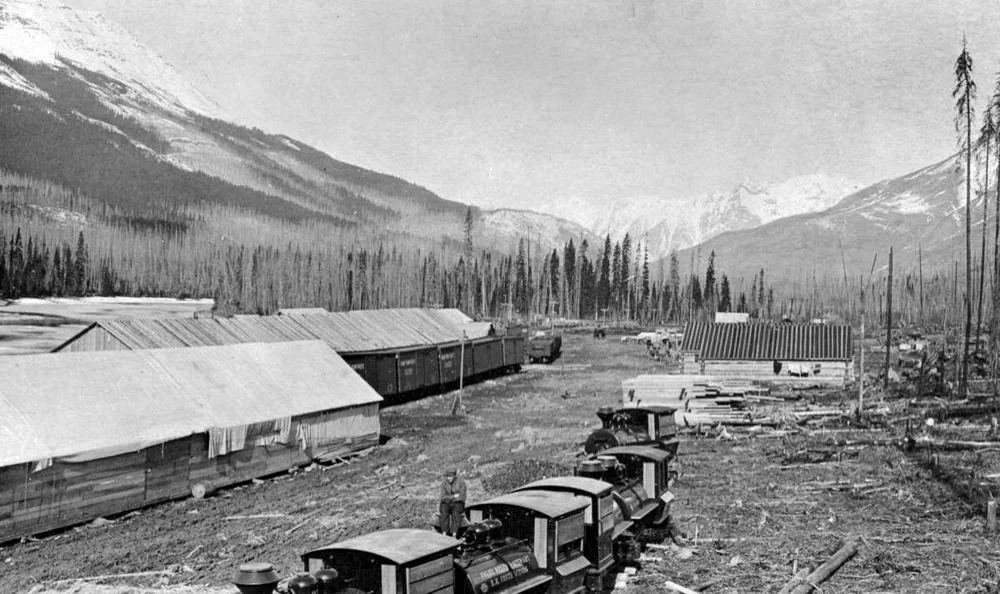
Construction of the Grand Trunk Pacific, as shown here in 1912, created a short-lived land boom that drew many, including Mr. Ilstad and his friends, to northern BC. —BC Archives
We broke camp at dawn and set our faces resolutely towards the icy mountain that chilled our shivering bodies. But loaded as we were with camp gear, the exertion of ascending the steep glacier soon warmed us to the excess.
Hostile Indians were behind us now, but before us loomed the glacier with its unknown and hidden crevasses. We hoped if the weather remained fair and no snow fell to conceal these dreaded pitfalls, we could in a matter of hours win free from our frigid prison. With this hope uppermost in our minds we ascended without pause. But we were not to escape these menacing ice fields without an unforgettable trial.
We had scarcely set foot on the summit when the valley was darkened with the swiftly approaching snow storm. In moments we were engulfed in flying snowflakes that shut out our vision. Blindly and fearfully we struggled on for we had yet to negotiate the extremely dangerous ice stairs where one slip would mean death.
Our terrifying and only guide now was the snow slides as they roared down from the summit, having been launched by the new falling snow.
We strung out Indian file for safety with Benson leading and probing with a pole for hidden ice bridges. Suddenly, to our horror, he plunged through a snow-covered ice bridge. His head and shoulders were still above the crevasse. For a moment we were stunned. In the next instant I had set down my pack and moved cautiously toward Benson until I could get my hands firmly on him.
With a powerful effort I managed to hoist him clear. The three of us, pale and shaken, stared down into the dark abyss as I retrieved our testing pole. Then shouldering, my pack, I took the lead.
The miracle that saved Benson's life was the packboard on his back. Its hardwood frame had caught on a projection of ice and so stayed his downward plunge.
Our pace was slow and fearful as we moved towards the hazardous ice stairs which we now neared but could not see. Then, as if by magic, the snow ceased as suddenly as it started and to our joyful surprise we were close by one of the red iron staffed pennants that fluttered as if to welcome us through their fearsome way.
Carefully, we brushed the snow from each ice step and inched downward with dreadful caution until finally we set foot on the firm earth. We breathed a prayer of thanksgiving and hurried on.
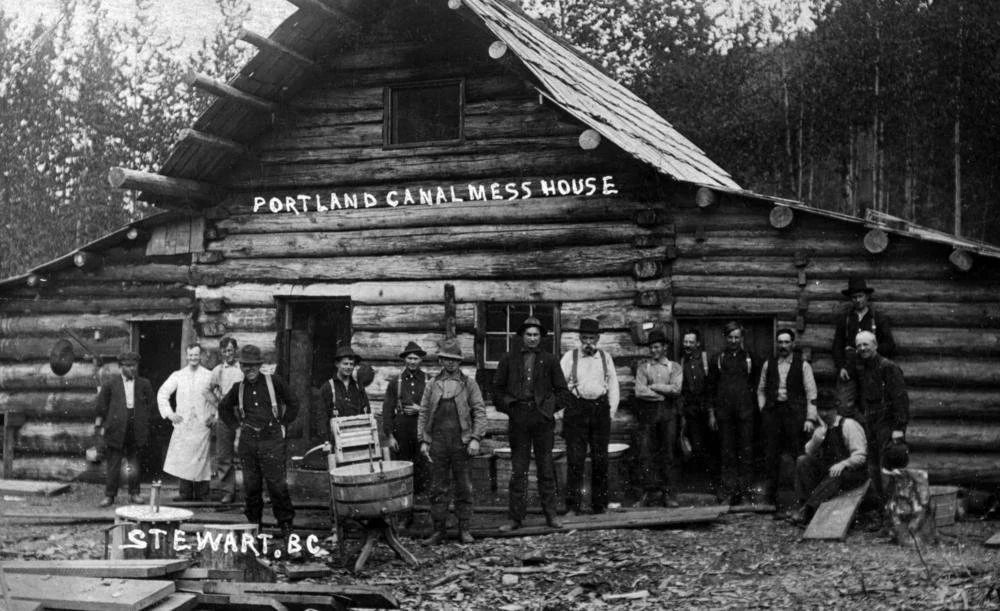
Accommodation on the trail, as our adventurers found, was rough but welcome. —BC Archives
When we reached Bitter Creek the snow, glacier and Indians were all behind us. Again we sought the roadhouse proprietor to request a meal for our food supply had been exhausted. Even here we met with disappointment for the proprietor was living on scant rations. Nevertheless, he promised a meal of sorts and, taking up a fishing rod, strolled to a swiftly flowing brook nearby.
Wondering, and not a little skeptical, we followed. Almost with his first cast he landed a silver-bright six-inch trout and in 15 minutes he had landed about 20 which he quickly prepared for the pan. Shortly thereafter we were enjoying a meal of boiled potatoes, hot biscuits and freshly caught fish.
We paid our host with thanks as well as money and though weary and foot-sore, shouldered our packs and took to the trail again. If we missed the steamer connections out of Stewart the next day we would be obliged to wait a week for passage to Prince Rupert.
Long after dark we stumbled into Stewart and with packs still on our backs walked into a restaurant. We set our packs down in a corner and climbed onto the stools. Soon three trail-worn and hungry man were enjoying thick steaks. Next day, we paid the $7 fee to board the steamer and with only one stop on the US side in Alaska proceeded to Prince Rupert.
By now we were all but broke, but with Benson acting as the leader, we walked into the best hotel where we registered. We did not take our meals in the hotel but patronized a little cafe where prices were more in keeping with our purse. Benson sent a wire to the land company in Victoria requesting steamer fare and expense money. This was refused by a curt answer: the land company demanded bona fide application forms be presented at their office before payment could be made.
This came as a shock. We had spent our last dollar for meals and still owed for our room rent. We were at the little cafe early next morning to make our appeals to the young chef who was just starting a fire in the range.
Benson wasted little time on words in explaining our predicament and asked if our credit was good for meals. The startled young man turned searching eyes on us as if seeing us for the first time. Then he laughed. “Of course,” he said, “I'll stand good for the meals; now what would you like for breakfast?”
Benson next sent a telegram to his father in Victoria asking for funds although he was much embarrassed over the ignoble ending of the hopeful enterprise upon which we had so eagerly set forth. He received no immediate response to his appeal and our room rent was mounting daily.
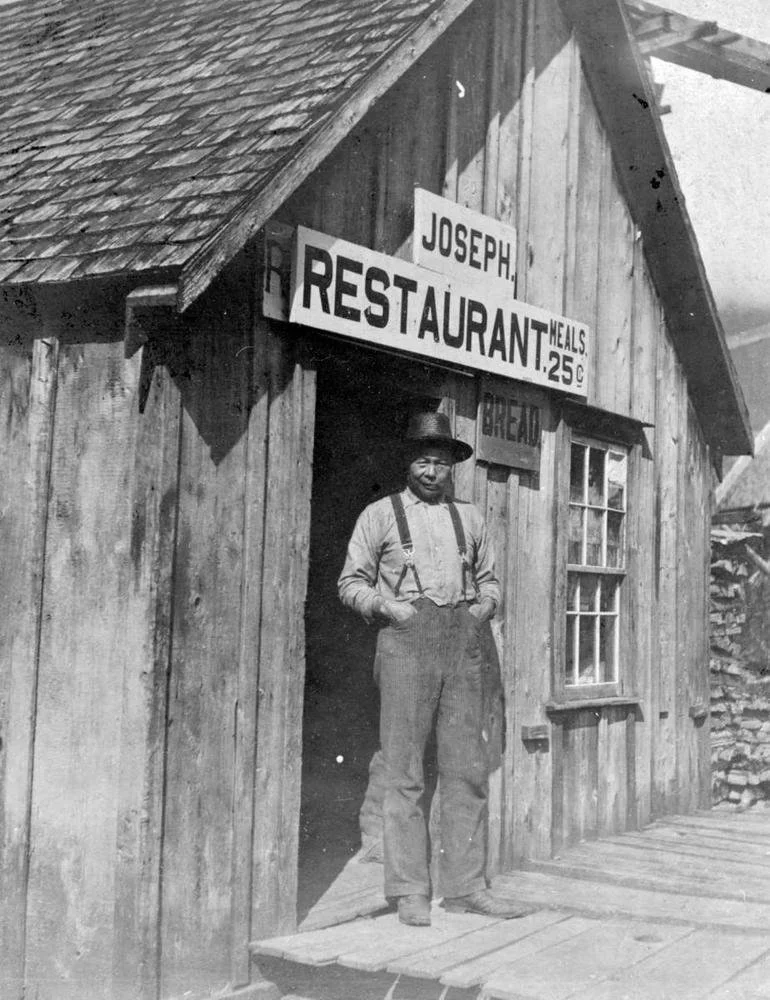
Fortunately for our heroes, a small cafe such as this extended them credit for their meals while they waited for money from home. —BC Archives
One evening, the bellboy knocked on our door. Benson was wanted at the desk. This was it...we thought, the dreaded moment of a demand for our room rent. We pictures ourselves cast out into the street minus our baggage.
Benson rose slowly to his feet. His outdoor tan turned to a sickly grey. He left the room without a word. and we waited in tense silence. But soon Benson returned, smiling. The Prince Rupert newspaper had published the list of passengers from Stewart. An old friend of Benson's father had seen Benson's name on the list and called at the hotel to invite him to his home for supper.
So ended for what to us were some very tense moments. Then the funds we were expecting came on the day of the southbound steamer[‘s] sailing.
After paying our hotel bill and the cafe chef that night found us penniless but steaming homeward.
Today [he wrote in 1969] the Nass Valley can be reached in a few hours with ease if not in luxury. An automobile road connects with Terrace on the Canadian National Railway and this road follows the Nass River to tidewater. Further advance of civilization, if not progress, is in the valley’s exploitation by logging companies.
Now great logging trucks with trailers thunder through the valley where once the silence of the wilderness reigned. Gone, too, are the dreams of wealth that inspired the speculator, the young unsung Jasons of that pristine timberland of the Nass Valley.
* * * * *
I explained earlier that, to my regret, I never met Guy Ilstad, that we corresponded for several years, beginning back when I was working for The Daily Colonist in Victoria at the start of my journalistic career.
Our friendship began by my playing a long shot after his name came up while I was researching the intriguing story of Quatsino’s John Sharp. The watchman for a dormant coal company, Sharp’s mysterious death had long intrigued historians because of rumours he’d really been William Clarke Quantrill,
History accepts that the notorious Confederate guerrilla leader was killed in the last days of the American Civil War. But, decades after Appomattox, people were convinced that the reclusive John Sharp was an escaped Quantrill.
