
Disaster at Coal Creek
There’s no denying that, after most of a lifetime of researching and writing about BC history, the fascinating, rich and tragic story of coal mining has become my favourite subject.
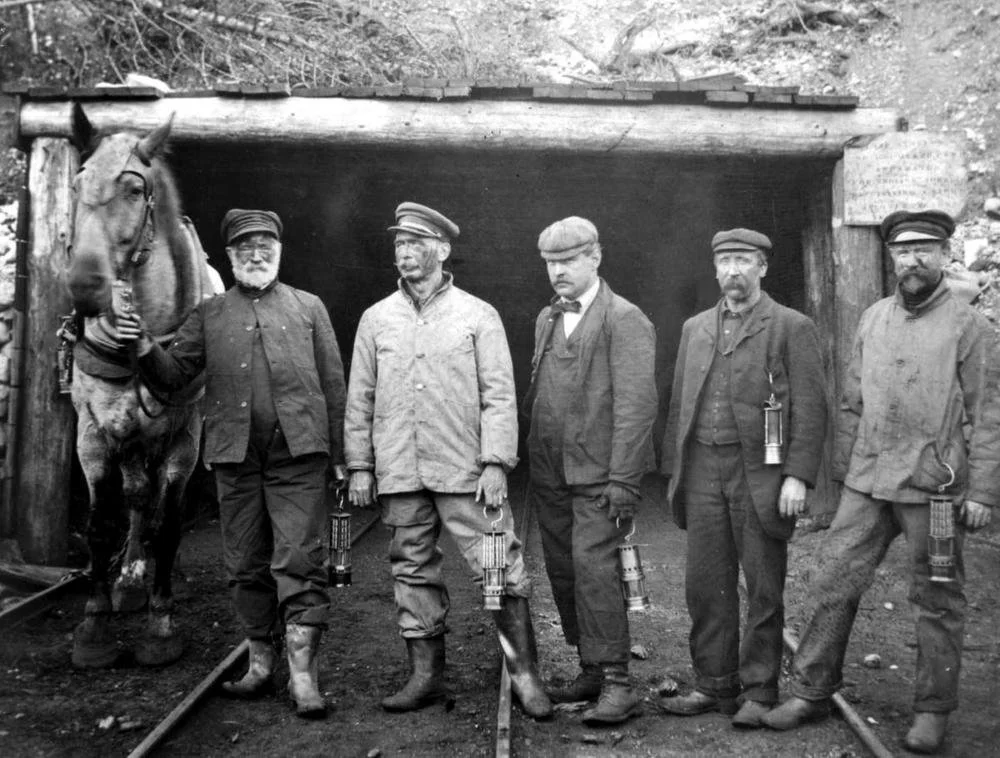
“Fernie miners,” 190-. If only these men could speak...—BC Archives
And, because the Greater Nanaimo area, which was home to some of the Island’s greatest coal mines, is also in my backyard, so to speak, that’s where I’ve focused my attention.
Reading about history is all very well and good; being able to visit the actual sites, to scratch and to see, touch, and to cast the mind back to what once had been but is no more—that, for me, is the ultimate thrill of history.
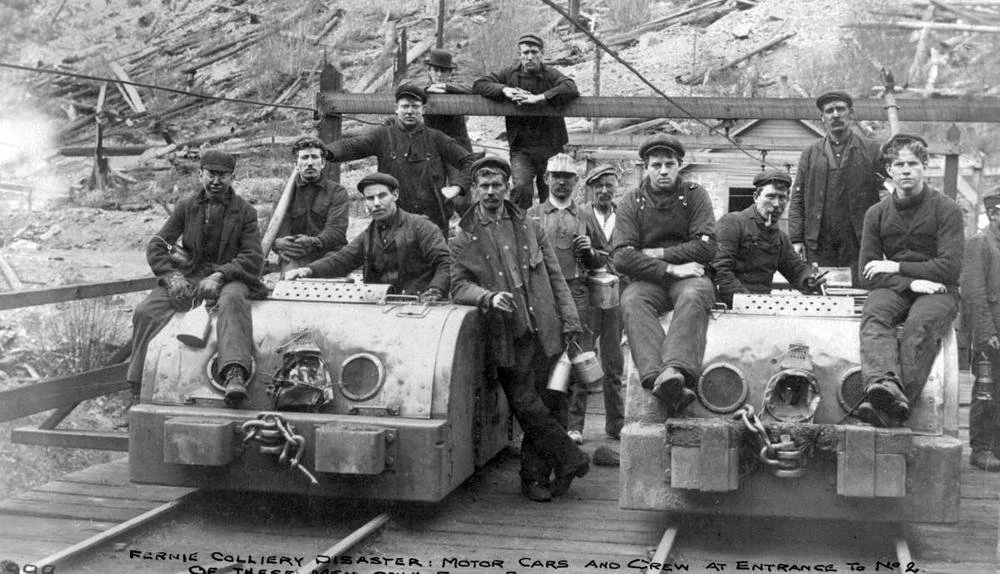
"Fernie Colliery disaster; motor cars and crew at entrance to No. 2; of these men, only four escaped death." —BC Archives
Although they’ve always been out of reach, the Crowsnest Pass collieries have also long intrigued me. Alas, other than a single visit, I’ve had to confine myself to researching them from my armchair and online...
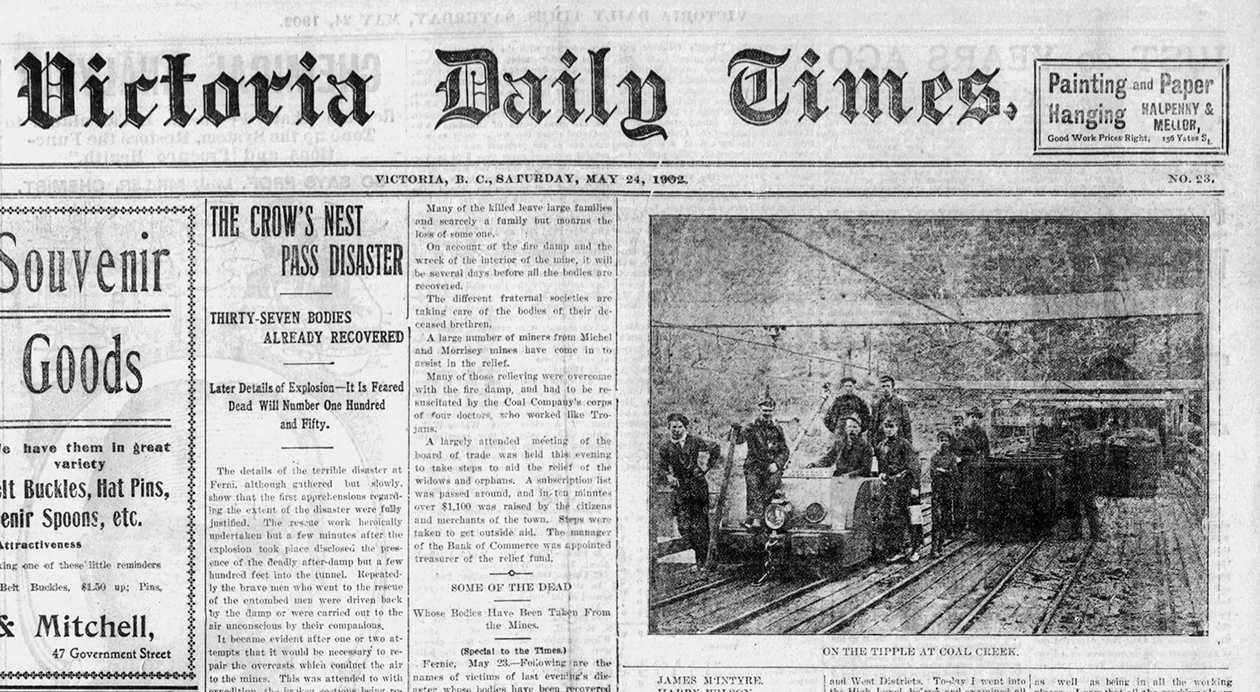
In this case, tragedy struck in far-off Crowsnest Pass. But readers of the Victoria Daily Times were no strangers to colliery disasters, Vancouver Island having more than its fair share of underground tragedy. —www.newspapers.com
To put things in context: the June 19,1914 disaster at Hillcrest, Alberta, killed 189 men of 228 miners on the job. Nanaimo’s No. 1 Esplanade comes second with 150 (including a rescuer) killed by explosion on May 3,1887, and Coal Creek, the subject of today’s Chronicle, occurred on May 22, 1902, claiming 128 men and boys. (Yes, boys.)
* * * * *
By August 1902, underground explosions in BC coal mines had become so frequent—and so deadly—that the Provincial Government appointed a special commission to “inquire into and obtain information respecting the causes of explosions in Coal Mines and the means that should be adapted to avoid such explosions...”
Sittings and some mine visits were held in the leading coal producing areas—Nanaimo, Ladysmith, Cumberland—and on the Mainland at Coal Creek, Michel and Morrissey. Most of those who gave evidence were professional miners and included those in management positions.
The main issues addressed were Ventilation; Coal Dust; Explosives; Blasting; Electrical Appliances; Firemen; Safety-lamps; Working more than one shift; the Panel System; Old and abandoned workings; Stoppings; Examinations.
After the horrific headlines of just a few months earlier, the commission report comes across as sounding almost academic. But one great discovery was revealed. Up until this time, it was believed that colliery explosions resulted only from the ignition of gas—fire-damp.
But investigation now pointed to coal dust as an equally volatile explosive.
Meaning that previous attempts to control dust had been fatally inadequate: “...Even where all precautions are taken it is doubtful if we can ever become entirely free from explosions...”
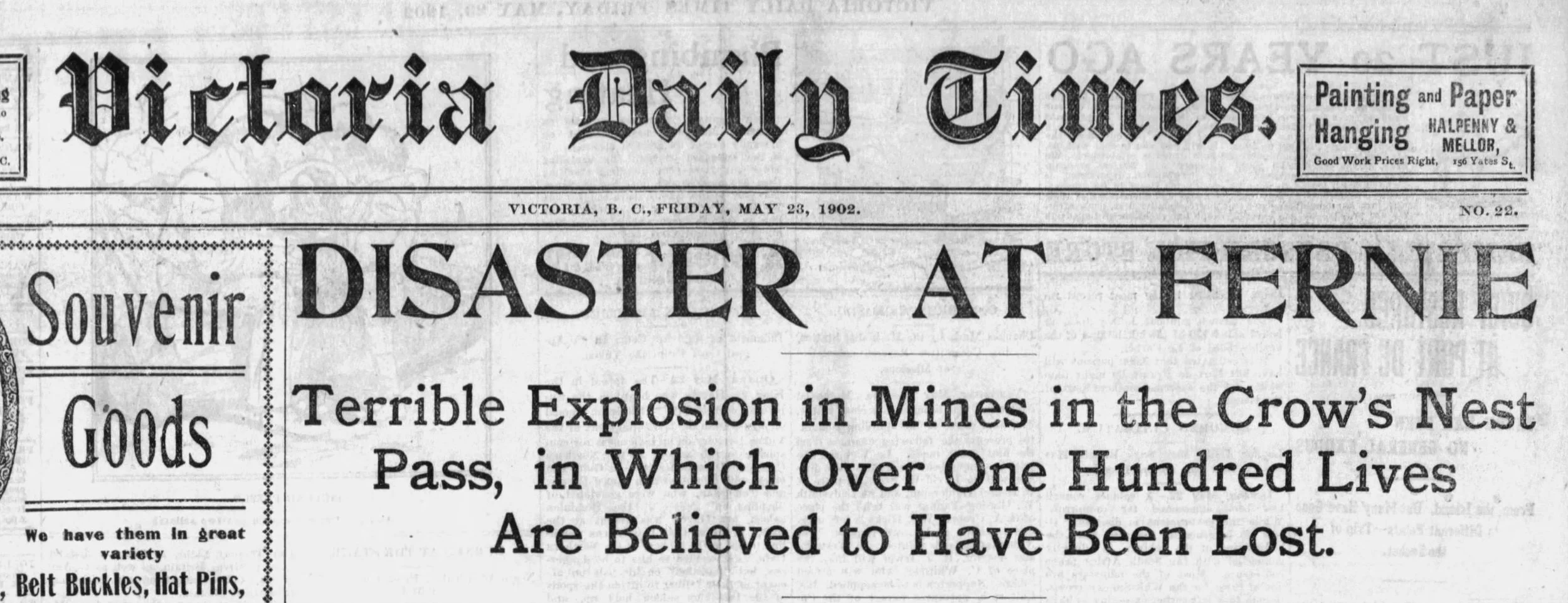
Too often, BC newspapers had to report another colliery disaster involving great loss of life. In small towns where everyone knew everyone else, was related to or worked with miners, tragedy spared no one. —www.newspapers.com
So great was the explosion that ripped through the No. 2 and 3 Coal Creek mines a few miles east of Fernie, at 7:30 p.m., May 22, 1902, that coal dust, flame and debris were spewed 1,000 metres—more than half a mile—into the evening sky, and the earth rolled as if from an earthquake.
Already, below ground, 128 miners were dead although, incredibly, 20 or so made it to safety.
Even more incredibly, within minutes, rescue efforts were underway despite the overwhelming presence of poisonous gases, the threat of further explosions and cave-ins. But, impeded by lack of sufficient air-breathing apparatus, there was little they could do. What began as a rescue attempt soon became a recovery operation—one that would take weeks to clear away the debris, shore-up collapsed passageways and haul bodies to the surface.
All the while, Fernie grieved. The first shockwave had given way to the immensity of the tragedy as more and more bodies were recovered and identified amid the continuous din of church bells. A temporary morgue was fed, endlessly it seemed, by one trainload of corpses after another, and volunteers worked around the clock to handle the flow, coffins having had to be ordered from Cranbrook and Nelson.
Two days after the blast, there was no celebrating Victoria Day as most public gatherings were those attending the first funerals which the Crows Nest Pass Coal Co. Ltd. had promised to pay for. A provincial way of sympathy also cancelled the holiday celebrations in other communities.
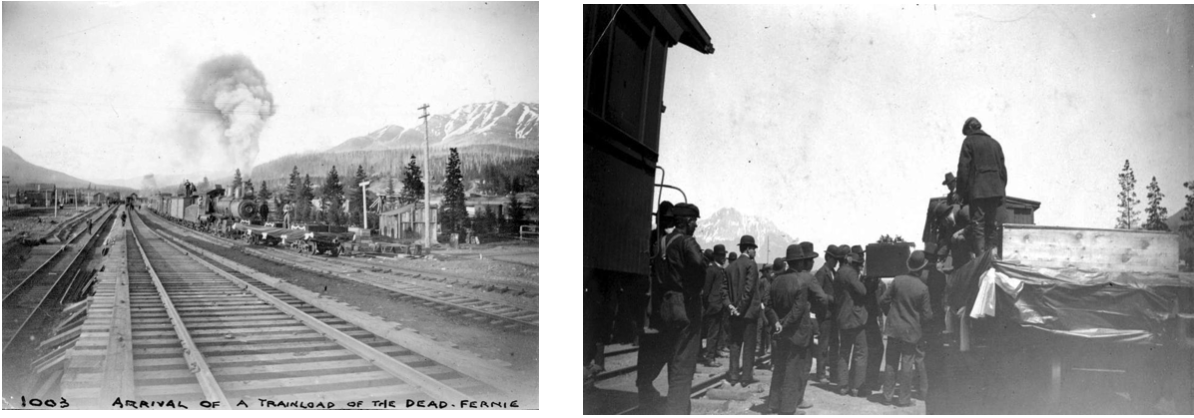
A locomotive pulls into Fernie “with a trainload of dead,” and “Loading the dead onto a train at Fernie.” —BC Archives
Despite there being no surviving witnesses, pinpointing the cause of the disaster appeared to be self-evident. A Coroner’s Jury ruled that the initial cause of the explosion occurred in No. 2 Mine, “and that said initial cause extended from the said undefined point throughout the greater portion of No. 2 and 3 mines, coal dust being the conveying medium.
“And we find that the inadequate method of watering and removing of the dust left the mine in such a condition [as] to be dangerous....”
Ironically, just two days before the disaster, a provincial mines inspector had toured the No’s 2 and 3 and declared them to be safe. Safe, but for a residue of coal dust waiting for just a spark to mangle, to suffocate and to poison 128 men and teenage boys.
The Coal Creek mines, relatively undamaged, were soon returned to production. On April 5, 1917, a second blast killed 34, and six more died in 1928.
* * * * *
Poor Fernie! Seven years later, on Aug. 1, 1908, a catastrophic wildfire swept through the town. In less than 90 minutes, nearly the entire town was gone with over $5 million in property loss.
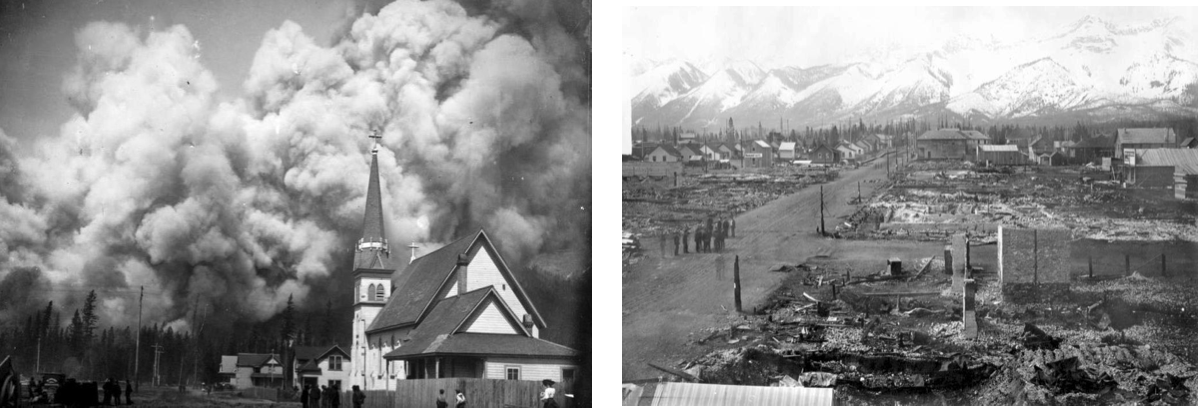
Fernie during and immediately after the great fire of August 1908. —BC Archives
* * * * *
Do you still wonder why BC coal mining fascinates me?
